

The journey into Wing Chun Kung Fu is one of profound discovery, marked by the elegance of its principles and the efficiency of its movements.
Yet, for the enthusiastic beginner, this path is often littered with common, frustrating mistakes.
The initial excitement of learning the forms and techniques can quickly give way to confusion when those movements fail to translate into effective application.
True mastery in Wing Chun is not achieved by avoiding mistakes, but by identifying and systematically correcting them.
Every error is a vital piece of feedback, a signpost pointing toward a deeper understanding of the art’s core principles.
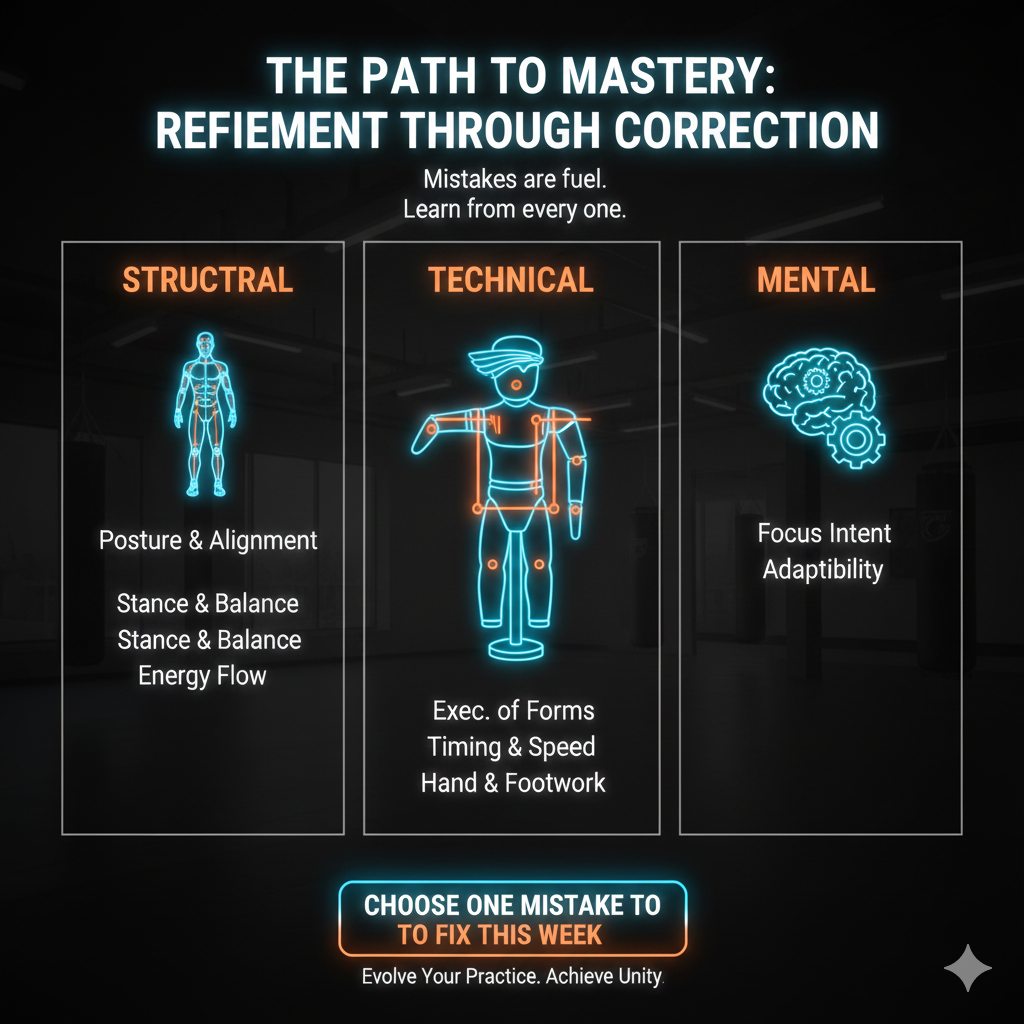
This comprehensive guide will illuminate the most common structural, technical, and mental errors beginners make, and provide practical, drill-based solutions to turn those errors into stepping stones toward mastery.
Structural Mistakes: The Foundation is Flawed
Wing Chun is a system built on a stable, rooted structure.
If the foundation is weak, the entire system collapses under pressure.
The most common beginner mistakes are structural, and they must be addressed first.
1. The Collapsed Stance (Yee Jee Kim Yeung Ma)
The Yee Jee Kim Yeung Ma (Character Two Adduction Stance, or Goat-Clamping Stance) is the engine of Wing Chun power.
It is designed to channel force from the ground up and provide a stable, mobile base.
- The Mistake: Beginners often stand too high, allowing the knees to splay out instead of clamping in.
- This mistake compromises the Yee Jee Kim Yeung Ma, leaving the structure vulnerable to lateral force.
- A collapsed stance leads to instability, poor ground force transmission, and excessive reliance on upper body strength.
- The Correction: **Wall Sit with a Ball** **Drill** **:** Perform a wall sit with a tennis ball or soft pad wedged between the knees.
- Holding the ball forces the constant inward pressure required for the stance.
- Hold for 60 seconds per set, focusing on sinking the weight into the heels and keeping the back straight.
2. Shoulders Up (The Tension Trap)
Tension is the enemy of fluidity and power in Wing Chun.
The principle of *Sung* (Relaxation) is critical for transmitting force.
- The Mistake: Beginners unconsciously tense their shoulders and traps, holding their arms up with muscular effort rather than skeletal structure.
- This “shoulders up” posture blocks the energy from the ground and telegraphs movement.
- The Correction: **Shoulder Release Drill** **:** During *Siu Lim Tao* (Little Idea Form), pause before every single technique.
- Take a deep breath and consciously “drop” the shoulders and elbows.
- The power of *Siu Lim Tao* is in its relaxation and the use of the elbow as a fulcrum—not the shoulder.
https://www.youtube.com/watch?v=SiuLimTaoStanceDrill
Technical Mistakes: Misunderstanding the Principles
These errors occur when the technique is performed without respecting the underlying Wing Chun strategy.
1. Abandoning the Centerline
The centerline is the most fundamental concept in Wing Chun.
All attacks and defenses are launched from and directed at this line.
- The Mistake: Beginners often try to move around an attack rather than moving forward through the attack.
- They leave the centerline exposed when executing a *Pak Sau* or a punch, allowing the opponent to counter easily.
- The Correction: **Centerline Shield Drill** **:** Stand facing a wall or a wooden dummy.
- Practice a simple *Tan Sau* to *Fook Sau* combination.
- Focus on ensuring the forearm always occupies the space of the centerline, acting as a shield, even during the transition.
- The hand should feel like it is defending the bridge of the nose.
2. Arm Sparring (Losing the Core)
Wing Chun is a full-body system, not just an arm-fighting system.
- The Mistake: When drilling *Chi Sau* (Sticking Hands) or performing techniques on the dummy, beginners rely only on the muscles of the arm.
- They fail to engage the hip, waist, and stance, making the technique weak and easily overcome by a stronger opponent.
- The Correction: **Hip Pivot Punch Drill** **:** Practice the *Chain Punching* (*Lien Wan Kuen*) technique, but stop after every two punches.
- Before throwing the third punch, consciously pivot the hips a tiny amount (less than an inch).
- This ensures every strike is powered by the body rotation and the ground force, integrating the core into the movement.
https://www.youtube.com/watch?v=CenterlineDefenseAndAttacks
3. Lazy Chain Punching
The Chain Punch is the signature technique for continuous forward pressure.
- The Mistake: When practicing Chain Punching, beginners fail to fully retract the non-striking hand to the elbow.
- They also often let the punch lose its vertical thrust and start punching in a wide arc.
- This results in less penetrating power and exposes the body to counter-attack.
- The Correction: **Target and Marker Drill** **:** Use a small marker (like a dot on a wall or a partner’s finger) as a fixed target.
- Ensure the *Chain Punches* always land on that precise, vertical target.
- Use a mirror to ensure the non-striking hand is pulled back to the elbow, maximizing the speed and economy of the return.
https://www.youtube.com/watch?v=ChainPunchingFocusDrill
Mental Mistakes: The Mindset Barrier
Martial arts mastery is as much a mental game as a physical one.
These errors stem from poor training habits and mindset.
1. Training with Ego (The “Harder is Better” Fallacy)
The pursuit of power prematurely is a common trap.
- The Mistake: Beginners often try to hit the dummy or their training partners as hard as possible, believing that more muscle equals better Wing Chun.
- This leads to tension, poor structure, and injury.
- **The Correction: ** **The Slow-Motion Test** **:** Force yourself to practice every new technique at 25% speed.
- Focus on perfect alignment and the feeling of the connection with the ground.
- If your structure breaks at slow speed, it will certainly fail at high speed.
- Technique first, power later.
2. Inconsistent Practice (The Mental Trap)
Consistency trumps intensity.
Short, frequent training sessions are far more effective than long, sporadic ones.
| Mistake Type | Symptom |
|---|---|
| Inconsistent Practice | Long breaks between training allow muscle memory to decay, forcing the practitioner to relearn fundamental lessons. |
| The Correction | **Establish a Daily 15-Minute Routine**:** Dedicate a short, focused 15-minute session each day to one specific area: 5 minutes of stance work, 5 minutes of chain punching, and 5 minutes of *Siu Lim Tao*. |
| **The Result** | This consistency is far more valuable than one long, exhausting session per week, as foundational lessons require constant reinforcement. |
Conclusion: The Journey of Continuous Refinement
The path to mastering Wing Chun is a journey of continuous refinement, and mistakes are the essential fuel for that journey.
They are not failures; they are opportunities to deepen your understanding of the art’s profound principles.
By systematically addressing the structural, technical, and mental errors outlined in this guide, you can accelerate your progress and ensure that your training is efficient and effective.
Embrace the feedback your body, your Sifu, and your training partners give you.
The true master is not the one who never makes a mistake, but the one who learns from every single one.
Choose one mistake to fix this week.
Dedicate your solo training to its correction, and watch as your Wing Chun evolves from a collection of techniques into a unified, powerful system.
References
- The importance of structure and relaxation in Wing Chun Kung Fu.
- Analysis of the centerline theory and simultaneous attack/defense.
- Pedagogical methods for correcting common errors in martial arts training.