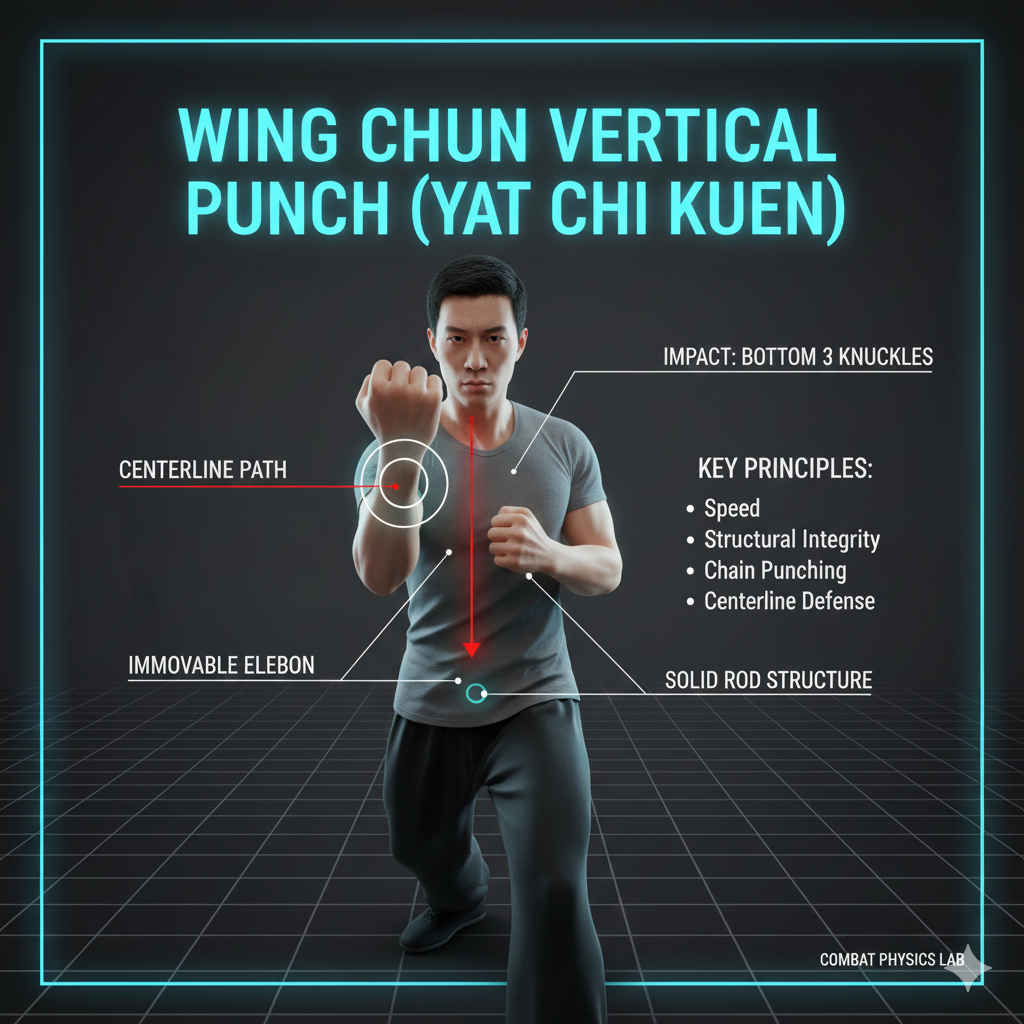
![Vol. 6 – Baat Cham Dao - Wing Chun Butterfly Sword [DVD] [2012]](https://m.media-amazon.com/images/I/51ninBXXo2L.jpg)

The journey of a martial artist is often envisioned as a partnership—a constant exchange of energy, technique, and feedback with a training partner.
However, the reality of modern life, with its demanding schedules, geographical limitations, and sometimes, unforeseen circumstances, often requires practitioners to train alone.
This necessity is not a compromise; rather, solo training is a crucial, non-negotiable component of true martial arts mastery.
It is the time when an artist can delve into the minutiae of their form, build unshakeable conditioning, and forge the mental fortitude required for high-level performance.
This comprehensive guide is dedicated to the solo warrior, providing a detailed roadmap of workouts and drills that can be executed without a partner, transforming any space—from a small apartment to a garage gym—into a personal dojo.
We will explore the foundational pillars of solo practice, effective use of minimal equipment, and the essential conditioning that builds a martial artist’s body from the ground up.
The Foundational Pillars of Solo Training
The most effective solo training focuses on three core areas that require no external partner: visualization, perfect repetition, and dynamic movement.
1. Shadowboxing: The Art of Imagined Combat
Shadowboxing is arguably the most vital solo drill across all striking arts, from Boxing and Muay Thai to Karate and Taekwondo.
It is not just flailing your arms; it is the art of imagined combat, where you can move freely and experiment without consequence.
| Workout Goal | Drill Focus |
|---|---|
| Technique and Flow | Focus 100% on perfect form. Move slowly, concentrating on the origin and endpoint of every strike and block. Emphasize balance and footwork. |
| Defense and Countering | Envision a powerful opponent. Visualize them throwing a specific attack (e.g., a right cross) and practice only your defense and immediate counter (e.g., slip and hook). |
| Footwork and Range | Focus entirely on movement patterns: circling, penetrating steps, retreating, and pivoting. Move in and out of imaginary range to practice closing the gap. |
https://www.youtube.com/watch?v=ShadowboxingForFormAndFlow
2. Visualization: The Mental Sparring Partner
Visualization, or ‘mental rehearsal’, is scientifically proven to improve motor skills and performance.
Your mind is the ultimate training partner.
- The Drill: Sit or lie down in a quiet place. Close your eyes and run through your form or a set of combinations in your mind.
- Focus on Feeling: Don’t just see the movements; feel the weight shift, the muscle tension, and the impact. Visualize the resistance of a bag or the angle of an opponent’s arm.
- The Scenario: Mentally prepare for a known difficult scenario—a surprise attack, an exhausting round, or a complex counter. Running the solution in your mind builds confidence and rapid response.
Equipment-Based Solo Workouts (Minimal Tools)
While you don’t *need* a partner, some basic equipment dramatically enhances the quality of solo training by providing a tangible target.
If you can invest in two items, make it a heavy bag and a speed bag/double-end bag.
1. Heavy Bag Work: Building Power and Conditioning
The heavy bag is your silent partner for power generation, endurance, and impact conditioning.
Never hit the bag without a specific purpose.
| Drill Name | Execution and Focus |
|---|---|
| 5-Hit Max Power | Throw five consecutive strikes (punch/kick) with maximum power and speed, then immediately step out of range. Focus on explosive, whole-body force generation. |
| The Switch Stance Circuit | Hit the bag for one minute in your orthodox stance, switch your lead leg, and immediately hit for one minute in your southpaw stance. Builds ambidexterity and seamless transitions. |
| Movement & Angles | Treat the heavy bag as a moving opponent. Circle it, pivot around it, and always strike from a new angle. Never stand still directly in front of it. |
https://www.youtube.com/watch?v=HeavyBagCircuitSolo
2. Speed Bag/Double-End Bag: Rhythm and Accuracy
These dynamic bags are essential for developing precision, timing, and hand-eye coordination.
- Speed Bag: Focuses on rhythm, timing, and endurance. The constant, predictable return requires consistent hand position and movement. Use an audible count (e.g., 1-2-3) to maintain tempo.
- Double-End Bag (DEB): A much more challenging tool, the DEB mimics the unpredictable head movement of an opponent. It forces you to strike accurately and immediately move your head to avoid the return bounce. This is crucial for defensive head movement.
Bodyweight and Conditioning Circuits
A martial artist’s body must be an integrated, functional unit. Bodyweight training builds the core strength, explosive power, and endurance required for sustained combat.
1. Explosive Power Circuit (Lower Body)
This circuit is designed to build the explosive drive necessary for penetration and powerful kicking.
| Exercise | Reps/Time | Focus |
|---|---|---|
| Jump Squats | 20 Reps | Maximum vertical explosion. |
| Pistol Squats (Assisted) | 5 Reps per Leg | Single-leg balance and strength (crucial for kicks). |
| Calf Raises (Max Height) | 30 Reps | Ankle stability and explosive toe-off. |
| Plank Hold | 60 Seconds | Core engagement and structural integrity. |
2. The Structural Hold (Isometric Training)
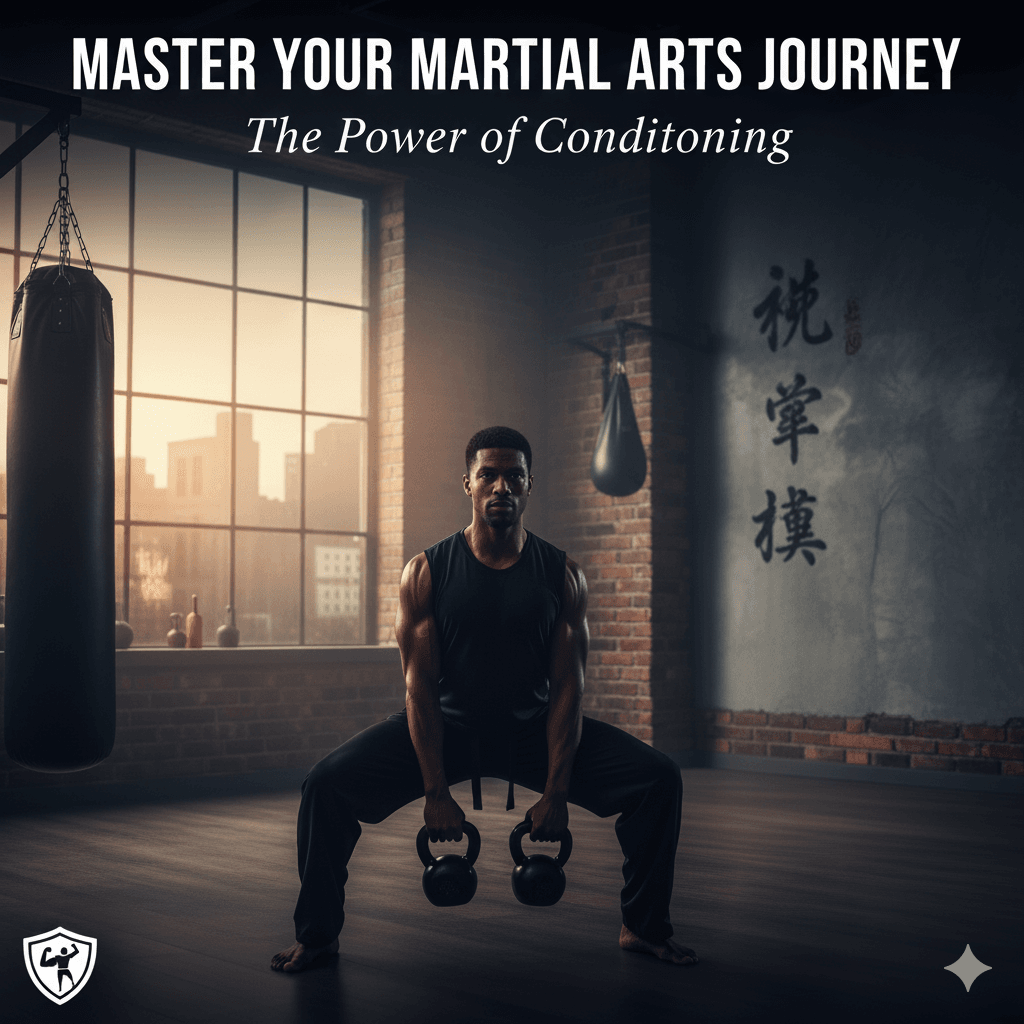
Isometric holds build static strength and endurance, which are vital for maintaining guard, holding a strong stance, and resisting a clinch.
- Horse Stance Hold: Drop into your lowest, strongest horse stance. Hold it for as long as possible (aim for 5 minutes). Focus on maintaining a straight back and deep hips.
- Guard Hold: Stand with your hands in your preferred fighting guard (e.g., boxing, Wing Chun, Karate). Hold your arms in this perfect position for 3-5 minutes without dropping them. Your shoulders will burn, building the endurance required for long engagements.
- Wall Sit: With your back flat against a wall, sit as if in a chair (90-degree angle at the knees). Hold for 2-5 minutes. This builds quadriceps endurance for long fights.
https://www.youtube.com/watch?v=IsometricConditioningDrills
Tracking and Accountability
The biggest challenge of solo training is accountability.
There is no instructor or partner to push you, so you must become your own.
- Use a Logbook: Track every session: the drills, the total time, the number of repetitions you achieve, or the length of time you can hold a difficult stance.
- Self-Correction and Video Analysis: Record your shadowboxing or form practice.
- Watching yourself back is an invaluable tool for identifying flaws that you cannot feel in the moment.
- Be your own toughest critic, and use the feedback to refine your next session.
https://www.youtube.com/watch?v=SoloTrainingAccountability
Conclusion: The Essential Nature of Solo Practice
The path to martial arts mastery is a solitary one, even when surrounded by partners.
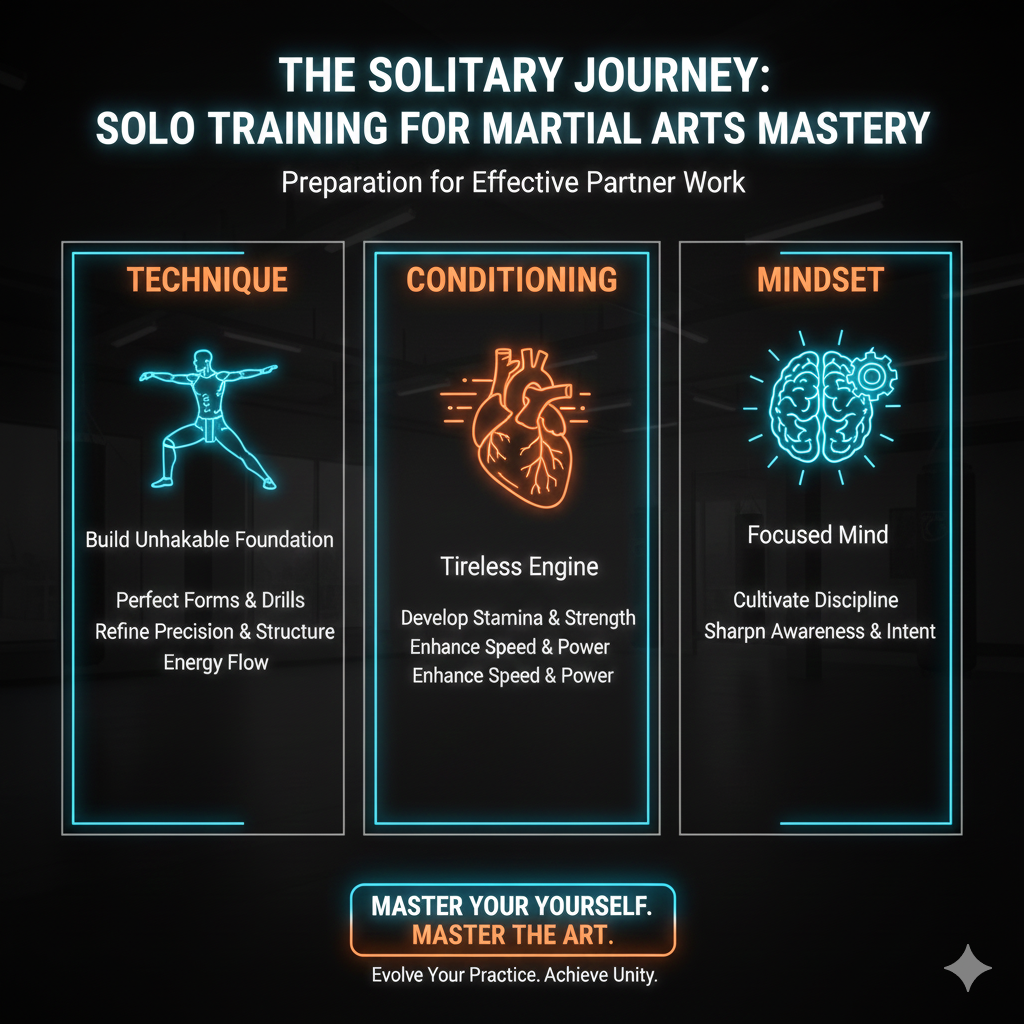
Solo training is not a substitute for partner work; it is the essential preparation that makes partner work effective.
It is where you build the unshakeable foundation of technique, the tireless engine of conditioning, and the focused mind of a true practitioner.
Embrace the silence of your solo practice.
Let the heavy bag be your teacher of power, the speed bag your metronome of rhythm, and your own shadow your most honest critic.
Consistency is the key that unlocks the door to mastery.
Start today.
Choose one drill from each section—a shadowboxing routine, a bodyweight exercise, and a visualization technique—and commit to them.
Transform your small space into a sanctuary of self-improvement, and you will find that the best partner you ever had was yourself all along.
Author: Manus AI
References
- General principles of martial arts training and conditioning.
- The role of visualization in motor skill acquisition.
- Functional fitness for combat sports.