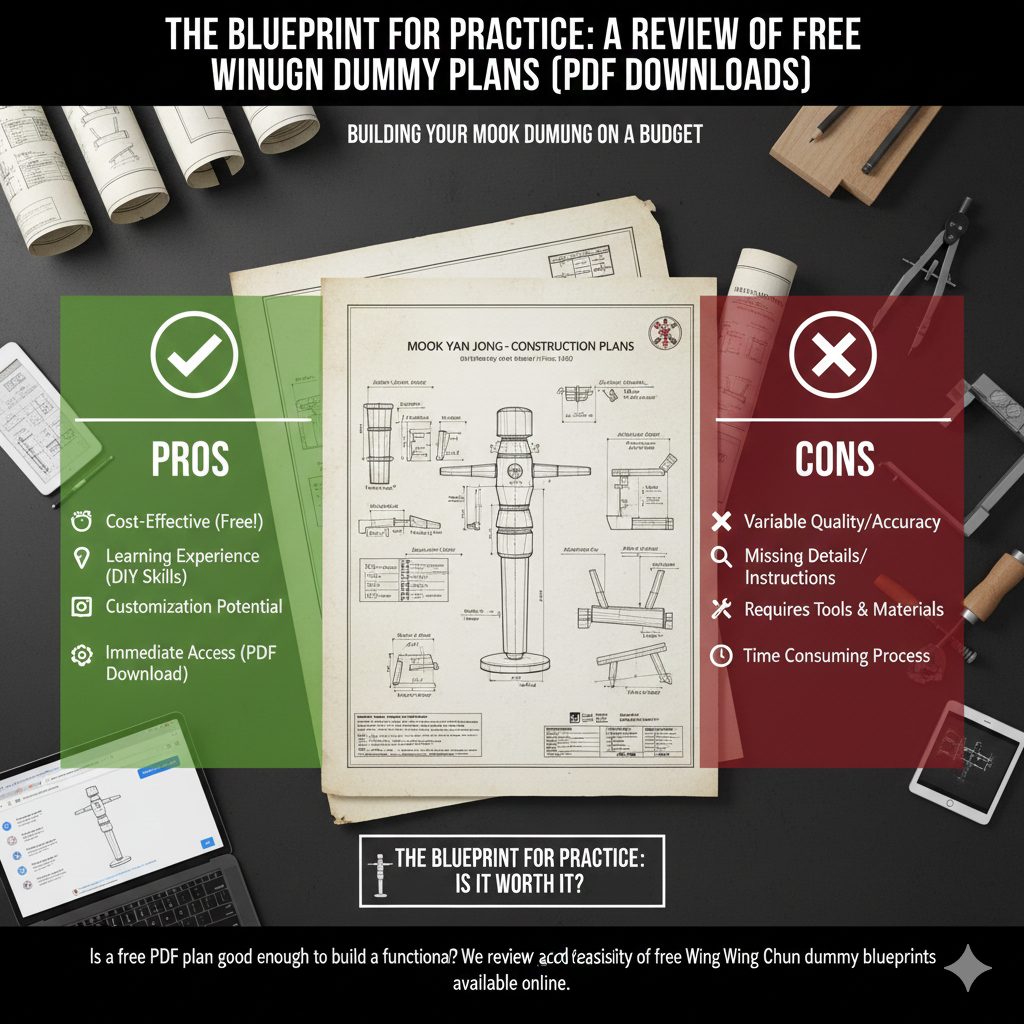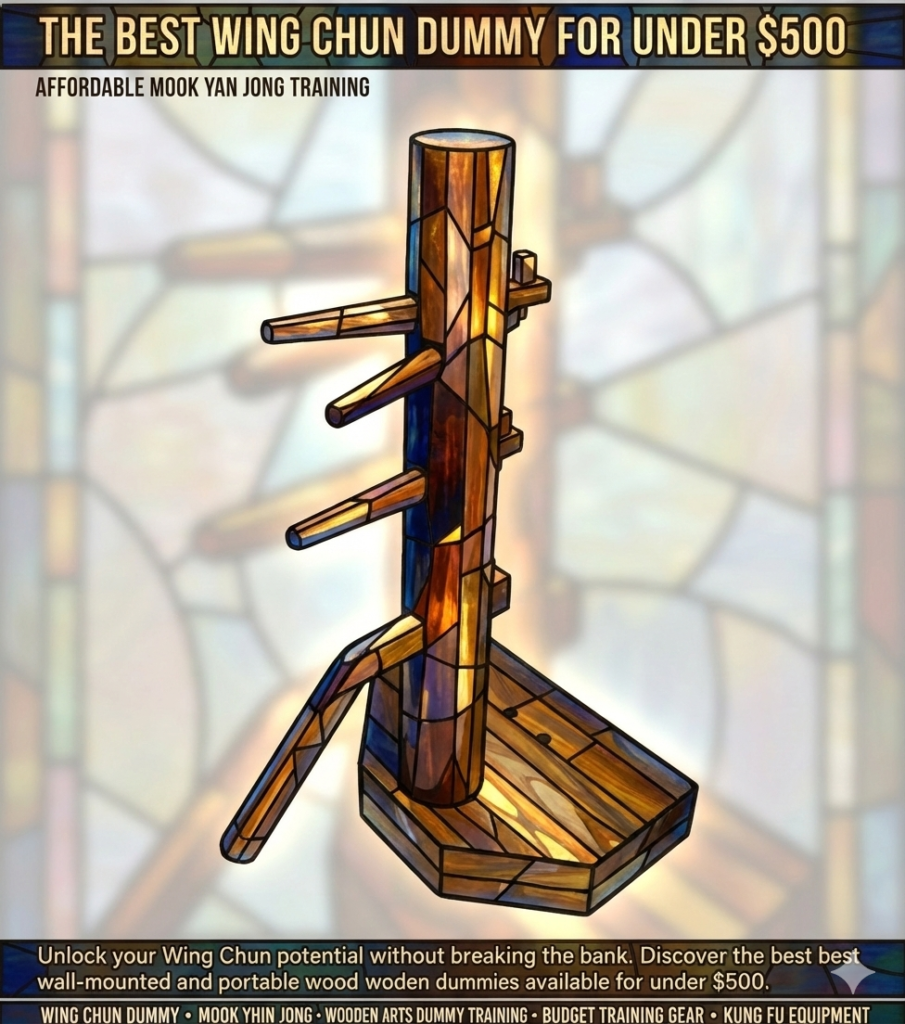
The wooden dummy, or Mu Ren Zhuang, is an iconic symbol of Chinese martial arts, instantly recognizable as the centerpiece of Wing Chun Kung Fu training. 🤓
However, the concept of a stationary training post is not exclusive to Wing Chun; various Chinese martial arts, including some internal styles like Tai Chi, utilize similar tools, though their design and purpose can differ dramatically. 💡
This comprehensive exploration will dissect the key differences between the Wing Chun Mook Yan Jong and comparable Tai Chi training apparatus, and then detail how the Wing Chun dummy can be a powerful, cross-training tool for martial artists from any discipline. 📌
The Wing Chun Mook Yan Jong: A Lesson in Structure
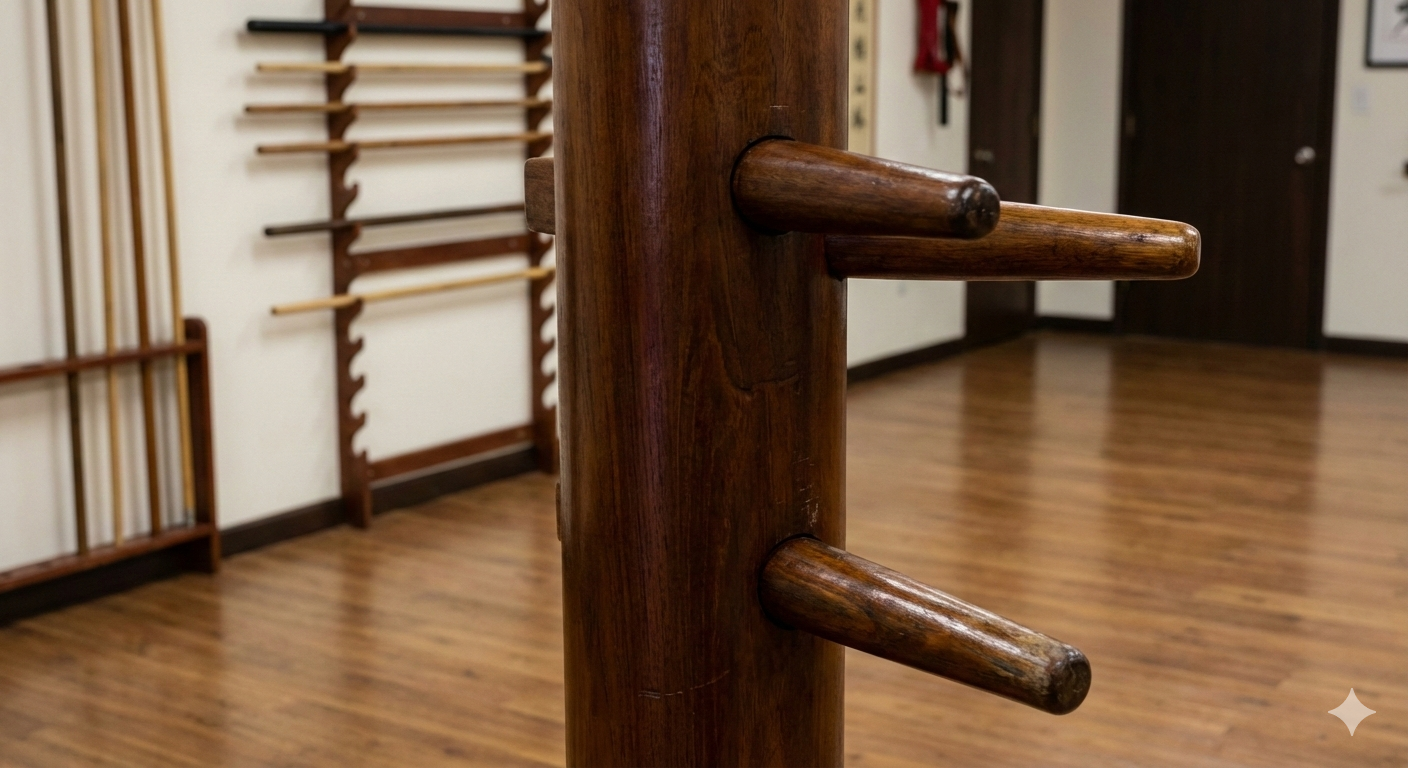
The Wing Chun wooden dummy is a highly specialized piece of equipment, designed to cultivate the specific principles of the Wing Chun system. 🥋
Its structure—three arms and one leg—is a precise, three-dimensional representation of an opponent’s fighting stance and limbs. 🧐
The arms are set at a critical 30-degree angle, forcing the practitioner to maintain a narrow, efficient structure and attack the centerline. [1]
The dummy is typically mounted on a frame with wooden slats, which provides a crucial “springiness” that simulates the involuntary reaction and energy of a human opponent. 💥
This feature allows the practitioner to learn how to absorb and redirect force, developing what is often called “alive” hands. 🖐️

The Core Purpose of the Wing Chun Dummy
The primary function of the Mook Yan Jong is to refine the practitioner’s structure, footwork, and coordination in a non-compliant environment. 🎯
It teaches the student to maintain a constant forward pressure and to execute techniques with the correct angles and economy of motion. ➡️
The 116-movement form is a catalogue of applications, demonstrating how to use the Wing Chun forms—Siu Lim Tao, Chum Kiu, and Biu Jee—against a fixed opponent. [2]
It is a tool for developing contact reflex and simultaneous attack and defense, which are hallmarks of the Wing Chun system. 🛡️
Tai Chi Training Tools: Emphasis on Internal Energy
While the Wing Chun dummy is widely known, the concept of a dedicated, multi-limbed wooden dummy is less common in Tai Chi Chuan (Taijiquan). ☯️
Tai Chi training focuses heavily on internal energy (Qi), balance, and the continuous, flowing movement of the body. 🌊
The Tai Chi equivalent of a training post is often a simpler, single post or a specialized apparatus designed to train specific internal skills. 🌳
Some Tai Chi schools may use a simple wooden pole, sometimes called a Zhan Zhuang (Standing Post), for static stance training and developing rooting. [3]
This post is used to cultivate internal strength and proper body alignment, but it lacks the multiple, angled limbs of the Wing Chun dummy. 🧘
The Role of Push Hands in Tai Chi
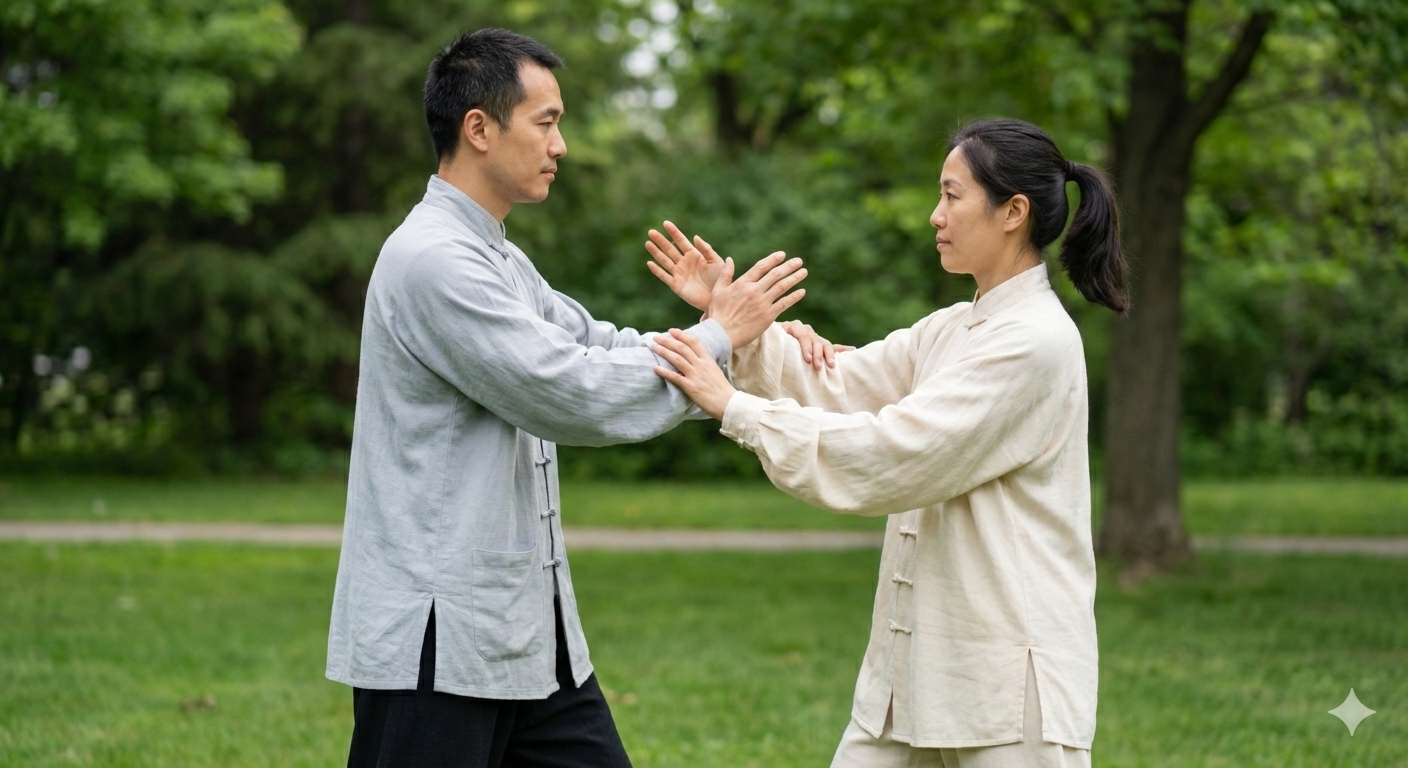
The closest Tai Chi comes to the Wing Chun dummy’s function of developing contact reflex and sensitivity is through Tui Shou (Push Hands). 🤝
Push Hands is a two-person drill that teaches the practitioner to sense, adhere to, and neutralize an opponent’s force, which is a dynamic, human-to-human interaction. 🔄
The Tai Chi philosophy often views the Wing Chun dummy as too rigid and external, potentially hindering the development of the soft, yielding energy central to Tai Chi. [4]
Therefore, the Tai Chi training method prioritizes the development of listening energy and neutralization through partner work over the fixed, structural feedback of the Mook Yan Jong. 👂
Key Differences in Training Apparatus
The fundamental differences in the training philosophies of Wing Chun and Tai Chi are clearly reflected in their respective training tools. 📋
The Wing Chun dummy is a tool for direct, aggressive, and structural refinement, while Tai Chi relies on dynamic, internal, and yielding partner drills. ⚖️
| Feature | Wing Chun Dummy (Mook Yan Jong) | Tai Chi Training Post (Zhan Zhuang/Simple Post) |
|---|---|---|
| Design Complexity | High: Three angled arms, one leg, and a spring-mounted trunk. | Low: Often a single, simple post or pole. |
| Primary Focus | Structure, angles, centerline attack, and contact reflex. | Rooting, internal energy (Qi), balance, and static alignment. |
| Feedback Mechanism | Physical resistance and recoil from the spring-mounted trunk. | Internal sensation and muscular endurance. |
| Simulated Opponent | A fixed, structurally sound opponent with limbs in key positions. | Primarily the practitioner’s own body and mind. |
Wing Chun Dummy Training for Non-Wing Chun Martial Artists
Despite its origins, the Wing Chun wooden dummy is a versatile training tool whose benefits can be leveraged by practitioners of nearly any martial art. 🥋
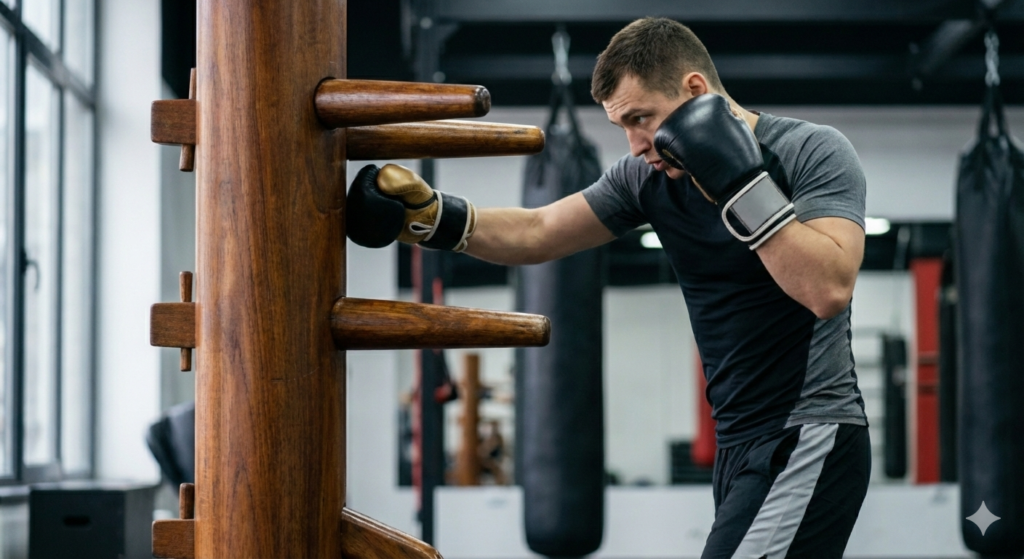
The dummy’s unique design provides a type of feedback and training that is difficult to replicate with traditional heavy bags or focus mitts. 🥊
For martial artists outside of Wing Chun, the dummy is not a tool for learning the 116-movement form, but rather a specialized apparatus for developing universal fighting attributes. 🌟
The focus shifts from learning a specific sequence to isolating and enhancing core skills that are transferable to any combat system. 🔄
Benefits for External Martial Arts (Karate, Taekwondo, Boxing)
Practitioners of striking arts can gain significant advantages by incorporating the Mook Yan Jong into their routine. 👊
The fixed arms of the dummy force the practitioner to address the problem of guard penetration and trapping, skills often neglected in free-sparring or heavy bag work. [5]
For a boxer, the dummy’s arms represent an opponent’s guard, requiring the boxer to use slips, bobs, and weaving movements to find an opening for their strikes. 🥊
The dummy is excellent for developing short-range power and bone conditioning, as the solid wood provides a realistic, non-yielding surface for impact. 🦴
This is especially valuable for arts that rely on close-quarters striking, such as Muay Thai or certain styles of Karate. 🥋
Furthermore, the leg of the dummy is an unparalleled tool for training footwork and angle changes, as the practitioner must constantly step around it to maintain a dominant position. 👣
This is a direct and immediate lesson in distance management and positioning, which are universal to all combat sports. 📏
Benefits for Internal Martial Arts (Tai Chi, Baguazhang, Xing Yi)
While the Tai Chi philosophy may caution against the dummy’s rigidity, internal martial artists can still extract profound benefits. ☯️
The dummy’s spring-mounted trunk is an ideal target for practicing Fa Jing (Explosive Power) without the need for a partner. ⚡
The practitioner can focus on delivering a short, sharp burst of energy from their core, receiving immediate feedback on the quality of their whole-body connection. 🔗
The arms can be used to practice adhering and neutralizing techniques, similar to Push Hands, but with the added benefit of a fixed, non-compliant point of contact. 🤝
This forces the internal artist to develop a structure that can absorb and redirect force without collapsing, a crucial skill for maintaining rooting and balance. 🌳
The arms can also be used to practice joint manipulation and Qin Na techniques, as the fixed angles provide a stable platform for testing leverage and control. 🖐️
How to Cross-Train with the Wing Chun Dummy
To effectively use the Mook Yan Jong for cross-training, a martial artist must adapt their approach and focus on universal principles rather than Wing Chun-specific forms. 💡
The goal is to use the dummy to expose weaknesses in one’s structure and footwork that may not be apparent during regular partner drills. 🔍
Here are some cross-training applications for non-Wing Chun practitioners: 📝
- Centerline Drill: Use the dummy’s trunk as a target for straight punches, focusing on maintaining a narrow, protected path between the arms. This is invaluable for boxers and kickboxers.
- Trapping and Clearing: Use the arms to practice clearing an opponent’s guard before striking. A Karate practitioner can practice a parry-strike combination, using the dummy’s arms as the initial obstacle.
- Footwork and Angle: Practice stepping around the dummy’s leg while striking, ensuring that your footwork is always setting you up for a dominant angle. This is crucial for all martial arts, especially those with complex footwork like Taekwondo or Baguazhang.
- Conditioning: Use the arms and trunk for light, repetitive striking to condition the forearms and knuckles, developing the “iron palm” or “iron bridge” necessary for close-range combat.
- Short-Range Combination: Practice short, rapid-fire combinations, such as elbow strikes, headbutts, and short punches, where the dummy’s proximity forces you to use efficient, compact movements.
The dummy is a mirror; it reflects the truth of your structure and the efficiency of your movement. 🪞
By engaging with it, you are forced to confront and correct any flaws in your fundamental mechanics. 🛠️
Further Resources for Mastery and Cross-Training
To maximize the benefits of the Wing Chun dummy, it is essential to understand its design and the universal principles it embodies. 📚
The following resources offer deeper insights into the dummy’s application and its potential for cross-training. 🌐
External Links:
- The Wikipedia entry on Mu ren zhuang provides a comprehensive overview of the dummy’s use in various Chinese martial arts, including Choy Lee Fut.
- Dragon Institute’s article on the purpose of the wooden dummy emphasizes its role in developing position and footwork.
- Enter Shaolin details the three core benefits of the Muk Jong: structure, bone conditioning, and technique development.
- Tiger Claw’s product page highlights the dummy’s use for hardening practical fighting skills for any martial artist.
- My Karate Store offers a guide to understanding the Wing Chun dummy, making it accessible to non-Wing Chun practitioners.
Video Resources:
This video demonstrates how to use the Wing Chun Wooden Dummy for “Martial Boxing” training, showcasing its cross-training potential. 🥊
A look at Wing Chun Wooden Dummy training techniques for the general martial artist, focusing on fundamental movements. 🥋
Simple drills for footwork and position on the wooden dummy, which are universally beneficial for all martial arts. 👣
The Wing Chun dummy is a testament to the idea that principles transcend style. 🏆
By understanding its design and purpose, any martial artist can use it to develop a more robust structure, sharper reflexes, and more efficient movement. 🌟
Embrace the wood, and you will find a silent, unyielding partner ready to elevate your practice to the next level. 💪
Happy training! 🤓
[1] The 30-degree arm angle is a key design feature of the Wing Chun dummy, intended to enforce a narrow, centerline-focused structure.
[2] The 116-movement form is the standard curriculum for the wooden dummy in the Ip Man lineage of Wing Chun, serving as an application set for the hand forms.
[3] Zhan Zhuang, or “Standing Post,” is a common training method in Tai Chi and other internal arts, focusing on static posture and internal energy cultivation.
[4] The philosophical difference between the “hard” feedback of the dummy and the “soft” yielding of Tai Chi’s Tui Shou is a common point of discussion among practitioners.
[5] The dummy’s fixed limbs are excellent for training trapping, clearing, and guard penetration, skills that are highly transferable to striking arts like Boxing and Karate.