
The Mook Yan Jong (Wooden Dummy) is an unparalleled teacher in the Wing Chun system.
Its unyielding nature provides immediate, honest feedback on the practitioner’s structure, angles, and force generation.
However, this very quality—its unyielding nature—also makes it a significant source of potential injury if approached incorrectly.
The dummy is designed to expose flaws, and if those flaws are met with brute force, the resulting impact can lead to chronic joint and tendon issues.
Safe and effective dummy training is not about avoiding contact; it is about a disciplined approach that prioritizes structure, relaxation, gradual progression, and proper pre- and post-training care.
This comprehensive guide will detail the most common dummy-related injuries and provide a robust set of prevention strategies to ensure your Mook Yan Jong practice is a source of refinement, not destruction.
Understanding the Risks: Common Dummy Injuries
The injuries sustained from improper dummy practice are typically not acute, but rather chronic, developing over time due to repeated structural errors.
They primarily affect the joints and connective tissues.
1. Joint and Tendon Issues (The Most Common)
The most frequent injuries occur when the practitioner’s structure fails to absorb or redirect the force of the impact, causing the energy to rebound directly into the joints.
- Wrist and Elbow Sprains: These are often caused by striking the dummy with a bent wrist or a locked elbow.
- When the joint is not aligned, the impact force cannot travel through the skeletal structure and instead strains the ligaments and tendons.
- Shoulder Impingement and Rotator Cuff Strain: This is a common consequence of the “Chicken Wing” mistake—allowing the elbow to flare out or raising the shoulder during techniques like Bong Sau (Wing Arm).
- This position compromises the shoulder joint, leading to painful impingement over time.
- Forearm Bruising and Bone Bruises: While some conditioning is expected, excessive bruising or deep bone pain is a sign of improper contact angle or striking with too much tension.
- The force is not being distributed correctly across the forearm.
2. Structural and Muscular Issues
These injuries stem from poor body mechanics and a failure to use the Wing Chun stance and footwork correctly.
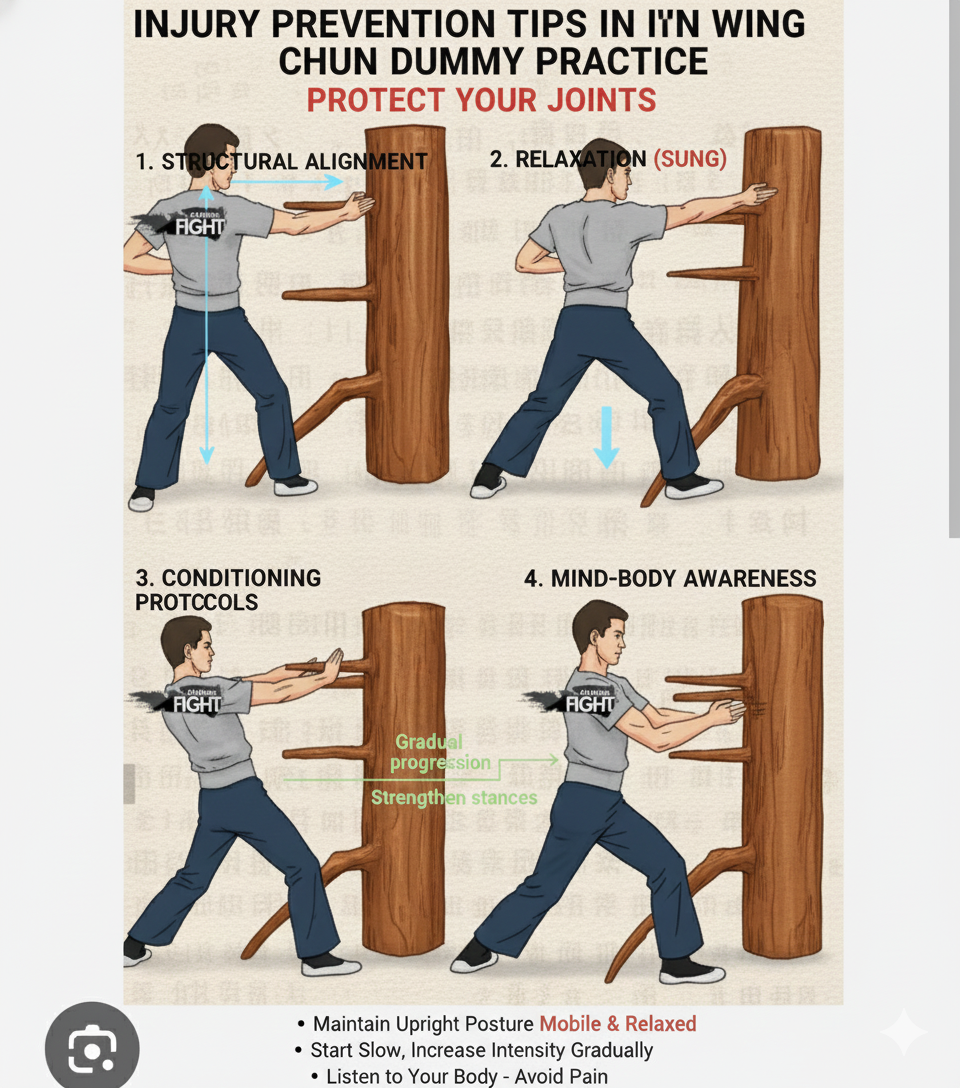
- Lower Back Strain: Caused by leaning into the dummy, twisting the torso instead of pivoting the hips, or failing to maintain the upright posture of the stance.
- The back muscles take the strain that the core and legs should be absorbing.
- Knee Pain: This is a serious risk, often caused by failing to maintain the Yee Jee Kim Yeung Ma (Goat-Clamping Stance) correctly.
- Twisting the foot or knee joint during footwork, rather than pivoting the entire body, places shearing forces on the knee ligaments.
Structural Prevention: The Core of Safety
The safest way to train on the dummy is to embody the core principles of Wing Chun.
The art itself is the best injury prevention system.
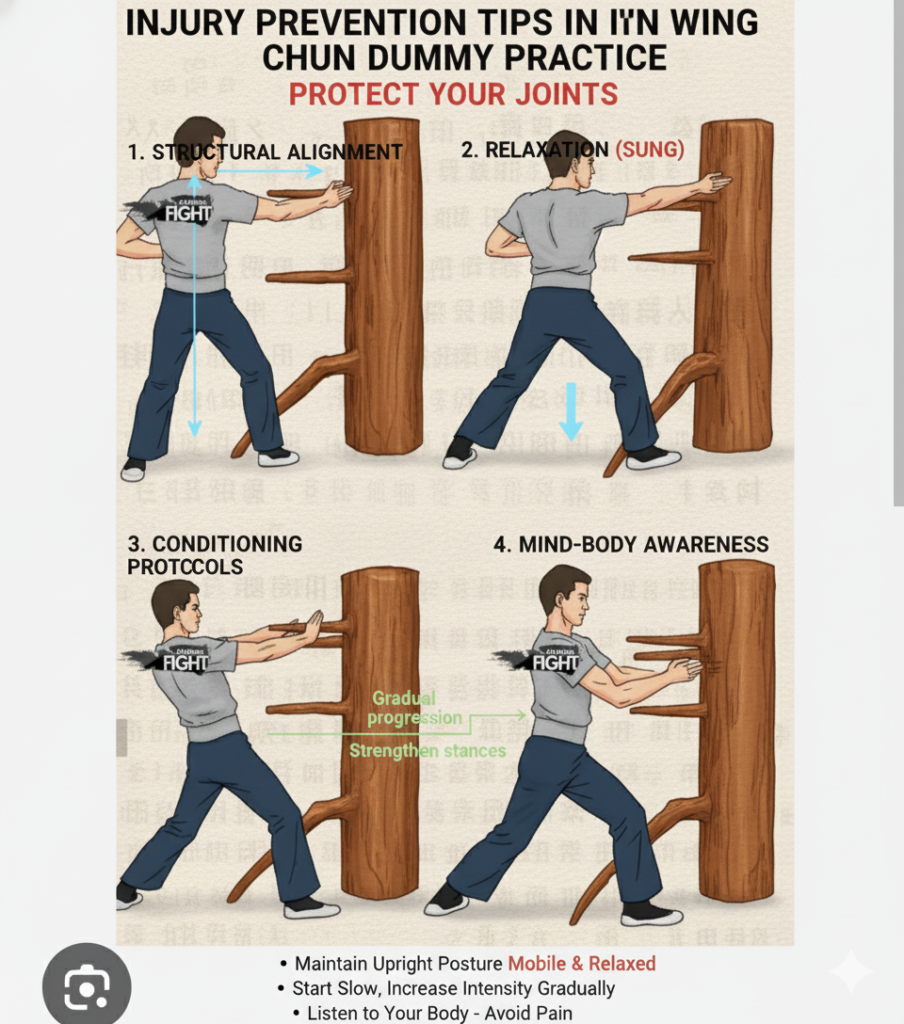
1. The Principle of Relaxation (Sung)
In Wing Chun, relaxation (Sung) is not weakness; it is the prerequisite for power and the key to injury prevention.
A tense muscle is a rigid structure that absorbs shock, while a relaxed muscle allows force to be channeled through the bone structure.
- Tip: Never strike the dummy with a tense muscle.
- The force must be generated from the ground, through the relaxed body, and released through the point of contact.
- Drill: Practice the Mook Yan Jong form in slow motion, focusing on dropping the shoulders and relaxing the arms before contact.
- If you feel tension, stop, shake it out, and restart the movement with less effort.
https://www.youtube.com/watch?v=WingChunSungRelaxation
2. The “Elbow-In” Rule (Protecting the Joints)
Maintaining the elbow-in position is paramount for protecting the shoulder and ensuring the skeletal structure is aligned to receive and redirect force.
- Tip: The elbow should remain close to the body, acting as a gate to the centerline.
- This ensures that when you make contact, the force is absorbed by the stronger bone structure of the forearm and humerus, not the delicate shoulder joint.
- Drill: Use the “Belt Drill” (looping a belt around the upper arms to enforce the correct distance) to physically train the muscle memory of keeping the elbows close.
- This simple tool provides constant, non-verbal feedback.
3. Proper Wrist Alignment
A bent wrist is a broken wrist waiting to happen.
The wrist is the weakest link in the chain of force transmission.
- Tip: The wrist must be straight and locked in line with the forearm upon impact.
This is true for all striking techniques, from the straight punch to the Pak Sau (Slapping Hand).
- Drill: Practice slow-motion strikes, paying obsessive attention to the wrist at the moment of contact.
- Use a mirror or video recording to ensure the wrist is perfectly straight.
- Any deviation means the force is being absorbed by the joint, not the bone.
https://www.youtube.com/watch?v=DummyWristAlignmentDrill
Training Protocol Prevention: Gradual Progression
The Mook Yan Jong is a tool for refinement, not a test of strength.
Your training protocol must reflect a commitment to gradual, intelligent progression.
1. Start Light, Stay Light (The “Touch” Principle)
For beginners, the dummy is for position and structure, not power.
The goal is to perfect the angle and the body mechanics.
- Tip: Use minimal force.
- The contact should be a “touch” that allows you to feel the dummy’s resistance without causing your structure to collapse.
- Progression: Only increase speed and force when your structure is perfect and the movement is entirely pain-free.
- If you feel pain, you are training too hard or too fast.
- Reduce the speed and force immediately and re-examine your technique.
2. Warm-up and Cool-down
Neglecting the warm-up is a direct path to injury, especially when dealing with the high-impact nature of the dummy.
- Warm-up: Focus on dynamic stretching for the joints that will be used: wrists, elbows, and shoulders.
- Include light cardio and joint rotations (e.g., arm circles, wrist rotations, light shadowboxing) to increase blood flow and synovial fluid production.
- Cool-down: Static stretching, especially for the forearms, shoulders, and lower back, helps to reduce muscle soreness and maintain flexibility, which is crucial for the relaxed structure of Wing Chun.
3. Listen to the Feedback (The Dummy as a Mirror)
The dummy is the most honest training partner you will ever have.
It does not lie.
- Tip: Pain is the dummy’s way of telling you your structure is wrong.
- If you feel sharp pain, stop the drill immediately.
- If you feel a dull ache, you are overtraining or using too much tension.
- Correction: Do not try to “push through” the pain.
- Instead, reduce the speed and force, and re-examine the technique’s structural alignment.
- The dummy is a mirror reflecting your internal flaws; learn to read the reflection.
Supplementary Prevention: Conditioning and Equipment
While structure is the primary defense against injury, supplementary conditioning and the use of protective equipment can significantly enhance safety and longevity in your practice.
1. Forearm and Grip Conditioning
Strong forearms and hands are essential for stabilizing the wrist and absorbing impact.
- Purpose: Conditioning the striking surfaces and strengthening the muscles that support the joints.
- Tools: Iron rings (worn on the forearms during form practice), grip strengtheners, or traditional rice bucket training (plunging hands into a bucket of rice or sand) are excellent for developing the necessary hand and forearm strength.
https://www.youtube.com/watch?v=ForearmConditioningForImpact
2. Dummy Padding and Protection
Especially for beginners, using padding can help condition the body gradually without causing severe bruising.
- Tip: Use foam padding, towels, or cloth wraps on the dummy arms and leg during the initial stages of training.
- This reduces the immediate impact shock, allowing the tendons and bones to strengthen gradually.
- As your structure improves and your body conditions, you can remove the padding.
3. Dit Da Jow (Traditional Liniment)
The use of traditional herbal liniments is a time-honored practice in Chinese martial arts for injury prevention and recovery.
- Purpose: Dit Da Jow (Hit/Fall Wine) is a traditional herbal liniment applied externally to the hands and forearms before and after training.
- It is believed to promote blood circulation, reduce bruising, and strengthen bones and connective tissues against the impact of the dummy.
Conclusion: Train Smart, Train Long
The Wing Chun Wooden Dummy is a powerful tool, but like any powerful tool, it demands respect and correct usage.
The key to injury prevention is not in avoiding the dummy, but in embracing the principles of Wing Chun—relaxation, structure, and economy of motion—in every single movement.
By prioritizing perfect structure over raw power, listening to the feedback the dummy provides, and committing to a smart, gradual training protocol, you ensure that your Mook Yan Jong practice is a lifelong source of growth and refinement.
Train smart, not just hard.
Your body is your most valuable training tool; protect it by training with discipline and intelligence.
References
- Biomechanics of impact and force transmission in martial arts.
- The role of relaxation (Sung) in internal martial arts training.
- Traditional Chinese medicine and herbal liniments for martial arts conditioning.