The Man Sau: Structural Verification, Not Strike
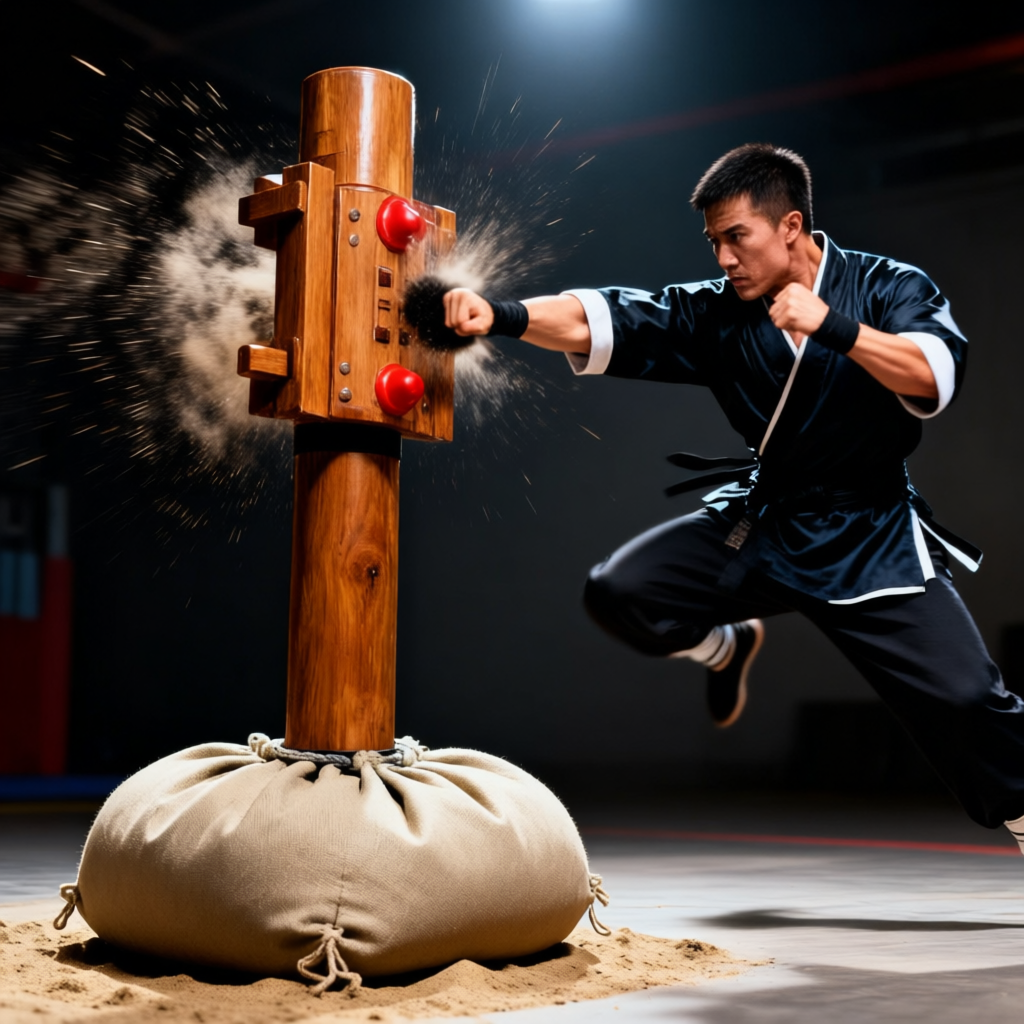
The Man Sau is not a strike. It is a structural verification. When you practice this technique on the wooden dummy, you are not trying to overpower the wood. You are testing centerline integrity. The goal is to transfer force from your core, through a properly aligned forearm, and into the dummy without compromising your wrist or elbow.
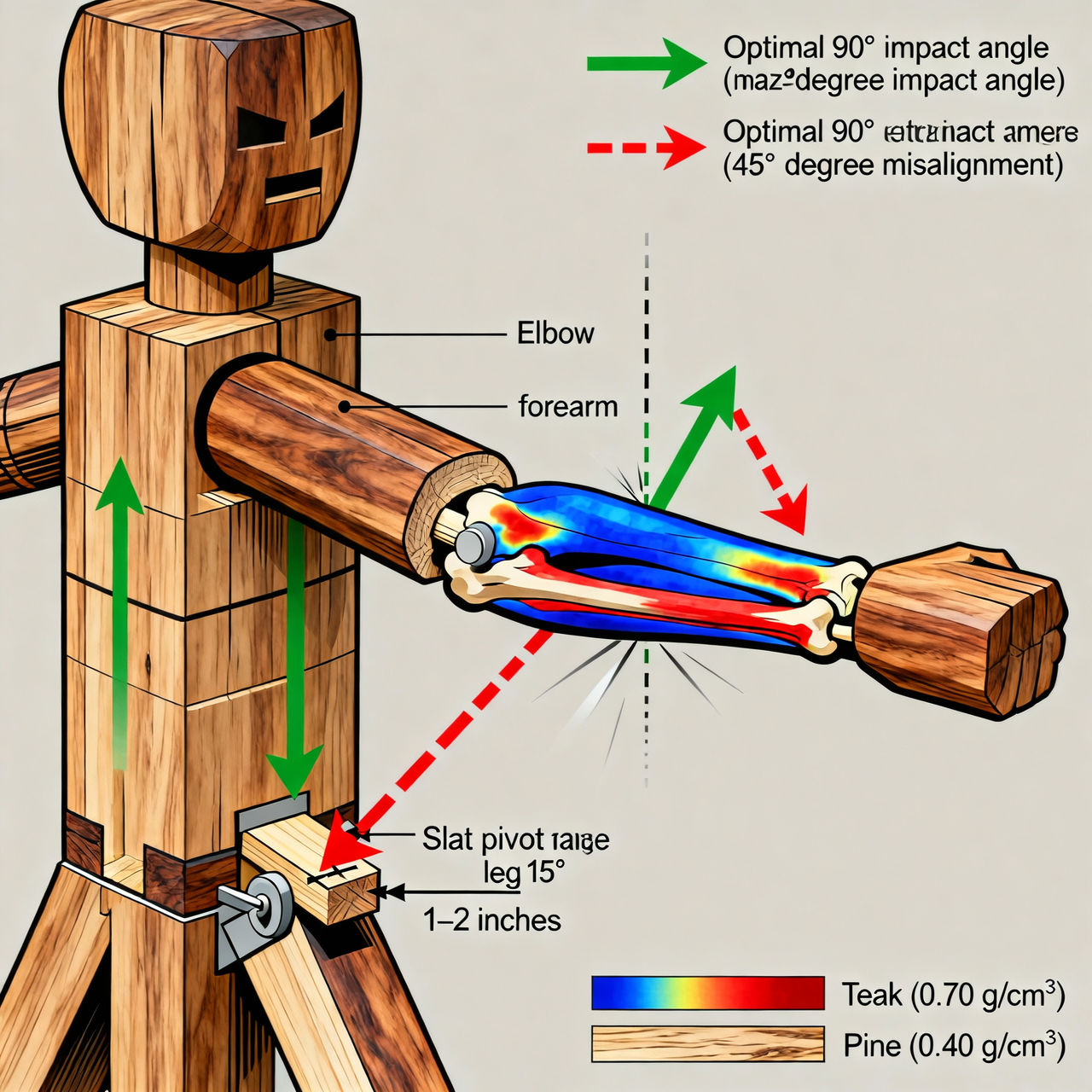
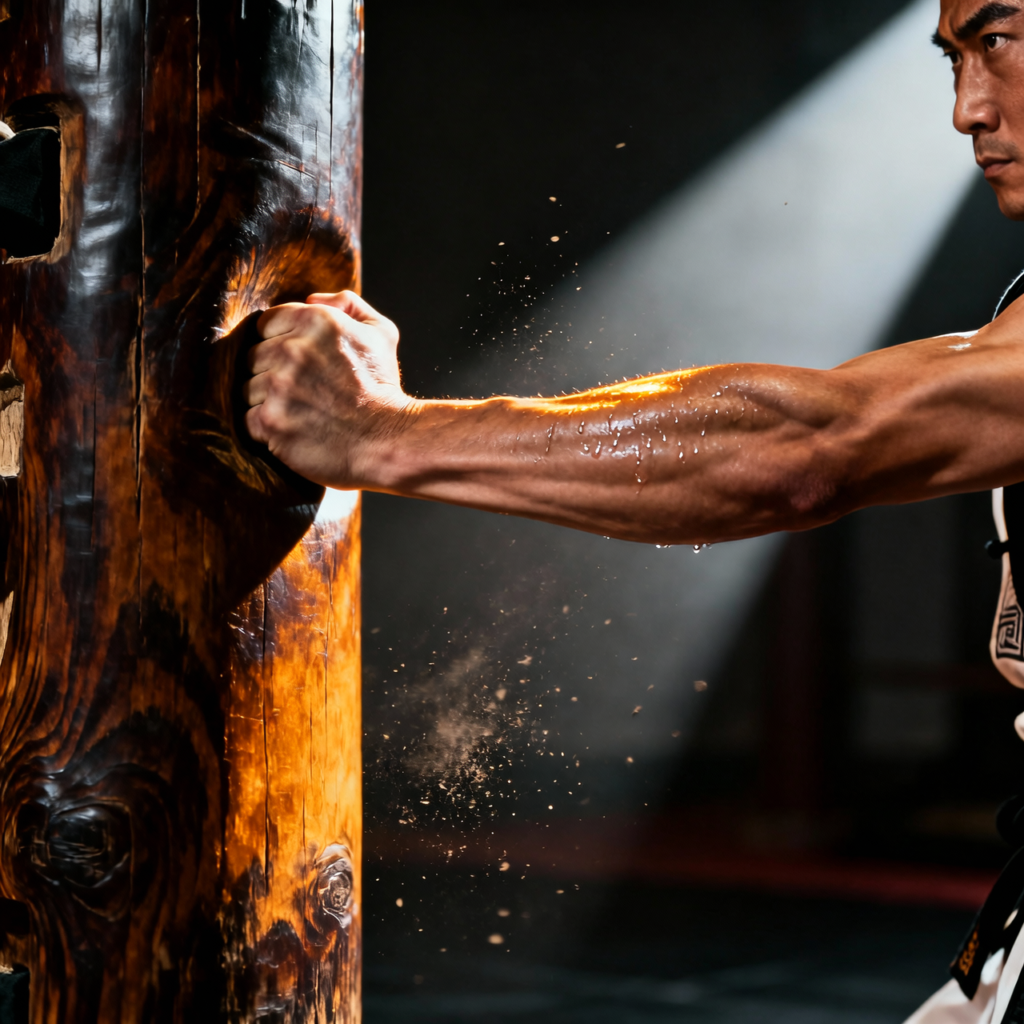
Hardwood density measures approximately 0.70 g/cm³ for dense species like Teak or Red Oak. This density creates a rigid, unyielding surface that absorbs impact correctly. Hitting a hollow PVC pipe or a softwood trunk creates a low-rigidity environment that fails to simulate real resistance. When you strike a compliant surface, the energy rebounds directly into your radius bone and ulnar nerve. A dense hardwood trunk dissipates that energy safely, protecting your joints while teaching your body to recognize true structural contact.
The Setup Protocol
Positioning the dummy correctly is the foundation of accurate Man Sau practice. Align the dummy so the upper arm channels sit directly on your centerline. Your stance must remain closed. An open stance forces you to strike at a 45-degree angle, which breaks structural alignment. The correct Man Sau must contact the dummy at a perpendicular 90-degree angle.
Check the slat tension before you begin training. The horizontal slats connecting the arms to the trunk should allow the arms to move one to two inches laterally before offering resistance. This slight pivot simulates human joint movement. If the arms lock up instantly, the impact energy travels straight into your wrist. If they swing wildly, you are training with dead weight that teaches you to rely on shoulder strength instead of core structure.
Inspect your equipment for warning signs of poor construction. Excessive trunk shaking, loud cracking sounds, or arms that feel loose indicate structural failure. Mortise geometry must remain perfectly perpendicular to the trunk axis. Any angled cuts in the square holes will ruin your Man Sau angle and force your elbow to flare outward. Leg stability is equally critical. The legs must be cut at a strict 15-degree downward angle. This angle locks the base into the ground. If the legs wobble, your upper body loses its anchor, and your forearm conditioning becomes inconsistent.
The Drill Progression
Build your practice methodically. Rushing into high-speed strikes will damage your joints and reinforce bad habits.
Step One focuses on static pressure. Place your Man Sau against the upper arm channel and apply steady force. Push the dummy back slightly while maintaining your elbow tucked against your ribs. This builds the inch power required to break an opponent’s guard. Keep your forearm perpendicular to the contact surface.
Step Two introduces the single strike. Execute a sharp Man Sau motion and immediately reset. Focus on the acoustic feedback. A properly constructed hardwood dummy produces a deep, solid thud. A hollow or poorly built dummy produces a sharp, hollow crack. Use that sound to diagnose your alignment. If the impact feels jarring, check your elbow position. The elbow must remain tucked. If it flares, the contact point shifts to your bicep or tricep, which invites tendon strain.
Step Three integrates flow drills. Execute the One-Touch Drill by striking the left arm channel with your right hand, then immediately countering with your left. The dummy must remain stationary during this exchange. If the entire unit shifts more than two inches upon impact, your mounting or base is insufficient. Practice the Angle Correction Drill by using the dummy as a mirror. Watch your forearm alignment on every repetition. Correct any drift toward a 45-degree angle before it becomes muscle memory.
Injury Prevention & Recovery
Forearm conditioning generates significant micro-trauma. The repeated impact of the Man Sau places stress on the wrist joint and elbow tendons. Proper warm-up routines are non-negotiable. Dynamic stretching and light Chi Sao drills prepare the connective tissue for impact.
Recovery requires targeted support. Apply aged Dit Da Jow liniment immediately after training. Traditional formulas, such as the Shen Formula, penetrate deep into the tissue to reduce inflammation and promote circulation. Do not ignore sharp pain in the ulnar nerve or wrist. Adjust your slat tension, verify your mortise angles, and reduce striking intensity until the joint stabilizes.
Equipment Recommendations
Check out our top-rated Wing Chun training gear & equipment on Amazon
The effectiveness of your Man Sau practice depends entirely on your dummy’s construction. Commercial hardwood dummies like the AugustaPro Wing Chun Wooden Dummy offer factory-tuned slat tension and precise mortise angles. These units typically weigh between 130 and 200 pounds and feature a trunk diameter of approximately 9 inches. The mass and density provide the consistent resistance required for serious forearm conditioning.
DIY builds carry significant friction points. Improper glue-ups or a lack of slat flexibility create a dead impact that ruins training. Users frequently fail to cut the leg mortise at the correct 15-degree angle, causing the lower body to wobble during low kicks. This distraction breaks upper body form. If you choose to build your own, use standard woodworking tools like 18-inch spade bits and track saws to ensure clean, perpendicular cuts. Select dense hardwoods like Teak, Mahogany, or Red Oak. Avoid softwoods like Pine. Pine compresses under repeated impact, enlarging the square mortise holes within weeks and creating a loose, unpredictable training surface.
Complement your dummy work with solid rattan or bamboo training rings. These tools develop the stickiness and sensitivity required for Chi Sao, which directly supports your Man Sau mechanics. For practitioners who cannot yet invest in a hardwood dummy, heavy leather striking pads mounted to a wall provide a safer alternative for developing initial forearm hardness before transitioning to wood.
ComponentOptimal SpecificationCommon Failure Point
Trunk Material
Teak, Red Oak, Mahogany (0.68–0.72 g/cm³)Pine, Bamboo, Hollow PVC
Recommended Insights From Our Wing Chun Guide Library:
- Mastering Sticky Hands: How the Wing Chun Dummy Elevates Your Chi Sao Training
- Wing Chun Dummy Drills for Small Spaces: Mastering the Mook Yan Jong at Home
- Structural Calibration for Solo Combat Readiness – Wing Chun Dummy
- Unlocking Kinetic Flow: The Art of Training with the Wooden Dummy
- Mastering Wooden Dummy practice : A Comprehensive Guide
Slat Pivot Range1–2 inches lateral movementZero movement (rigid) or >3 inches (floppy)
Mortise Angle (Legs)15° downward angleVertical or uneven cuts causing wobble
Impact SoundDeep, resonant thudHollow crack or plastic ping
Check out our top-rated Wing Chun training gear & equipment on Amazon
Recommended Companion ToolSolid Rattan Chi Sao Training RingsHard plastic or foam pads
Post-Training RecoveryShen Formula Aged Dit Da Jow LinimentIce only or non-traditional topical sprays
Martial Arts Reference & Authority Resources:
- Eddie Chong – Yip Man Wing Chun – 3 DVD Set
- Wooden Dummy and Chi Sau: When to Actually Teach in Wing Chun
- Wing Chun Articles tagged with Wooden Dummy
🔍 Explore More: See all Wing Chun training guides for How to practice the Man Sau on the dummy.
Check out our top-rated Wing Chun training gear & equipment on Amazon