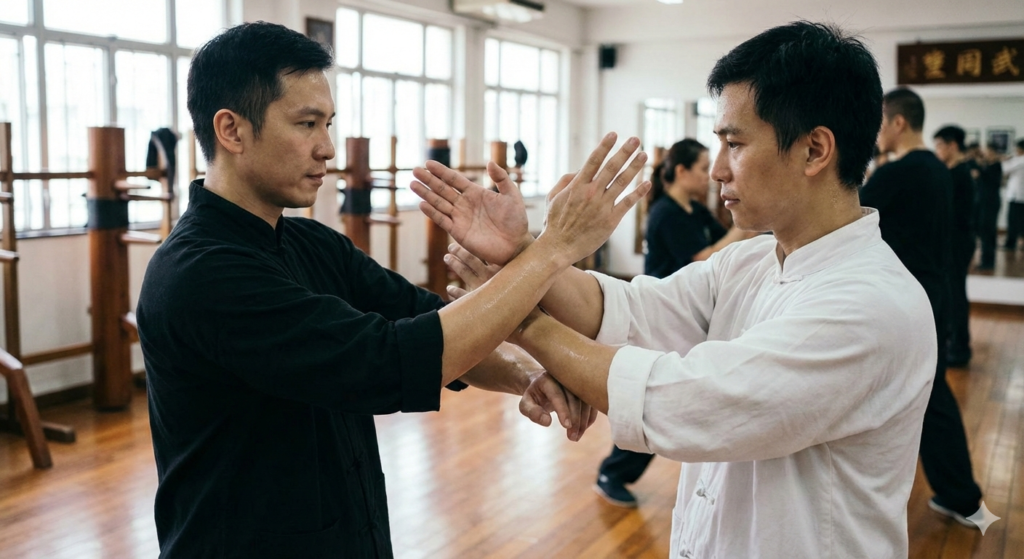
Chi Sao, which translates literally to “Sticky Hands,” is the most recognizable and arguably the most crucial training method in the Wing Chun Kung Fu system.
It is not a fighting technique in itself, but rather a sophisticated, dynamic drill designed to cultivate the essential skills needed for close-range combat.
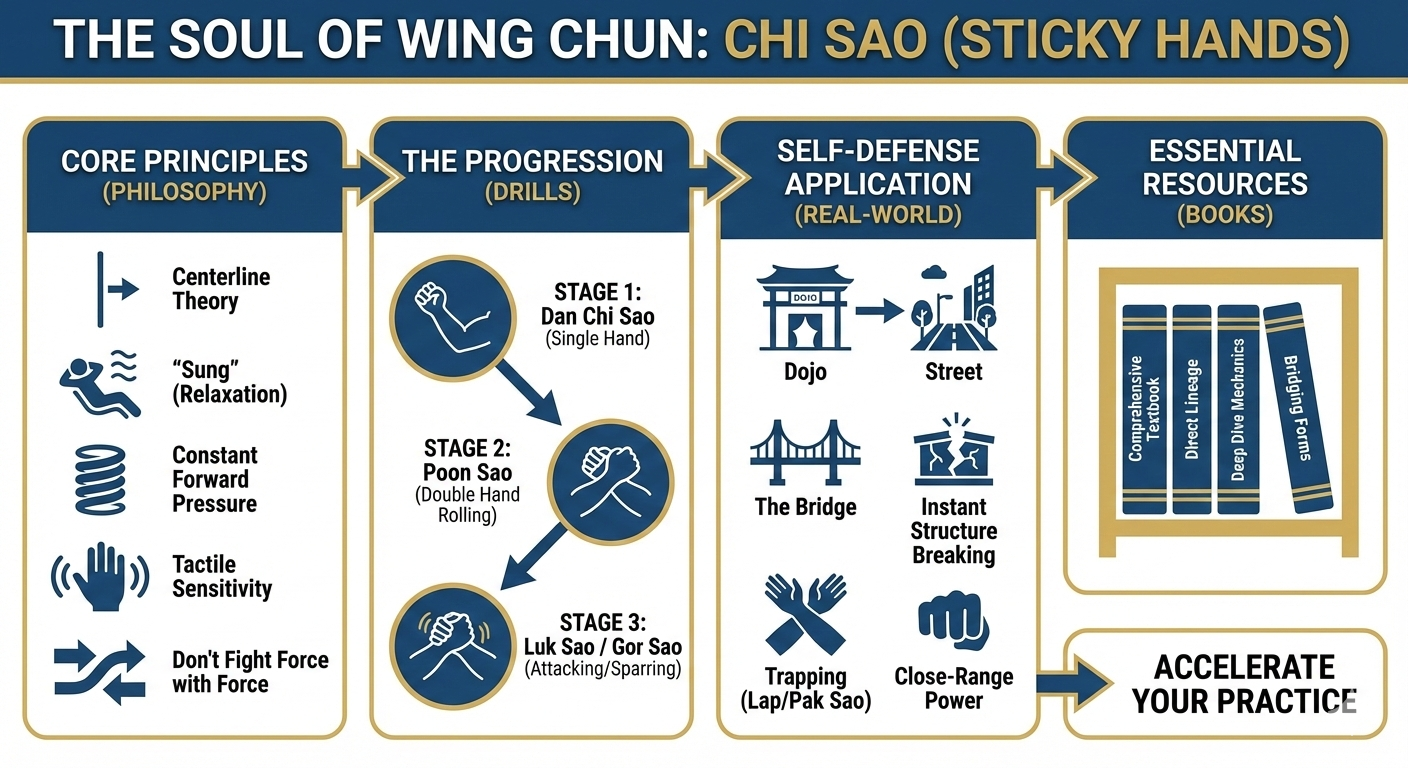
The goal of Chi Sao is to develop tactile sensitivity—the ability to “read” an opponent’s intentions and energy through physical contact—and to apply the core principles of Wing Chun, such as the centerline theory and simultaneous attack and defense.
For the self-defense practitioner, Chi Sao is the bridge between the static forms and the chaotic reality of a street confrontation.
It trains the practitioner to maintain contact, control the opponent’s structure, and exploit openings the moment they appear, all without relying on visual cues or brute force.
The Fundamentals of Chi Sao for Self-Defense
The essence of Chi Sao lies in four fundamental principles: sticking, adhering, yielding, and following.
These principles ensure that the practitioner remains connected to the opponent, ready to respond instantly to any change in pressure or direction.
In a self-defense context, this means that once contact is made, you do not lose it, effectively neutralizing the opponent’s ability to launch a second, more powerful attack.
The initial drills, such as Dan Chi Sao (single sticky hand) and Luk Sao (rolling hands), teach the basic mechanics of maintaining this contact and developing the necessary sensitivity in the forearms.
The ultimate goal is to transition from a reactive state to a proactive one, where your movements are dictated by the opponent’s energy, not by their visual attack.
This is what makes Chi Sao a truly unique and effective self-defense tool, allowing a smaller, weaker person to overcome a larger, stronger assailant by exploiting their structure and momentum [1].
Core Drills and Their Self-Defense Applications
The progression of Chi Sao training is systematic, moving from simple, structured drills to complex, free-flowing exchanges.
Each drill has a direct application to self-defense:
- Dan Chi Sao (Single Sticky Hand): This drill focuses on the basic cycle of attack and defense with one arm, teaching the practitioner to maintain the correct elbow position and forward pressure. In self-defense, this translates to the ability to control a single incoming limb and simultaneously strike.
- Poon Sao (Rolling Hands): This is the two-arm, continuous rolling drill that forms the foundation of free Chi Sao. It develops the ability to switch between offensive and defensive techniques seamlessly, teaching the practitioner to find the “hole” in the opponent’s defense.
- Gwoh Sao (Crossing Hands): This is the free-flowing, non-cooperative stage of Chi Sao, where the practitioner applies the learned principles against a resisting partner. This is the closest a student gets to sparring in a controlled environment, directly preparing them for the unpredictable nature of a street fight.
The key takeaway is that the hands are merely the tools; the real training is in the mind and the body’s ability to maintain a strong, stable structure while remaining fluid and adaptable [2].
Product Review: Essential Chi Sao Books on Amazon
While Chi Sao is a physical art that must be learned through practice, a good book can provide the theoretical framework, historical context, and detailed diagrams necessary to deepen your understanding.
Here are some of the most highly-regarded Chi Sao books available on Amazon, perfect for supplementing your physical training:
The Self-Defense Edge: Bridging the GapThe true value of Chi Sao in self-defense is its ability to train the body to react without conscious thought.In a high-stress situation, the mind often freezes, but the reflexes honed through thousands of hours of Chi Sao practice take over.
The drill teaches you to manage the distance (the “bridge”) between you and your opponent, ensuring you are always in a position of advantage.
It is a constant lesson in economy of motion: the shortest distance between two points is a straight line, and every movement must serve a dual purpose.
For instance, a simple Bong Sau (wing arm) used in Chi Sao instantly becomes a powerful deflection and simultaneous counter-strike in a self-defense scenario.
This is the genius of the system: the training is the application.The goal is to turn the opponent’s attack into their own defeat by borrowing their energy and structure.
Common Mistakes and How to Correct ThemMany beginners make the mistake of treating Chi Sao like a pushing contest or a wrestling match.This is a fundamental misunderstanding of the drill’s purpose.The goal is not to overpower, but to sense and control.
A key indicator of incorrect practice is the use of excessive muscular tension, which is the antithesis of Wing Chun’s principle of relaxation and springy power.
Another common error is allowing the elbows to flare out, which compromises the centerline and invites the opponent to attack the vulnerable core.
The books reviewed above, particularly those with detailed diagrams, can be invaluable for self-correction, as they provide visual and textual cues for maintaining the correct structure and posture.
Always remember the mantra: “If the hands are sticky, the body is free.”
Integrating Book Knowledge with Physical Practice
The most successful Wing Chun practitioners are those who seamlessly integrate the theoretical knowledge from texts with the physical experience of the drill.
Use the books to understand the *why* behind the movements, and use your training partner to experience the *how*.
For example, after reading a chapter on the principles of “borrowing force,” immediately apply that concept in your next Chi Sao session.
The books serve as a constant reference, helping you to troubleshoot problems and deepen your appreciation for the subtle genius of the art.
They are a crucial part of the solo training component, allowing you to study the masters’ insights even when a partner is unavailable.
By combining dedicated physical practice with scholarly study, you will unlock the full potential of Chi Sao as a powerful and sophisticated self-defense system.
Conclusion:
The Path to Reflexive MasteryChi Sao is more than just a drill; it is a philosophy of combat that emphasizes sensitivity, structure, and control.It is the ultimate expression of Wing Chun’s goal: to end a conflict quickly and efficiently by neutralizing the threat at the point of contact.
By diligently practicing the drills and supplementing your training with the authoritative texts available on Amazon, you will develop the lightning-fast, reflexive skills necessary to apply Wing Chun effectively in any self-defense situation.Start your journey today, and feel the flow of Chi Sao transform your martial art.
| Book Title | Author | Focus/Key Feature | Amazon Link |
|---|---|---|---|
| How To Do Chi Sao: Wing Chun Sticky Hands (Self-Defense) | Sam Fury | Practical, street-adapted drills and applications. Excellent for beginners. | View on Amazon |
| Dynamic Chi Sao | William Cheung | Focuses on the “Dynamic” aspect, emphasizing movement and flow. A classic text. | View on Amazon |
| Chi Sao: The Genius of Wing Chun | Sifu Wayne Belonoha | A deep dive into the underlying concepts and philosophy of the drill. | View on Amazon |
| Tao of Wing Chun Do, Vol. 2: Bruce Lee’s Chi Sao | Bruce Lee | Historical and conceptual insights from the legendary Bruce Lee. | View on Amazon |