Mook Yan Jong Maintenance and Oiling Guide: Preserving Your Silent Partner 🥋🪵
Why Maintenance is Non-Negotiable
The Mook Yan Jong (Wooden Dummy) is a significant investment, both financially and in terms of your martial arts journey.
Unlike other training equipment, a wooden dummy is a living piece of wood that requires periodic care to ensure its longevity, prevent cracking, and maintain its optimal training surface.
Proper maintenance, particularly regular oiling, is crucial to protect the wood from environmental factors and the stress of repeated impact.
Wood is a hygroscopic material, meaning it absorbs and releases moisture based on the surrounding environment.
When a wooden dummy is exposed to rapid changes in temperature or humidity (common in garages, basements, or air-conditioned homes), it can lead to two major problems:
- Cracking (Checking): As the wood dries out too quickly, the outer layers shrink faster than the core, causing deep, structural cracks that can compromise the dummy’s integrity.
- Warping: Uneven moisture loss can cause the trunk or arms to twist, altering the geometry of the dummy and making training inaccurate.
- Splintering: Dry wood becomes brittle and is more prone to splintering under the stress of impact, creating a rough, dangerous training surface.
Regular oiling seals the wood, stabilizing its moisture content and protecting it from these issues. 🤓
Choosing the Right Oil
The choice of oil is critical, as it must penetrate the wood to nourish it without leaving a sticky or overly slick surface.
| Oil Type | Pros | Cons | Recommendation |
|---|---|---|---|
| Pure Tung Oil | Traditional choice, deep penetration, durable, water-resistant finish, non-toxic | Requires multiple coats, long curing time (days/weeks), can be expensive | Best Overall Choice |
| Boiled Linseed Oil (BLO) | Widely available, inexpensive, easy to apply, cures faster than pure Tung Oil | Contains chemical dryers, less durable than Tung Oil, can darken wood significantly | Good Alternative |
| Mineral Oil | Non-toxic, easy to apply | Does not cure, remains slick, requires very frequent reapplication, offers poor protection | Avoid |
| Varnish/Polyurethane | Highly durable, waterproof | Forms a hard, plastic-like surface that prevents wood from breathing and can crack under impact | Avoid |
Recommendation: Pure Tung Oil is the traditional and superior choice for long-term preservation and a natural, durable finish. 🛡️
Step-by-Step Oiling Guide
The oiling process should be performed every 6 to 12 months, or immediately if the wood appears dry, faded, or rough to the touch.
Step 1: Preparation and Cleaning
Disassemble: Remove the arms, leg, and any pads or covers. If possible, remove the trunk from its stand or mounting.
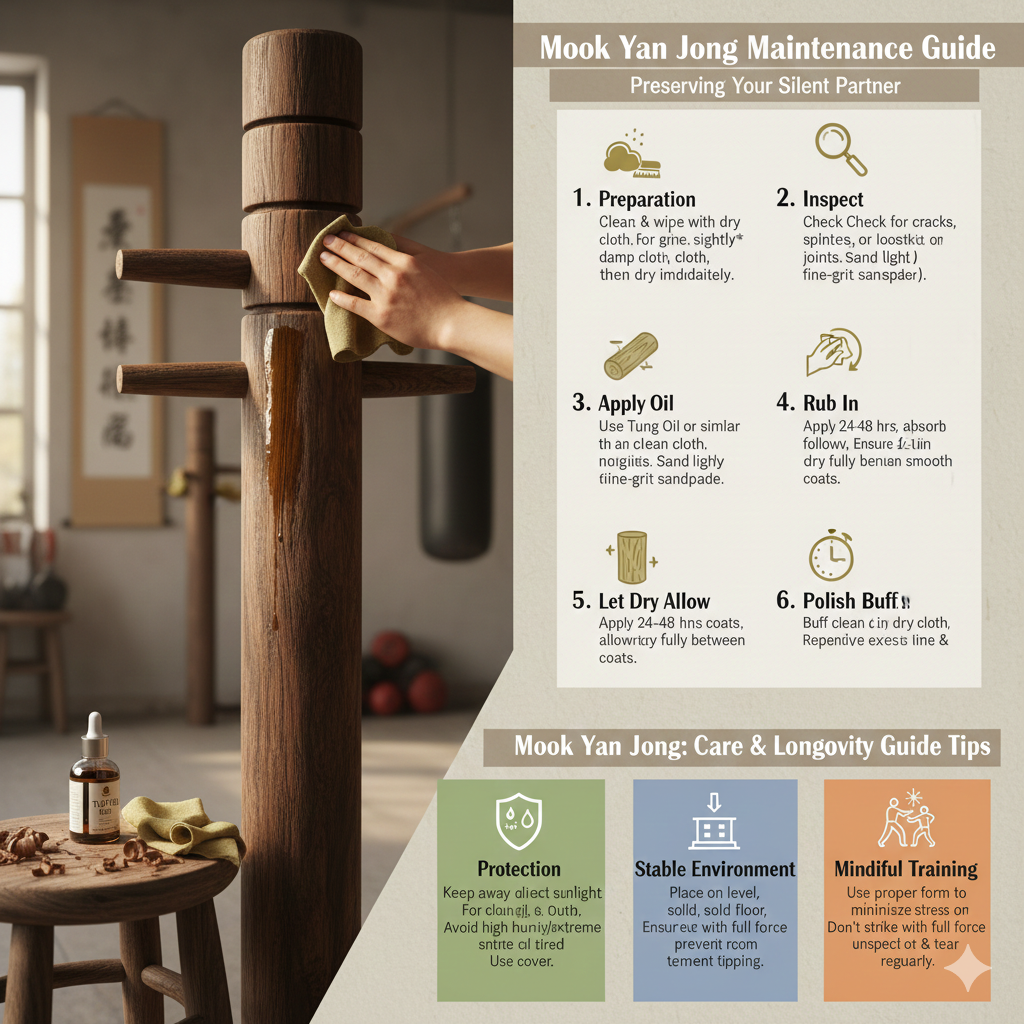
Clean: Wipe down the entire dummy (trunk, arms, and leg) with a clean, lint-free cloth to remove dust, dirt, and oil residue.
For stubborn grime, a light wipe with mineral spirits is acceptable, but ensure the wood is completely dry afterward.
Light Sanding (Optional): If the surface is rough or has minor splinters, lightly sand the entire surface with a fine-grit sandpaper (220-grit or higher).
This opens the pores of the wood and allows the oil to penetrate better. Wipe away all dust before proceeding. 🤓
Step 2: Oil Application
Dilution (First Coat): For the first coat, it is highly recommended to dilute the Tung Oil with a natural solvent (like citrus solvent or mineral spirits) at a 1:1 ratio.
This allows the oil to penetrate deeper into the wood fibers.
Application: Apply the oil liberally with a clean cloth or foam brush, working it into the wood grain.
Ensure all surfaces—especially the ends of the arms and the top/bottom of the trunk—are thoroughly coated.
Soak Time: Allow the oil to soak into the wood for 30 to 45 minutes. The wood should look wet and glossy.
Wipe Off Excess: Use a clean, dry, lint-free cloth to wipe off all excess oil.
If you leave excess oil on the surface, it will cure into a sticky, gummy residue. The goal is to nourish the wood, not to coat it.
Step 3: Curing and Reassembly
Curing: Allow the dummy to cure in a well-ventilated area. Tung Oil can take several days to fully cure.
Do not train on the dummy until the surface is completely dry to the touch and no longer smells strongly of oil.
Subsequent Coats: For maximum protection, apply a second and third coat of undiluted Tung Oil, following the same soak and wipe-off procedure.
Allow 24-48 hours between coats.
Reassembly: Once the final coat is fully cured, reassemble the arms and leg, ensuring they are properly aligned and secured.
Routine Maintenance Checklist
- Check for Cracks: Inspect the trunk and arms regularly. Small hairline cracks are normal; deep, widening cracks may require professional attention or filling with wood glue/epoxy.
- Tighten Arms and Slats: The arms and the suspension slats (for wall-mounted dummies) can loosen over time. Periodically check and tighten the wedges or bolts to ensure the dummy remains stable and the arms do not rotate excessively.
- Monitor Environment: If the dummy is in a dry environment, consider placing a humidifier nearby. If it is in a damp environment, ensure good airflow to prevent mold or excessive swelling.
- Treat your Mook Yan Jong with respect and care to ensure it serves you faithfully throughout your Wing Chun journey. 🥋
Reference and Further Reading
Dragon Institute — Wooden Dummy Construction and Installation
Yumpu — Wooden Dummy Wood Tools
Thank you for reading this guide and happy training! 🤓