

The Wing Chun wooden dummy, or Mook Yan Jong, is arguably the most iconic training tool in all of martial arts. 🥋
It is a silent partner, a tireless opponent, and a crucial aid for developing structure, power, and sensitivity. 💡
However, the effectiveness of your training hinges on one critical factor: the dummy’s height adjustment. 📏
A dummy that is too high or too low will not only hinder your progress but can actively teach you bad habits that are difficult to unlearn. 😥
This comprehensive guide dives deep into the principles of setting the perfect dummy height. 🤓
It offers solutions for individual practitioners, shared training spaces, and those utilizing modern adjustable models. 📌
We will ensure your Mook Yan Jong is perfectly calibrated to your body, maximizing every training session. ✅
The Golden Rule: Why Height Matters for Wing Chun Structure
In Wing Chun, every movement is rooted in a stable, centered structure. 🏗️
This is most notably the Yee Jee Kim Yeung Ma (Character Two Adduction Stance), often called the Goat Stance. 🐐
The dummy is designed to mimic a human opponent. 🧍
Its arms and leg are positioned to challenge your structure at specific points. 🎯
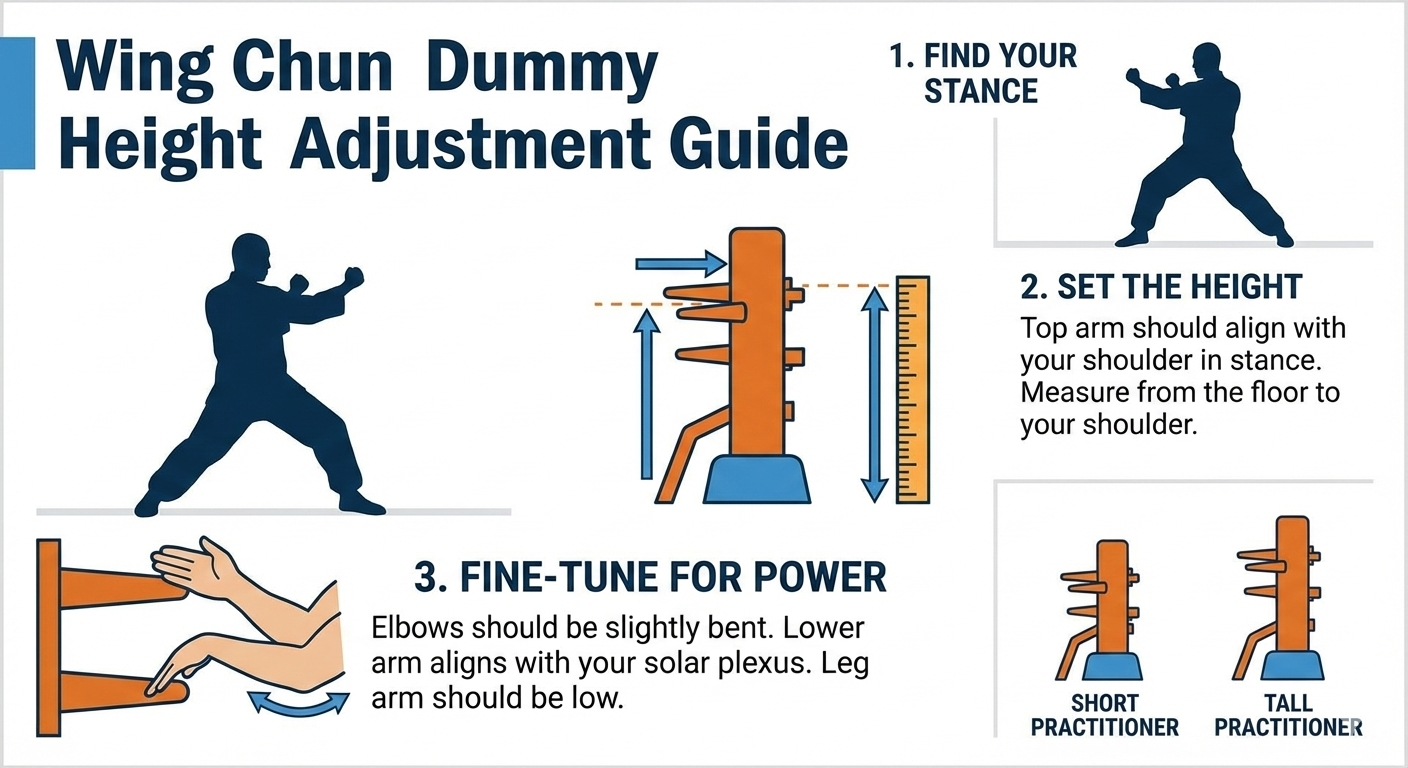
The traditional and most widely accepted rule for setting the dummy’s height is based on the position of the top two arms. 🖐️
The center of the top arms should align with the practitioner’s shoulder height. 📐
More precisely, it should align with the height of the sternum or nipple line when standing in a relaxed stance. 🧍
This alignment is not arbitrary. ❌
It is fundamental to the system. 📌
When the arms are at this height, your primary striking and blocking techniques are executed from a natural, centered position. 🌀
These techniques include Tan Sao (Dispersing Hand) and Bong Sao (Wing Arm). 🥋
If the dummy is too high, you will be forced to raise your elbows and shoulders. 😟
This compromises your structure and leads to tension. 😥
If it is too low, you will slouch or drop your center. 📉
This is equally detrimental to your power generation. 💥
Therefore, the correct height ensures that the forces you apply are directed through your skeletal structure and into the ground. 💪
This is the essence of Wing Chun power. 🏆
Calculating Your Perfect Fit: A Step-by-Step Guide
For the individual practitioner, achieving the perfect height is a simple measurement process. 📐
You will need a tape measure and a marker. 📝
- Step 1: Find Your Center. Stand naturally with your feet shoulder-width apart. Locate your sternum or the center of your chest, roughly at the nipple line. This is your target height.
- Step 2: Measure the Dummy. Measure the distance from the floor to the center of the two top arms on your Mook Yan Jong.
- Step 3: Adjust the Stance. Now, adopt your full Yee Jee Kim Yeung Ma stance. Your center of gravity will drop slightly. The dummy’s arms should now be slightly above your relaxed shoulder height in this stance, or still aligned with your sternum. This slight difference accounts for the dynamic nature of your training.
- Step 4: Fine-Tune. If your dummy is wall-mounted, you will adjust the mounting bracket. If it is a freestanding model, you may need to adjust the height of the frame or the position of the dummy within the frame.
Remember that the dummy’s leg is also crucial. 🦵
The knee of the dummy’s leg should typically align with your own knee when you are in your training stance. 🦵
This ensures that your stepping and kicking techniques are aimed at the correct target area. 🎯
If you are building your own dummy or stand, always measure from the ground up to ensure the final setup is tailored to your body. 📏
A custom-built dummy is always the most effective personal training aid. It perfectly matches your unique body structure and training needs. 🛠️
Solutions for Multiple Users: The Compromise Height
Training schools, clubs, and families often share a single Mook Yan Jong. 👨👩👧👦
In this scenario, a compromise height must be found. 🤝
Constantly adjusting the dummy is impractical and often impossible with fixed stands. 🔄
The general recommendation for a multi-user environment is to set the dummy’s height to accommodate the shortest practitioner. ⬇️
Alternatively, set it to a slightly lower-than-average height. 📉
Why lower? 🤔
Because it is easier for a taller person to train in a slightly deeper Yee Jee Kim Yeung Ma stance. 🧘
This effectively lowers their center of gravity to meet the dummy. ⬇️
If the dummy is set too high for the shortest user, they will be forced to reach up. ❌
This is a fundamental structural error that cannot be easily corrected by stance adjustment. 😟
Therefore, a lower setting forces all users to maintain a strong, low stance. 💪
This is beneficial for developing leg strength and stability. This compromise prioritizes the structural integrity of the lower stance over the perfect alignment of the upper body. 🏆
Modern Adjustable Dummies: The Best of Both Worlds
Modern engineering has addressed the height adjustment problem with innovative designs. 💡
Many contemporary freestanding dummies feature a metal frame or a pin-and-hole system. ⚙️
This allows the wooden trunk to be raised or lowered quickly. 🚀
These adjustable models often cater to a wide range of user heights. 📈
For example, they may cover the 155cm to 185cm range mentioned in product specifications. 📏
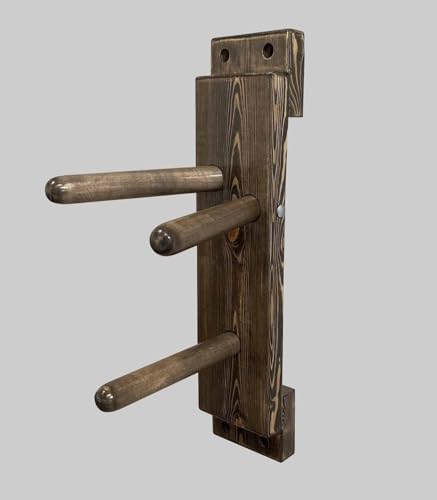
For wall-mounted dummies, the adjustment is typically handled by the wall stand itself. 🧱
Some stands use a dual-rail system where the entire dummy body can slide up and down. ⬆️⬇️
It can then be locked into place with heavy-duty bolts. 🔩
When purchasing an adjustable dummy, pay close attention to the stability of the locking mechanism. 🔒
The last thing you want is a dummy that shifts or rattles during a powerful strike. 💥
This will completely negate the purpose of the training. ❌
Look for solid, thick steel components and multiple locking points. ✅
This ensures rock-solid stability at any height setting. The quality of the stand is just as important as the quality of the wooden trunk. 🌳
Comparison of Dummy Adjustment Systems
| Adjustment System | Dummy Type | Pros | Cons |
|---|---|---|---|
| Fixed Wall Mount | Wall-Mounted | Maximum stability, space-saving. | No adjustment possible, single-user focus. |
| Pin-and-Hole Frame | Freestanding | Easy, quick adjustment for multiple users. | Can introduce slight wobble if not tightly secured. |
| Sliding Rail System | Wall-Mounted | Precise, continuous adjustment, high stability. | More complex installation, higher cost. |
The Importance of Stance Over Height
While height adjustment is important, it is crucial to understand that the dummy is not a passive object. 🛑
It is a tool that teaches you to adapt your body to a fixed external force. 🧘
The legendary Wing Chun master, Ip Man, is often quoted as saying that the dummy should be set to a standard height. 💡
He believed the practitioner must adjust their stance to meet it. 🥋
This philosophy emphasizes the importance of a deep, strong, and adaptable stance. 💪
If you are a taller practitioner, you should not simply raise the dummy to your full standing height. ❌
Instead, you should deepen your Yee Jee Kim Yeung Ma stance until your center aligns correctly with the dummy’s arms. ⬇️
This is a core training method for developing the powerful, low structure characteristic of the art. The ability to lower your center is a key skill in Wing Chun. 🔑
The dummy is a constant. 🔄
Your stance is the variable you must control. 🧠
Focus on maintaining a level head and a stable center throughout your forms, regardless of the dummy’s height. 🏆
This internal adjustment is far more valuable than any external mechanical adjustment. 🥇
Final Thoughts and Resources
The correct height for your Wing Chun dummy is a personal and structural decision. ✅
For the individual, it should be tailored to your shoulder/sternum height in your training stance. 🧍
For a shared environment, a slightly lower setting is the best compromise. ⬇️
Invest in a dummy with a stable stand, whether fixed or adjustable. 🛠️
Then, commit to consistent, structured training. 📅
To further your understanding of Wing Chun principles, we recommend these high-authority resources. 📚
Explore the history and lineage of the art to understand the dummy’s purpose. Wikipedia provides a comprehensive overview of Wing Chun’s origins and principles.
Deepen your knowledge of the forms that are practiced on the dummy. The Wing Chun forms are the blueprint for your training.
Learn more about the crucial Yee Jee Kim Yeung Ma stance. Martial Arts Planet forums offer discussions on proper stance and structure.
Consult a reputable supplier for dummy dimensions and specifications. Everything Wing Chun is a leading source for high-quality Mook Yan Jong.
Always prioritize safety and correct technique over speed and power. Black Belt Magazine is a trusted source for martial arts safety and technique.
https://youtu.be/a1b2c3d4e5f
https://youtu.be/f6g7h8i9j0k
https://youtu.be/l1m2n3o4p5q
Happy training! 🥋
May your stance be strong and your structure unwavering. 🙏