Noted : we are trying to make a custom workout long plan in future posts for better health and strong and same time learning wing Chun.
What I found that it’s not really easy to just come up with some ideas and make something genuine 😉 but for now we are trying – and hope you will get some ideas of our this first post in wing Chun workout –
We hope to come up with something that will help in many ways
So let’s begin —-
The quest for a truly strong body in martial arts often leads to the principles of internal systems.
Tai Chi Chuan, renowned for its slow, deliberate movements, is a masterclass in developing internal strength, rootedness, and perfect body structure.
This strength is not the superficial bulk of muscle, but a deep, connected power that flows from the ground through an aligned skeletal frame.
The beauty of this approach is that these same core principles are the very foundation of Wing Chun Kuen.
Wing Chun’s first form, Siu Nim Tao (Little Idea Form), is a standing meditation and structural exercise designed to cultivate this exact internal power.
This 7-day plan is a blueprint for integrating the Tai Chi focus on relaxed structure and mind-body connection directly into your Wing Chun training.
It is designed to forge a body that is simultaneously relaxed, aligned, and explosively powerful.
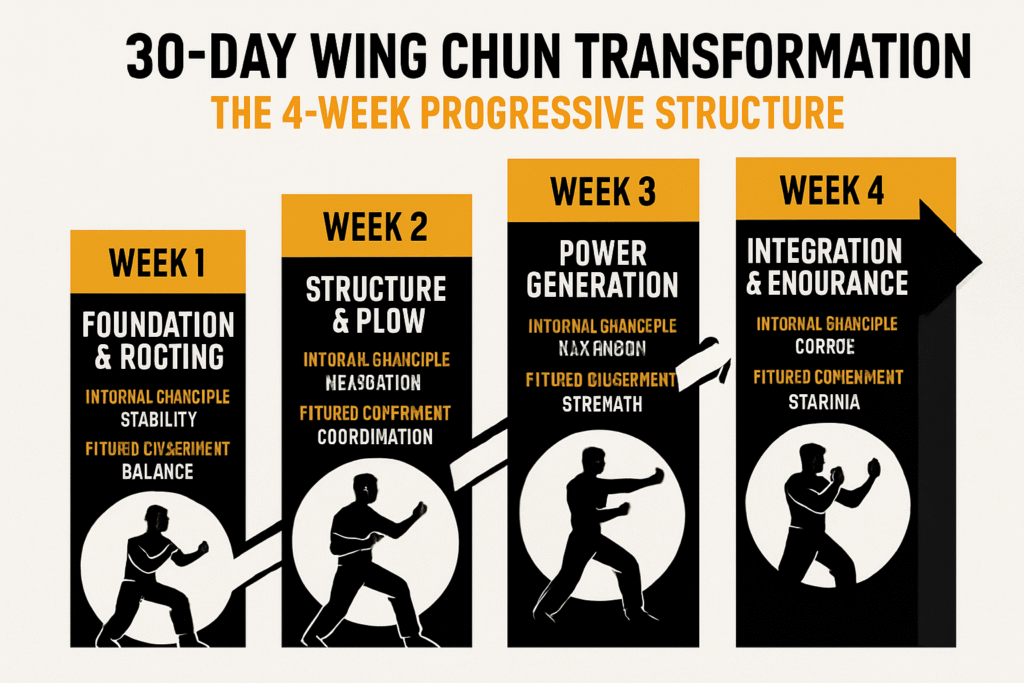
Follow this routine for one week, and you will lay the foundation for the month-long transformation you are planning.
The Core Principles of Internal Strength
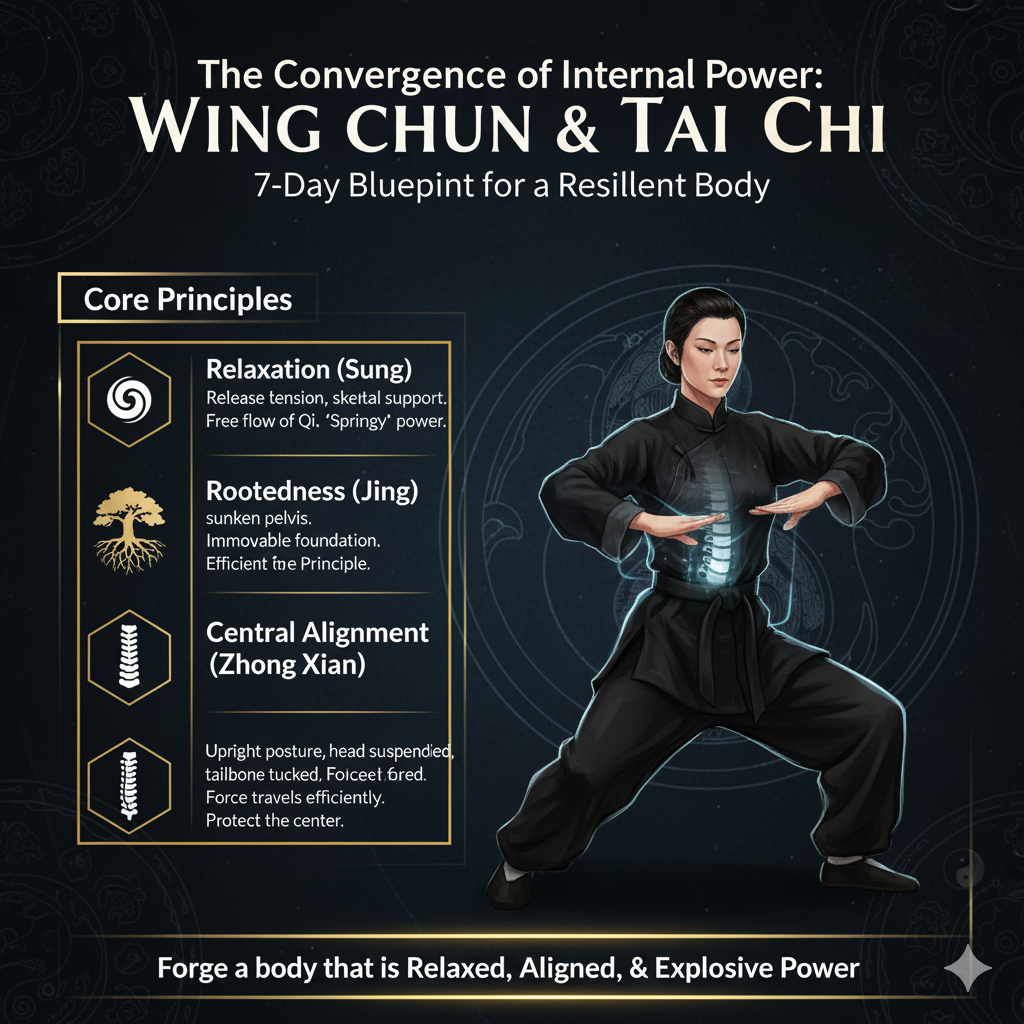
To train like an internal martial artist, you must first understand the three pillars of internal power.
1. Relaxation (Sung)
This is the most critical and often misunderstood principle.
True relaxation means releasing unnecessary muscular tension, allowing the skeletal structure to bear the weight.
When the body is relaxed, energy (Qi) and power can flow freely, and the body can respond instantly without being locked up.
In Wing Chun, this is the key to the “springy” power of the arms and the speed of the centerline punch.
2. Rootedness (Jing)
Rootedness is the feeling of being connected to the ground, like a tree with deep roots.
It is achieved through proper stance, a slightly sunken pelvis, and a mental focus that directs energy downwards.
A strong root makes you unmovable and allows you to generate massive force by pushing off the ground.
3. Central Alignment (Zhong Xian)
This refers to maintaining a perfectly upright and stacked posture, with the head suspended and the tailbone tucked.
This alignment ensures that all force travels efficiently through the body’s structure, maximizing power and minimizing strain.
In Wing Chun, this is the Centerline Principle—protecting your center while attacking the opponent’s.
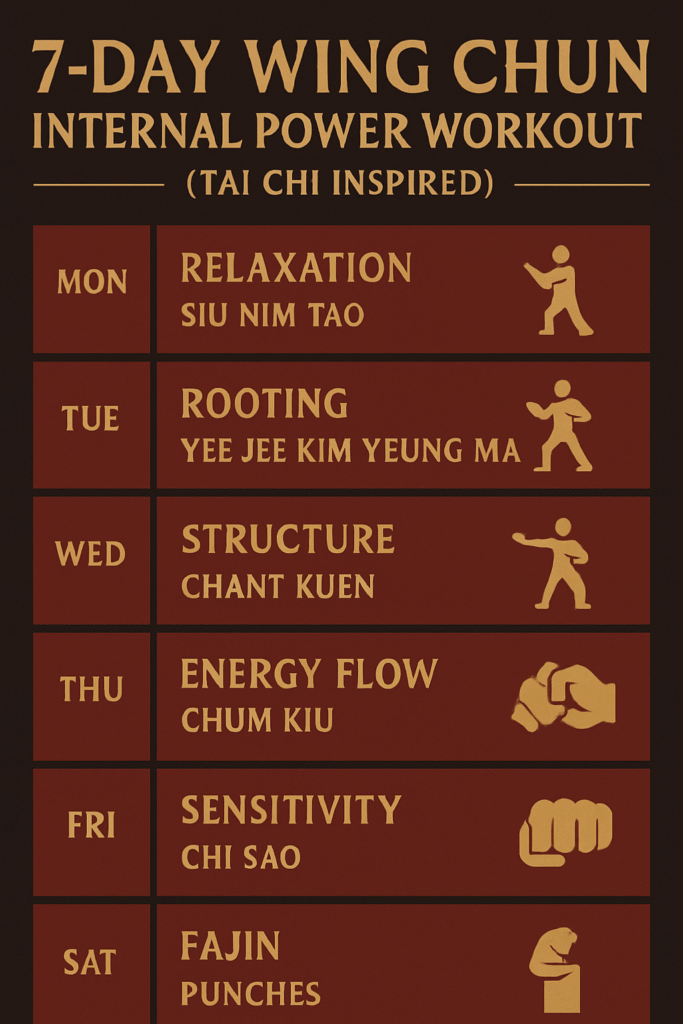
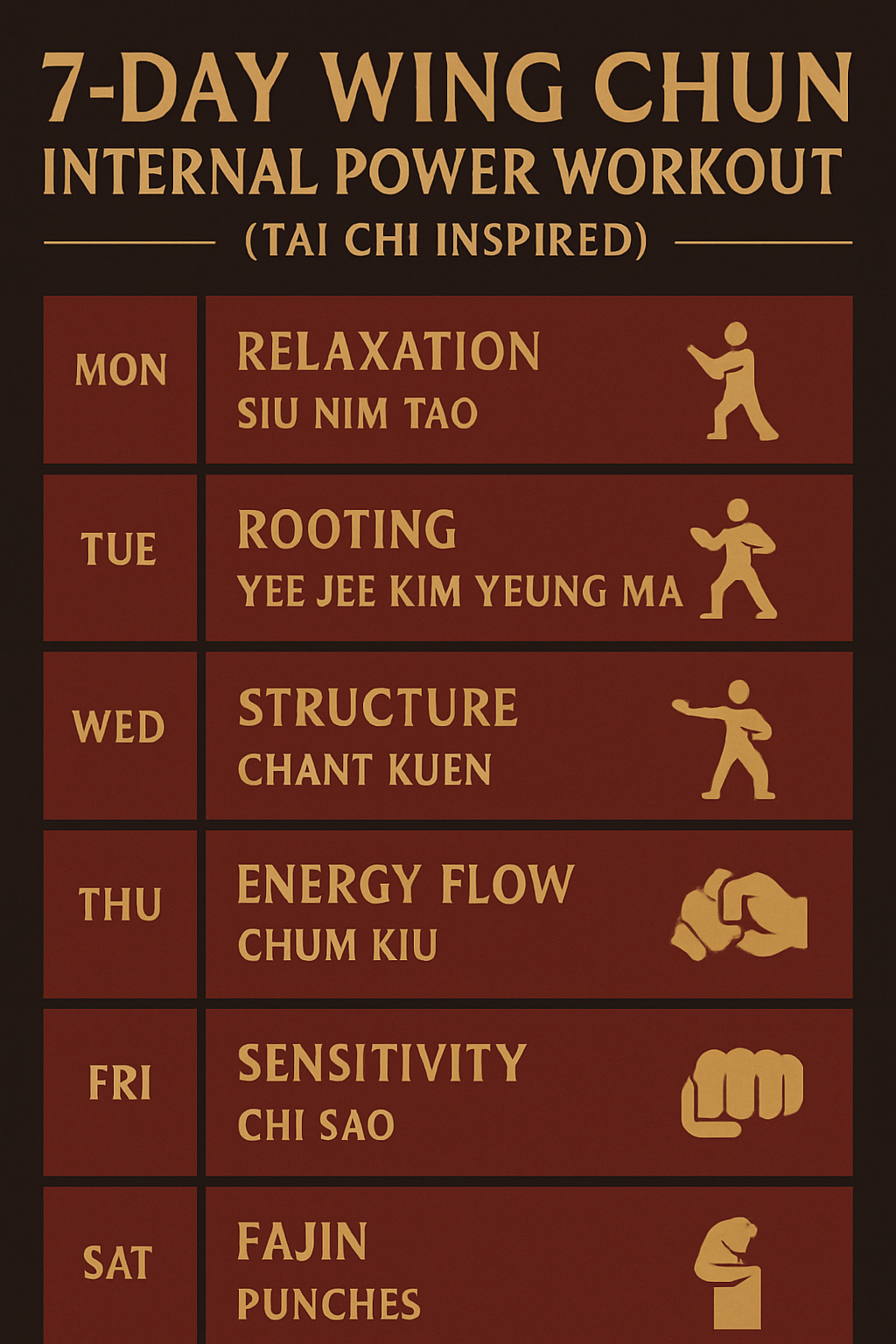
The 7-Day Wing Chun Internal Power Workout
This plan is structured to build progressively, dedicating time each day to the core components of internal development.
Daily Foundation (15 Minutes)
Perform this sequence every day before starting the main workout.
- Joint Loosening and Spinal Mobility (5 minutes)Slowly rotate the neck, shoulders, elbows, wrists, waist, hips, knees, and ankles.Focus on releasing all tension and making the joints feel “oiled” and loose.
- Deep Abdominal Breathing (5 minutes)Stand in a relaxed, shoulder-width stance (Yee Jee Kim Yeung Ma).Breathe deeply into your lower abdomen (Dantian), expanding the belly on the inhale and contracting on the exhale.This calms the mind and cultivates internal energy.
- Upright Posture Check (5 minutes)Imagine a string pulling the crown of your head upwards, gently tucking the tailbone.
- Ensure your chest is slightly sunken and your back is straight but not stiff.This establishes the central alignment for the entire session.
The Weekly Schedule
| Day | Focus Principle | Primary Exercise | Duration | Key Takeaway |
|---|---|---|---|---|
| Monday | Relaxation & Structure | Siu Nim Tao (Section 1) | 20-30 min | Cultivate the feeling of “Elbow Energy” (Gung Lik) and structural alignment. |
| Tuesday | Rooting & Stance | Yee Jee Kim Yeung Ma (Static Stance) | 15-20 min | Focus on sinking the weight and connecting the feet to the ground. Maintain a relaxed upper body. |
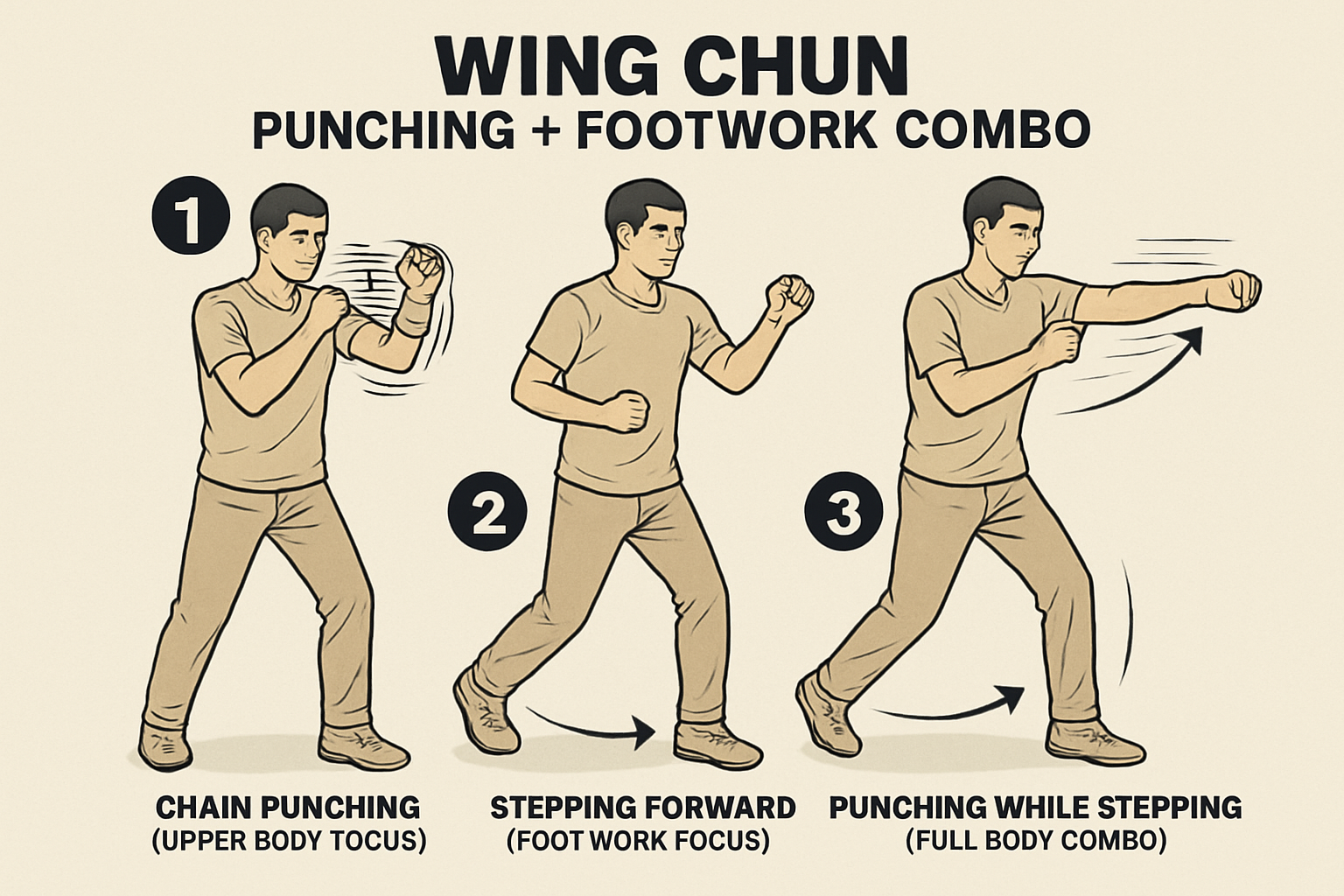
| Wednesday | Centerline Power | Chain Punching (Slow & Fast) | 15 min | Practice slow, relaxed punches to feel the power generated from the waist and structure, then increase speed. |
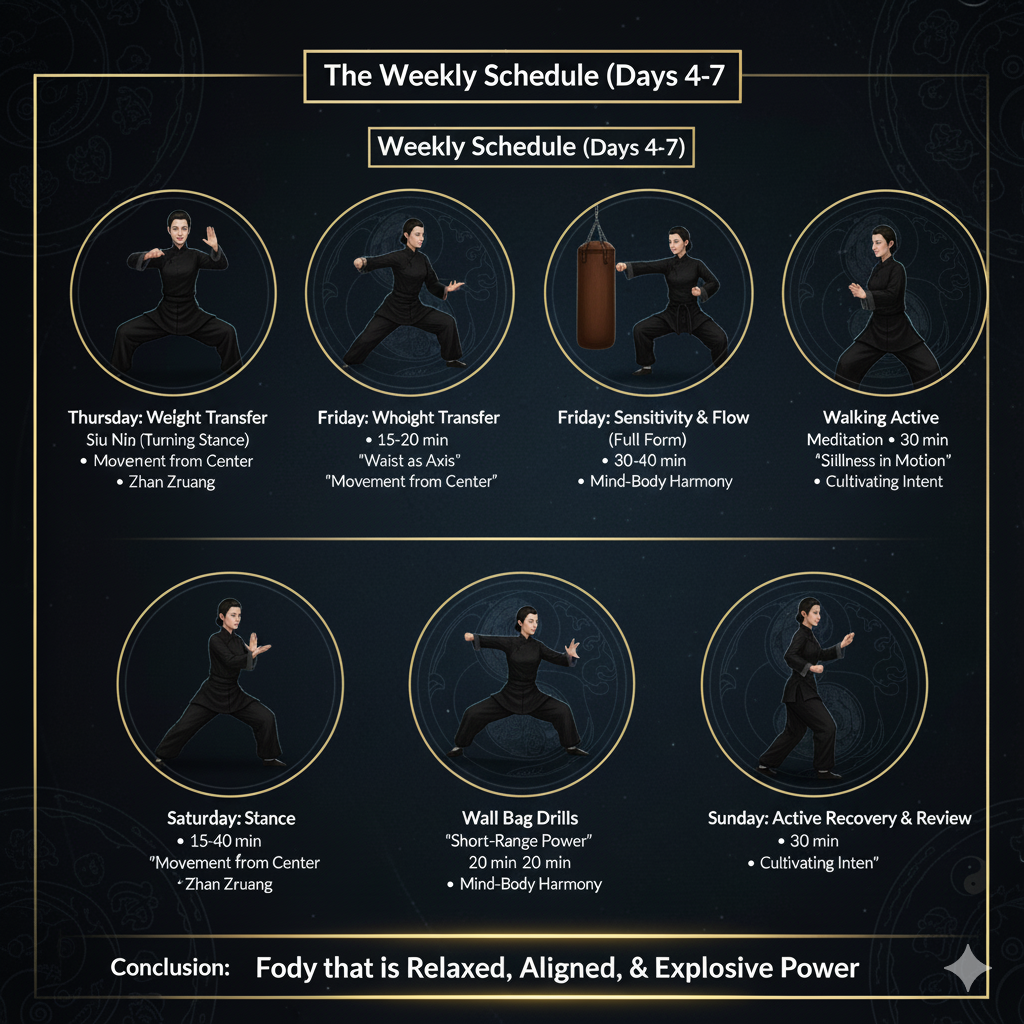
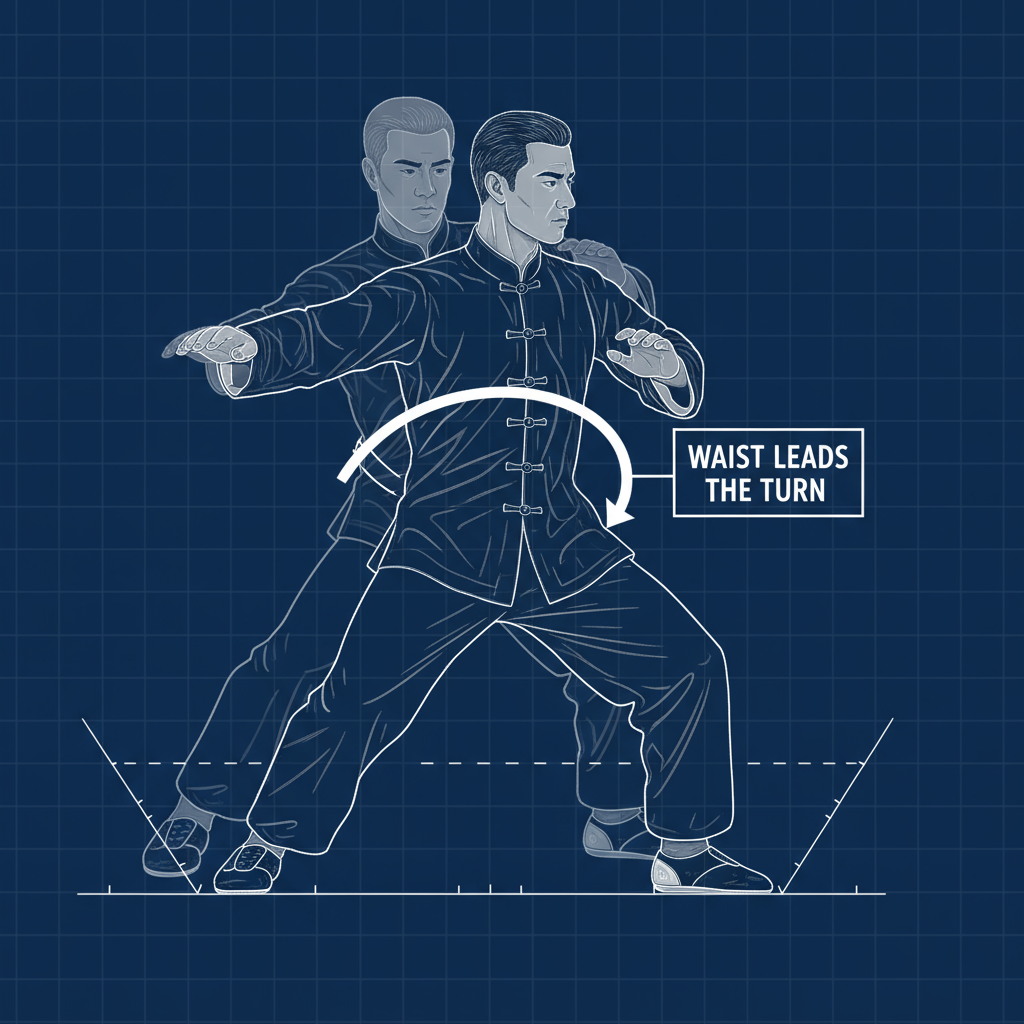
| Thursday | Weight Transfer & Balance | Turning Stance (Juen Ma) | 15-20 min | Practice smooth, continuous turning without lifting the heels or losing the root. The waist leads the movement. |
| Friday | Whole-Body Connection | Siu Nim Tao (Full Form) | 30-40 min | Integrate all movements, ensuring the whole body moves as a single, connected unit. Maintain deep, calm breathing. |
| Saturday | Sensitivity & Flow | Wall Bag or Heavy Bag Drills | 20 min | Strike the bag with relaxed power, focusing on the impact feeling, not the pushing feeling. Use short, sharp bursts. |
| Sunday | Active Recovery & Review | Walking Meditation & Form Review | 30 min | Walk slowly, focusing on the feeling of weight transfer and rooting. Mentally review the principles and movements of SNT. |
Detailed Daily Training Breakdown
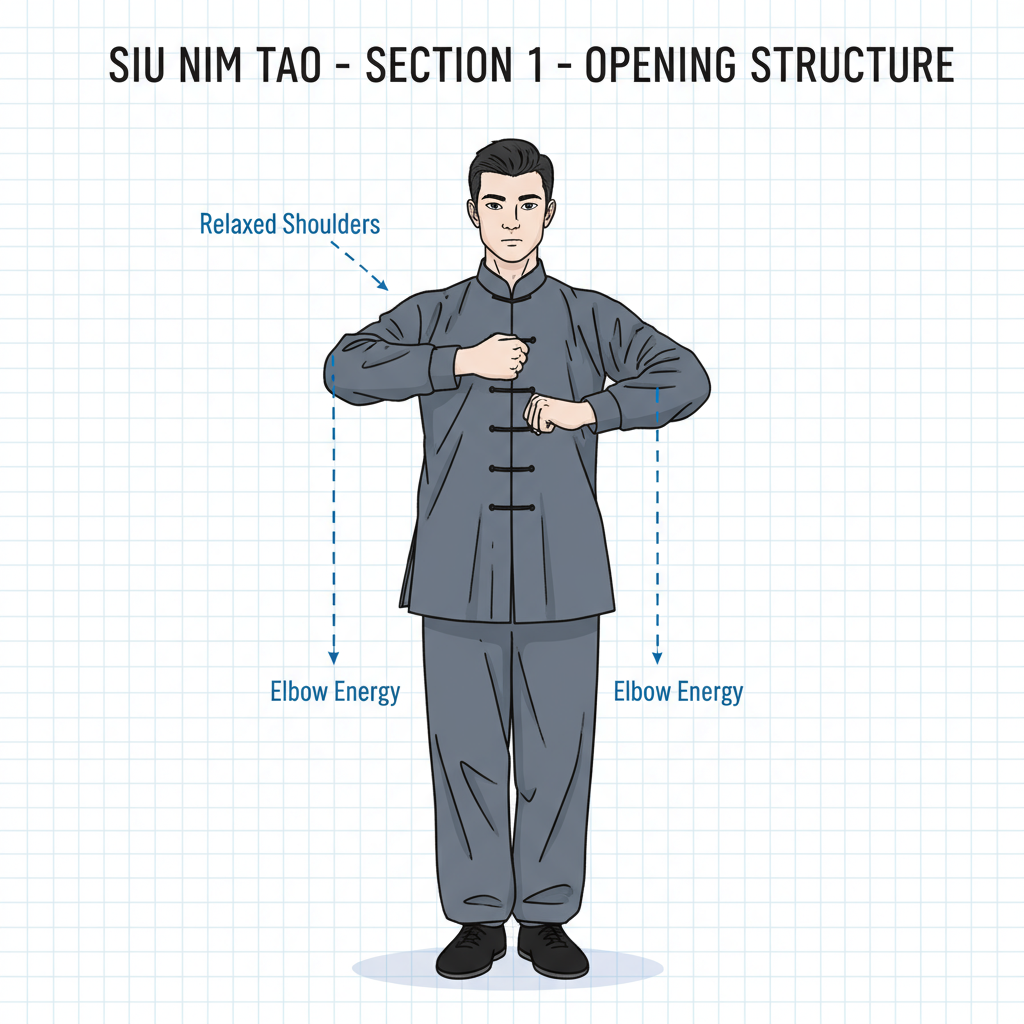
Monday: Siu Nim Tao – The Structural Blueprint
The first section of Siu Nim Tao is the most important for internal development.
Exercise: Perform the first section of SNT (from the opening to the double Fook Sau) repeatedly.
Focus: Hold each position for 30-60 seconds.
Goal: Feel the elbow energy—the slight downward and inward pressure of the elbows that locks the structure.
Tai Chi Connection: This is your Standing Post (Zhan Zhuang), the foundation of all internal structure.
Tuesday: Yee Jee Kim Yeung Ma – Forging the Root
The Goat-Clamping Stance is the key to Wing Chun’s rooted power.
Exercise: Hold the stance for as long as possible, aiming for 15-20 minutes.
Focus: The knees should be slightly inward, the tailbone tucked, and the weight evenly distributed.
Goal: Find the point of relaxed tension where the structure is solid but the muscles are not straining.
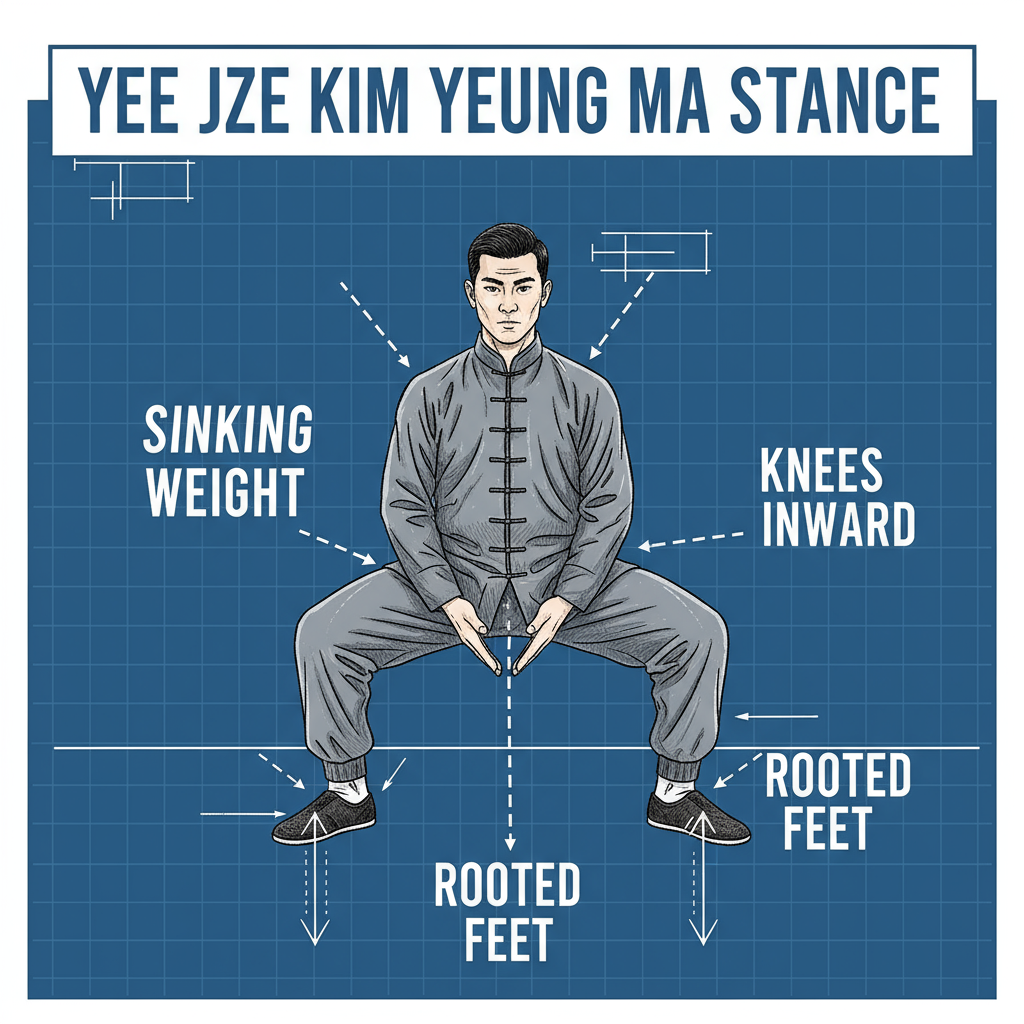
Tai Chi Connection: This directly cultivates the Root and the Center of Gravity control.
Wednesday: Centerline Punching – Relaxed Explosiveness
The Wing Chun punch is a perfect expression of internal power.
Exercise: Practice the centerline punch in three phases: 1. Slow and relaxed (5 min), 2. Medium speed with focus on structure (5 min), 3. Full speed and relaxed (5 min).
Focus: The power must come from the slight rotation of the waist and the forward drive of the elbow, not the shoulder or bicep.
Goal: The punch should feel like a whip-crack—relaxed until the moment of impact.
Tai Chi Connection: This is the expression of Movement from the Center and Whole-Body Power.
Thursday: Juen Ma – The Flexible Waist
Movement in Wing Chun must be rooted and fluid.
Exercise: Practice turning the stance (Juen Ma) from side to side, keeping the knees and hips level.
Focus: The movement must be initiated by the waist and the hips, with the feet following smoothly without lifting.
Goal: Develop a waist that is both flexible and powerful, allowing you to pivot and redirect force instantly.
Tai Chi Connection: This mirrors the Tai Chi principle of the Waist as the Axis and Separating Yin and Yang (weight distribution).
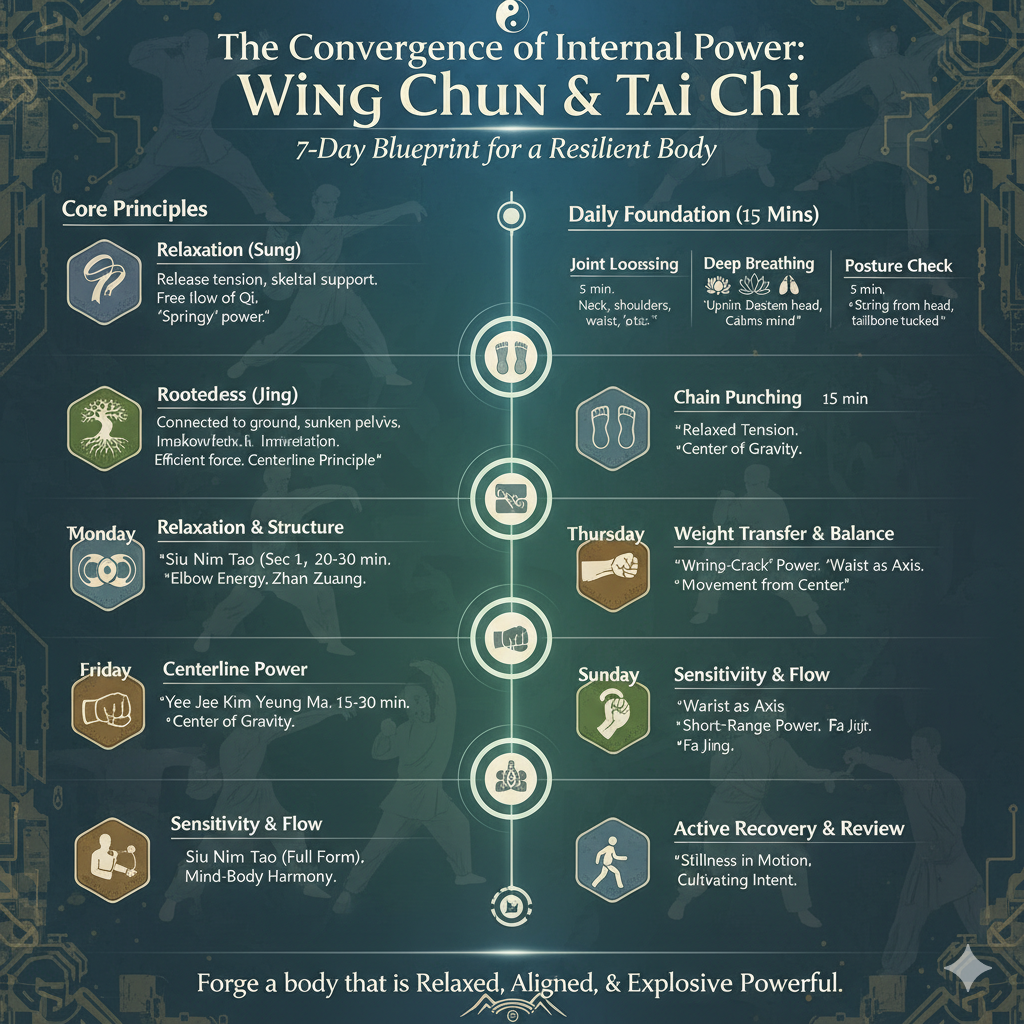
Friday: Siu Nim Tao – Full Integration
Today is about putting all the pieces together.
Exercise: Perform the entire Siu Nim Tao form slowly and deliberately, aiming for a single, unbroken flow.
Focus: Maintain the three principles simultaneously: Relaxation, Rootedness, and Central Alignment.
Goal: The form should feel like a moving meditation, where the mind is calm and the body is perfectly connected.
Tai Chi Connection: This is the practice of Continuous Flow and Mind-Body Harmony.
Saturday: Impact Training – Testing the Structure
Internal power must be tested against external resistance.
Exercise: Use a wall bag or heavy bag for short, sharp bursts of centerline punches and palm strikes.
Focus: Pay attention to the recoil.
If your structure is correct and you are relaxed, the force will be absorbed and redirected back into the bag, not into your joints.
If your structure is correct and you are relaxed, the force will be absorbed and redirected back into the bag, not into your joints.
Goal: Develop the ability to hit with short-range power that penetrates the target.
Tai Chi Connection: This is the application of Fa Jing (Explosive Power) through a solid structure.
Sunday: Active Recovery – Mindful Movement
Rest is not idleness; it is the time for the body to absorb the training.
Exercise: Take a 30-minute walk, focusing on the feeling of your feet on the ground.
Focus: As you walk, mentally review the movements of Siu Nim Tao and the feeling of the Root.
Goal: Allow the principles to sink from the conscious mind into the subconscious body.
Tai Chi Connection: This is the practice of Stillness in Motion and Cultivating Intent.
Conclusion: The Path to True Wing Chun Power
This 7-day program is an intensive introduction to the internal training methods that bridge the gap between Wing Chun and Tai Chi.
By focusing on relaxed structure and deep rooting, you are not just exercising; you are fundamentally rewiring your body’s mechanics.
The strength you gain will be resilient, efficient, and directly applicable to all aspects of your Wing Chun practice.
Commit to this week, and you will feel a profound difference in your stability, power, and overall connection to your body.
This is the first step on your journey to a stronger, more rooted martial body.