

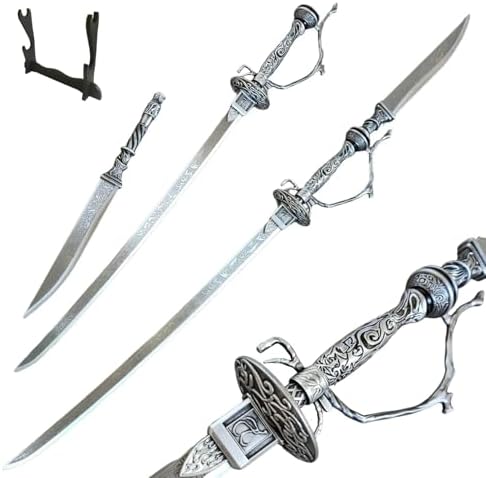
The Baat Jaam Do, or “Eight Cutting Knives,” is the final and most advanced form in the Wing Chun Kung Fu system. 🤓
It is a profound study in close-quarters combat, taking the core principles of the empty-hand forms and translating them into a devastating weapon application. ⚔️
Often romanticized in film, the true value of the Baat Jaam Do form lies not just in the swords themselves, but in the self-defense principles it instills in the practitioner. 💡
This breakdown will explore how the movements and philosophy of this iconic form are designed for practical, real-world self-defense. 🥋
It is a masterclass in timing, speed, and courage, meant to swiftly end a confrontation. 🎯
The Philosophy: An Extension of the Fists
The fundamental principle of the Baat Jaam Do is that the butterfly swords are simply an extension of the practitioner’s hands and fists. 🖐️
The form is built upon the foundation of the three empty-hand forms—Siu Nim Tao, Chum Kiu, and Biu Jee—and the Wooden Dummy techniques. 🔗
This means that every movement in the form is a direct application of a familiar Wing Chun principle, but with the added lethality of a blade. 🔪
The swords are short, designed for the same close-range fighting where Wing Chun excels, focusing on the immediate area around the body. 📏
The goal is to close the distance quickly and overwhelm the opponent with simultaneous attack and defense, a hallmark of the Wing Chun system. 💥
The form’s name, “Eight Cutting Knives,” refers to the eight primary cutting angles and methods used, which are executed with precision and economy of motion. 📐
As the final form, it is meant to unlock the practitioner’s full ability, integrating all previous lessons into a cohesive, weaponized whole. 🔑
Core Self-Defense Principles in the Form
The Baat Jaam Do form is a repository of advanced self-defense strategies, all centered on efficiency and control. 🧠
One of the most crucial lessons is the mastery of footwork, which is significantly emphasized in the form. 👣
The footwork is designed to facilitate rapid, precise turning and angling, allowing the practitioner to enter and exit the combat zone with minimal exposure. 🏃
This turning ability is considered the best for close-quarters fighting, enabling the practitioner to pivot around an attack and maintain the advantage of the centerline. 📍
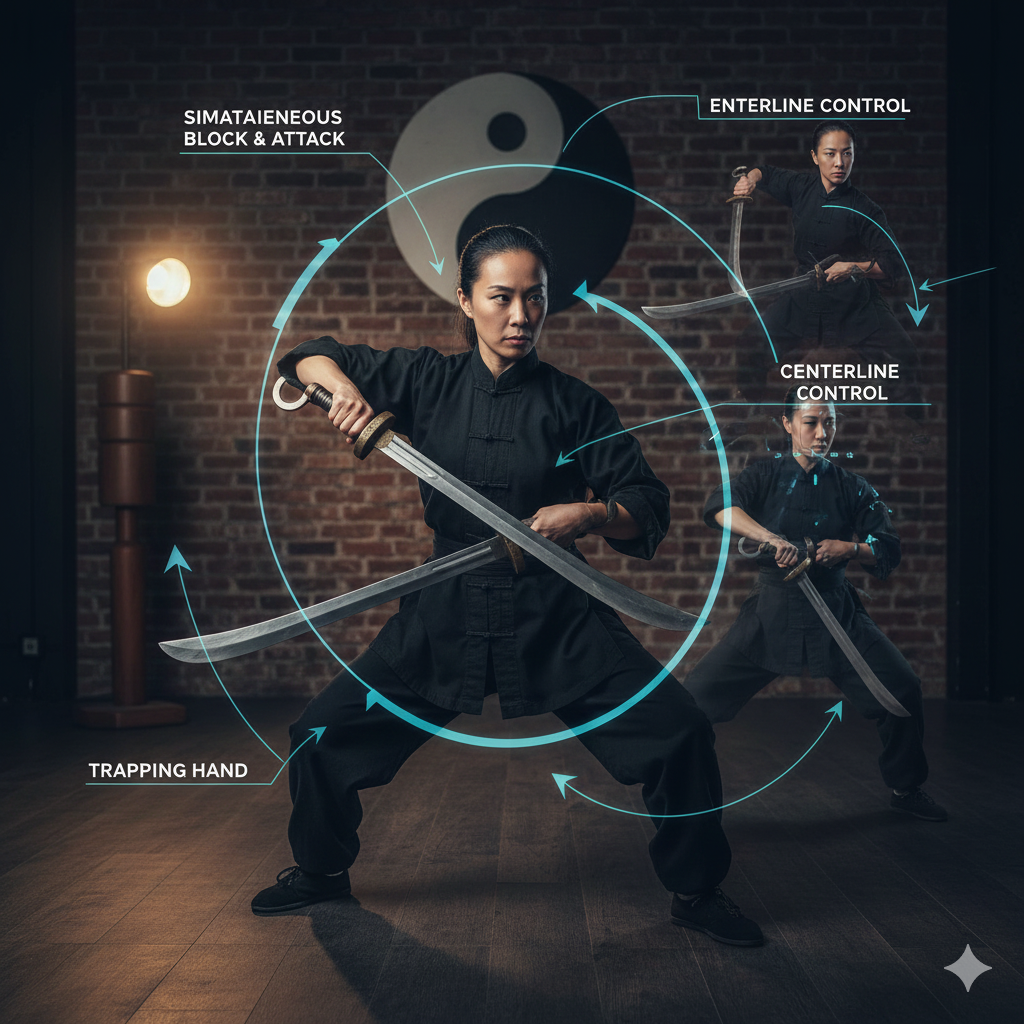
The swords’ large D-guards are used for trapping and blocking, effectively acting as a mobile shield and a secondary weapon for striking or hooking the opponent’s limbs or weapons. 🛡️
The form teaches the practitioner to use the two swords in a coordinated, simultaneous action, where one blade parries or traps while the other delivers a decisive cut. ☯️
This principle of simultaneous action is the core of Wing Chun’s self-defense effectiveness, ensuring that every defensive move is also an offensive one. 💯
Key Movements and Their Applications
The form is divided into sections, each focusing on a different aspect of combat, from long-range entry to grappling range. 🗺️
The initial movements focus on the entry, using the swords to clear the path and establish dominance over the opponent’s weapon or lead arm. ➡️
Techniques like *Cham Dao* (Cutting Knife) and *Pai Dao* (Slashing Knife) are practiced to develop the power and precision needed for devastating cuts. 💥
The form’s emphasis on the *Jing* (power) generated from the waist and structure ensures that even a short blade can deliver a powerful, fight-ending blow. 💪
The footwork movements, such as the *Jing Ma* (Advancing Step) and *Huen Ma* (Turning Step), are practiced to seamlessly integrate the body’s structure with the weapon’s movement. 🤸
The swords are also used to simulate trapping and controlling the opponent’s limbs, a direct carry-over from the empty-hand *Chi Sao* (Sticking Hands) drills. 🤝
This allows the practitioner to maintain contact and control the opponent’s structure, preventing them from generating power or escaping the close-quarters engagement. 🔒
The ultimate lesson is that the form is not just about cutting; it is about using the swords to create and exploit openings in the opponent’s defense. 🎯
The Self-Defense Takeaway: Principles Over Weapons
While most modern practitioners will never need to use butterfly swords in a real-life self-defense scenario, the form remains invaluable. 💎
The principles learned through the Baat Jaam Do are directly transferable to any object held in the hand, be it a stick, a bottle, or a tactical flashlight. 🔦
The form refines the practitioner’s understanding of distance, timing, and the importance of a strong, mobile structure. ⏱️
It teaches the student to be decisive and to act with a commitment that is necessary when a weapon is involved. 🦁
The focus on simultaneous attack and defense is a universal self-defense concept: never just block; always counter-attack immediately. ➡️
The form’s emphasis on close-range fighting reinforces the Wing Chun strategy of not backing away, but rather moving into the opponent’s space to neutralize their attack. 🛑
This is why the form is considered the pinnacle of the system; it forces the practitioner to execute the art’s most difficult concepts under the pressure of a weaponized context. 🤯
Baat Jaam Do: A Summary of Self-Defense Lessons
The table below summarizes the key self-defense lessons embedded within the Baat Jaam Do form. 📊
| Lesson | Principle Taught | Self-Defense Application |
|---|---|---|
| Simultaneous Action | One hand defends, the other attacks (or both do both) | Never block passively; always counter-attack immediately. |
| Footwork Mastery | Precise turning and angling (*Huen Ma*) | Rapidly pivot to avoid attacks and maintain a superior angle of attack. |
| Centerline Control | Using the D-guard and blades to dominate the central line | Control the opponent’s center to neutralize their power and structure. |
| Structural Power | Generating *Jing* (power) from the whole body structure | Ensure every strike, with or without a weapon, is backed by full body mass. |
| Decisiveness | The form is about swift, committed, fight-ending action | Act with courage and commitment to end the threat immediately. |
Conclusion: The Ultimate Wing Chun Lesson
The Baat Jaam Do form is far more than a sequence of movements with two short swords. 🌟
It is the ultimate expression of Wing Chun’s self-defense philosophy, distilled into a weaponized context. 🎯
By mastering the form, the practitioner refines their empty-hand skills, gaining a deeper understanding of distance, timing, and the power of simultaneous action. 💯
The swords are the teacher, but the lesson is about the body, the mind, and the spirit of the martial artist. 🧘
Whether you ever wield a butterfly sword or not, the principles of the Eight Cutting Knives will make you a more efficient, decisive, and formidable martial artist. 💪
Embrace the challenge of the form, and you will unlock the full potential of your Wing Chun training. 🔑
References and Resources
For further study on the Baat Jaam Do form and its applications, please consult the following resources. 📚
- Kwok Wing Chun – Wing Chun Knife Form – Bart Cham Dao: Wing Chun Knife Form – Bart Cham Dao
- Wing Chun Origins – The Baat Cham Dao: The Baat Cham Dao for Wing Chun
- Udemy – Wing Chun Butterfly Knife (Baat Jaam Do) sixth form: Wing Chun Butterfly Knife (Baat Jaam Do) sixth form
- Gary Lam Wing Chun – Double Knife Training: Double Knife Training
- London Wing Chun – The Eight Cutting Knives: Does it unlock your ability?: The Eight Cutting Knives: Does it unlock your ability?
We hope this detailed analysis inspires you to delve deeper into the art of the Eight Cutting Knives. 🙏
Remember, the weapon is only as good as the warrior who wields it. 🗡️