
The wooden dummy, or Mu Ren Zhuang, stands as a powerful and enduring symbol of Chinese martial arts, yet its interpretation and application vary dramatically across different styles. 🤓
While the Wing Chun Mook Yan Jong is globally recognized for its unique, multi-limbed structure, the training tools of Tai Chi Chuan (Taijiquan) reflect a profoundly different philosophical and technical approach. 💡
This exploration delves into the core distinctions between these two training methodologies, revealing how the choice of apparatus is a direct reflection of the art’s ultimate goal. 📌
The Wing Chun Dummy: A Tool for External Structure and Contact
The Wing Chun wooden dummy is a highly specialized piece of engineering, designed to cultivate the specific, practical, and structural principles of the Wing Chun system. 🥋
Its design is rooted in the concept of simultaneous attack and defense and the economy of motion, forcing the practitioner to adhere to the narrow, protected centerline. 🧐
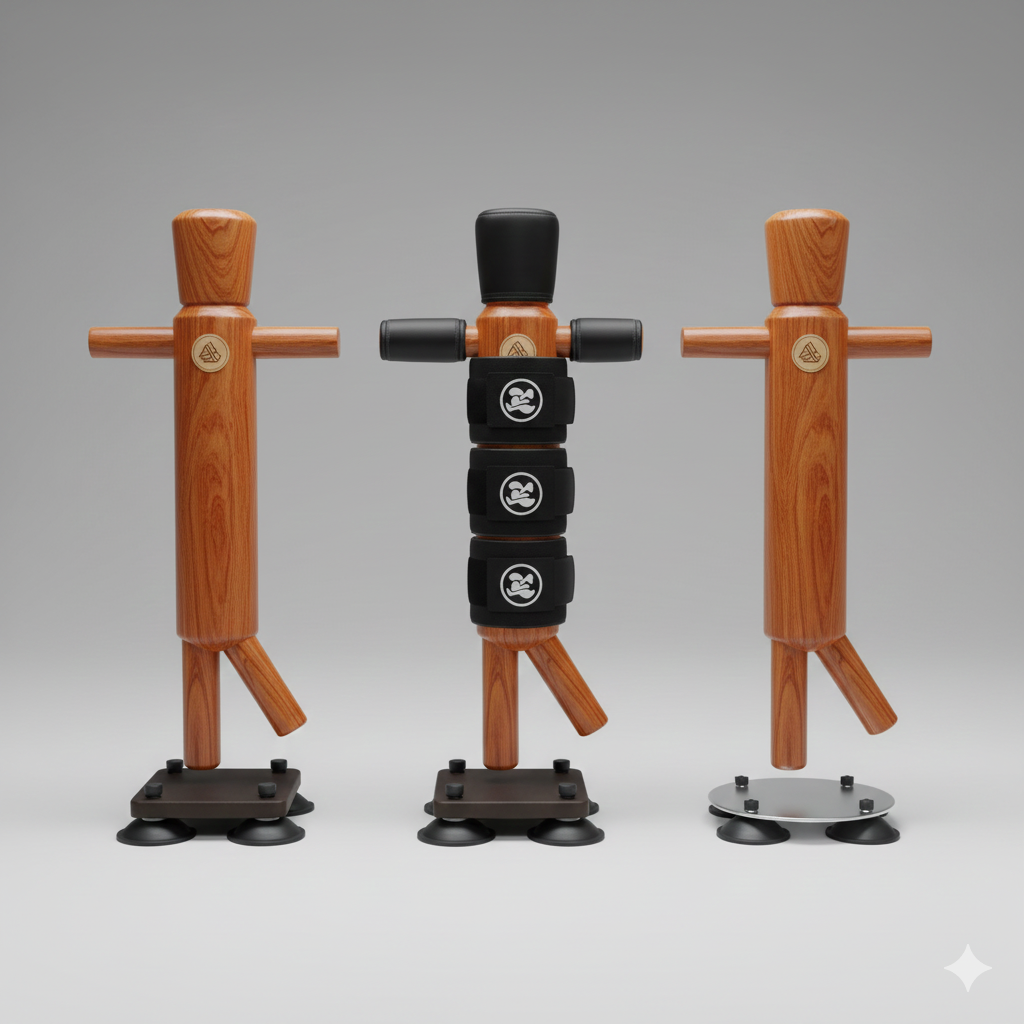
The three arms and one leg are positioned to represent an opponent’s limbs in various stages of attack and defense, requiring the practitioner to develop precise angles and footwork. [1]
Crucially, the modern dummy is often mounted on a spring-loaded frame, which provides a “live” feedback mechanism that simulates the recoil and energy of a human opponent. 💥
This springiness is essential for training the practitioner to absorb and redirect force without compromising their own structure, a skill known as contact reflex or chi sao (sticking hands). 🖐️
Philosophical Roots: Directness and Efficiency
The philosophy behind the Mook Yan Jong is one of directness and efficiency. ➡️
It is a tool of the External Arts (though Wing Chun is often considered a blend), focusing on the physical mechanics of structure, leverage, and bone conditioning. 🦴
The dummy is an unyielding object that demands a perfect, uncompromised structure from the practitioner; any flaw in angle or position is immediately and painfully exposed. 🤕
The training is about closing the gap and controlling the opponent’s limbs to create an opening for a decisive strike. 🎯
The dummy is the final step in solo training, where the principles of the hand forms are applied to a fixed, yet reactive, opponent before engaging in partner work. [2]
Tai Chi Training Apparatus: A Focus on Internal Energy and Flow
Tai Chi Chuan, by contrast, is a quintessential Internal Art, prioritizing the cultivation of internal energy (Qi), balance, and the philosophical principles of Yin and Yang. ☯️
The concept of a multi-limbed, fixed wooden dummy is largely absent from traditional Tai Chi training, as it is seen as counter-productive to the art’s core tenets. ❌
Instead of a complex dummy, Tai Chi utilizes simpler, more abstract tools that emphasize the development of internal power and yielding force. 🌊
The most common training apparatus is the Zhan Zhuang (Standing Post), which is often just a simple wooden pole or the act of standing in a fixed posture without any physical object. 🧘
The purpose of Zhan Zhuang is to develop rooting, alignment, and the flow of Qi through prolonged, static meditation in a martial stance. 🌳
Philosophical Roots: Yielding and Neutralization
The philosophy of Tai Chi training is one of yielding, neutralizing, and redirecting force. 🔄
The training is less about a direct, structural confrontation and more about sensing and manipulating the opponent’s energy. 👂
The primary method for developing this sensitivity is Tui Shou (Push Hands), a two-person drill that is the dynamic, human equivalent of the Wing Chun dummy. 🤝
In Push Hands, the practitioner learns to adhere to the opponent’s point of contact, sense their intention, and apply the Tai Chi principles of Peng, Lu, Ji, An (Ward Off, Rollback, Press, Push). [3]
The Tai Chi perspective is that a fixed dummy, even a spring-mounted one, cannot replicate the subtle, shifting, and yielding nature of a human opponent, which is essential for developing true internal skill. 🙅
The training is focused on softness overcoming hardness, a concept that is difficult to train against a rigid wooden post. The Tai Chi practitioner seeks to become the water, while the Wing Chun practitioner seeks to become the unmoving rock. 🌊⛰️
A Technical Comparison of Training Tools
The technical specifications of the two training methods highlight their divergent goals. 📋
The Wing Chun dummy is a complex, multi-functional tool, while the Tai Chi apparatus is simple, focusing on a single, deep principle. ⚖️
| Feature | Wing Chun Dummy (Mook Yan Jong) | Tai Chi Training Post (Zhan Zhuang/Simple Post) |
|---|---|---|
| Design | Three arms (30° angle), one leg, spring-mounted trunk. | Single, vertical post or no physical object (static posture). |
| Primary Training Goal | Developing structure, angles, footwork, and contact reflex. | Cultivating internal energy (Qi), rooting, and whole-body connection. |
| Feedback Mechanism | Physical recoil and resistance from the spring-mounted limbs. | Internal sensation, muscular fatigue, and subtle shifts in balance. |
| Simulated Opponent | A fixed, structurally sound opponent with limbs to be controlled. | The practitioner’s own internal blockages and lack of rooting. |
| Focus on Force | Direct, short-range, explosive force (Fa Jing). | Yielding, neutralizing, and redirecting force. |
The Philosophical Implications of Training Tools
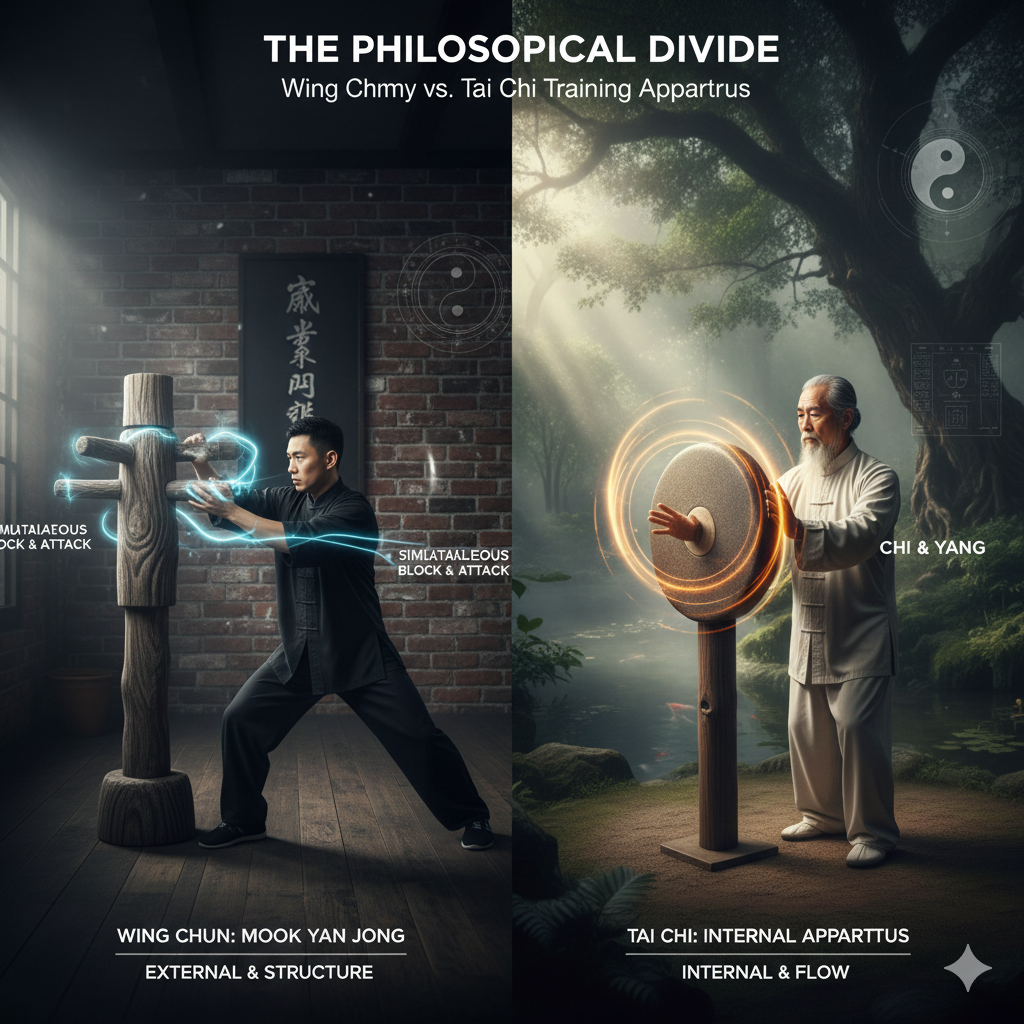
The difference between the Wing Chun and Tai Chi training tools is a microcosm of the larger philosophical debate between External and Internal martial arts. 🤯
The Wing Chun dummy is a tool of confrontation; it teaches the student to meet force with a superior, unyielding structure. ⚔️
It is designed to develop the ability to “stick” to an opponent and maintain control of the contact point, a skill that requires a high degree of physical and structural integrity. 🔗
The Tai Chi post, or the practice of Zhan Zhuang, is a tool of self-cultivation; it teaches the student to develop a deep, internal connection to the ground and to their own body’s energy. 🧘
The Tai Chi practitioner seeks to develop a body that is so rooted and internally connected that external force simply passes through or is easily neutralized. 💨
This is why a Tai Chi master might view the Wing Chun dummy as an unnecessary distraction, as it encourages a focus on the external mechanics of the limbs rather than the internal mechanics of the core. 🧠
Conversely, a Wing Chun practitioner might view Push Hands as too abstract, lacking the immediate, structural feedback necessary to develop the practical fighting skills needed for close-quarters combat. 💥
The truth is that both tools are highly effective within the context of their own art, and their differences are a testament to the rich diversity of Chinese martial philosophy. They represent two distinct paths to martial mastery. 🏆
The Evolution of the Wooden Dummy Concept
It is important to note that the concept of a wooden training post predates both modern Wing Chun and Tai Chi. 📜
Various Southern Chinese Kung Fu styles, such as Choy Lee Fut, have their own versions of the dummy, each with unique designs and purposes. [4]
For example, the Choy Lee Fut Ching Jong (Balanced Dummy) features a single top arm that moves up and down, anchored by a rope and weight, and two middle arms in a “V” shape. 📐
Another Choy Lee Fut dummy, the Sui Sau Jong (Breaking Hand Dummy), is designed with a swinging arm and a rotating “helicopter” arm to train quick reactions and counterattacks. 🚁
These variations demonstrate that the wooden dummy is a flexible concept, adapted by each style to reinforce its specific techniques and principles. 🛠️
The Wing Chun dummy, popularized by Grandmaster Ip Man, is simply the most refined and widely adopted version of this ancient training concept. 🌟
The Tai Chi approach, on the other hand, chose to focus its training on the dynamic, human element of Push Hands, rather than a fixed wooden apparatus. 🤝
This decision reflects the Tai Chi emphasis on sensitivity and yielding, which is best developed through constant, subtle interaction with a partner.
The Tai Chi practitioner’s “dummy” is often another person. 🧑🤝🧑
Bridging the Gap: Cross-Training Considerations
While the two tools are philosophically opposed, a martial artist can still benefit from understanding both approaches. 💡
A Wing Chun practitioner can gain deeper internal awareness by incorporating Zhan Zhuang, improving their rooting and Qi flow. 🌳
Conversely, a Tai Chi practitioner can use the Wing Chun dummy to test the structural integrity of their postures and to develop a more direct, short-range Fa Jing (explosive power). ⚡
The key is to use the tool to address the weaknesses in one’s own art, rather than trying to force one art’s techniques onto the other’s apparatus. 🔑
For example, a Tai Chi practitioner could use the dummy’s arms to practice neutralizing a direct, aggressive attack without losing their root, a skill that is often difficult to train safely in Push Hands. 🛡️
The dummy provides a constant, unmoving point of force, allowing the Tai Chi student to focus purely on the internal mechanics of yielding and redirection. 🔄
The philosophical divide is clear, but the practical benefits of cross-training are undeniable for the open-minded martial artist. 🌟
Further Resources for Deeper Understanding
To truly appreciate the depth of these two training methods, further study into their respective histories and philosophies is highly recommended. 📚
The following resources offer deeper insights into the dummy’s application and the philosophical underpinnings of both arts. 🌐
External Links:
- The Wikipedia entry on Mu ren zhuang provides a comprehensive overview of the dummy’s use in various Chinese martial arts, including its historical context.
- Kung Fu Tea’s article on the story of Ip Man’s Wooden Dummy details the evolution of the modern, spring-mounted design.
- Tai Chi Basics offers a general comparison of Tai Chi and Wing Chun, highlighting their different training focuses.
- Grandmaster Maurice’s site explores the similarities and differences between Wing Chun and Tai Chi training methods.
- Martial Talk discusses the importance of knowing how to practice with the Mook Yan Jong before purchasing one.
Video Resources:
An in-depth clarification on the Wooden Dummy by world-renowned Sifus, providing technical and philosophical context. 🗣️
Simple drills for footwork and position on the wooden dummy, demonstrating the structural focus of Wing Chun training. 👣
A look at Wing Chun Wooden Dummy training techniques, which can be contrasted with the yielding movements of Tai Chi. 🥋
The choice between the Wing Chun dummy and the Tai Chi training post is a choice between two martial philosophies: direct, structural confrontation versus internal, yielding mastery. 🏆
Understanding this difference is the first step toward mastering either art. Embrace the philosophy of your chosen path, and the tools will serve you well. 🌟
Happy training! 🤓
[1] The three arms and one leg configuration is the standard for the Wing Chun Mook Yan Jong, representing the opponent’s limbs.
[2] The dummy form is considered the highest level of solo training in Wing Chun, applying the principles of the three hand forms.
[3] Peng, Lu, Ji, An are the four primary energies or techniques in Tai Chi Push Hands, representing the core principles of the art.
[4] Choy Lee Fut’s various dummies, such as the Ching Jong and Sui Sau Jong, demonstrate the flexibility of the wooden post concept across different Southern Chinese styles.
[5] The philosophical difference between External (Wing Chun) and Internal (Tai Chi) arts is a long-standing tradition in Chinese martial arts, reflected in their training methods.