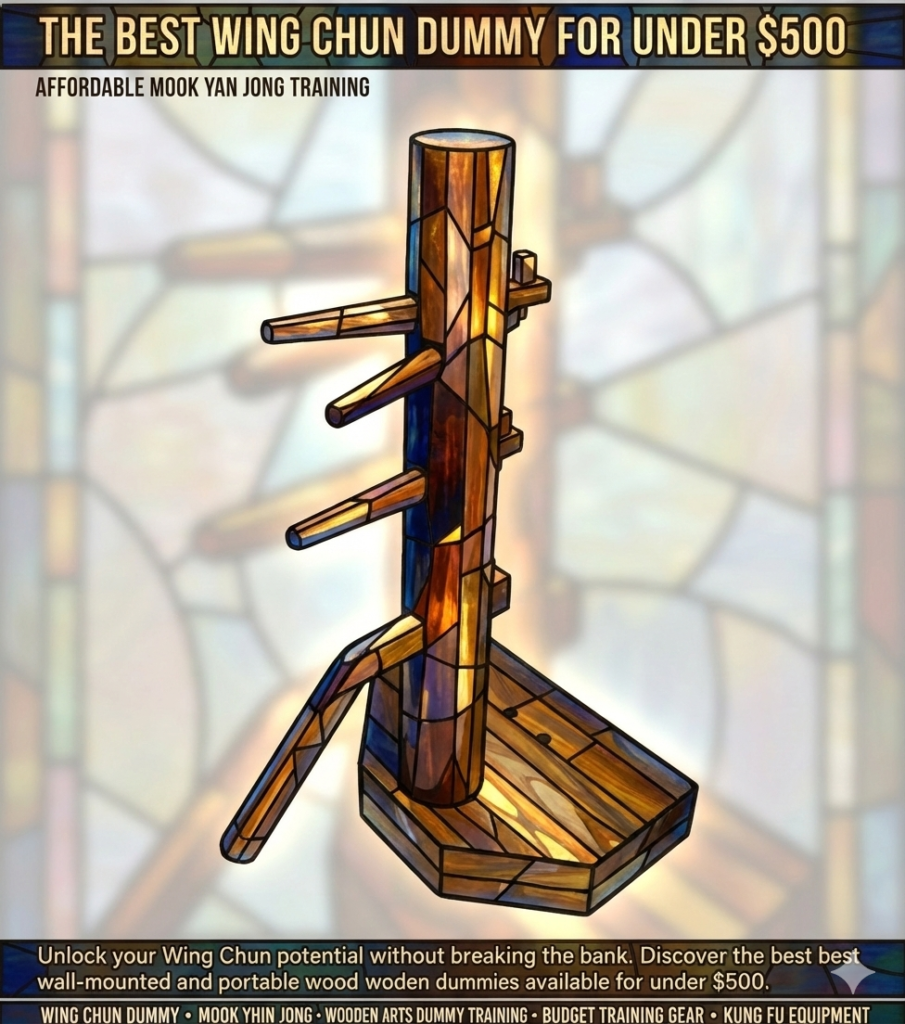
The Wing Chun wooden dummy, or Mook Yan Jong (literally “Wooden Man Post”), is more than just a training tool; it is a silent partner and a critical component of the Wing Chun system. 🤓
Its design is meticulously engineered to simulate the structure and angles of a human opponent, forcing the practitioner to adhere to the core principles of the art. 💡
The effectiveness of your training hinges entirely on the dummy’s setup, particularly the precise arm angles and proper alignment of its limbs. 📌
The Critical Geometry of the Mook Yan Jong
The standard Wing Chun dummy features three arms and one leg, each positioned with a specific purpose derived from the martial art’s combat theory. 🥋
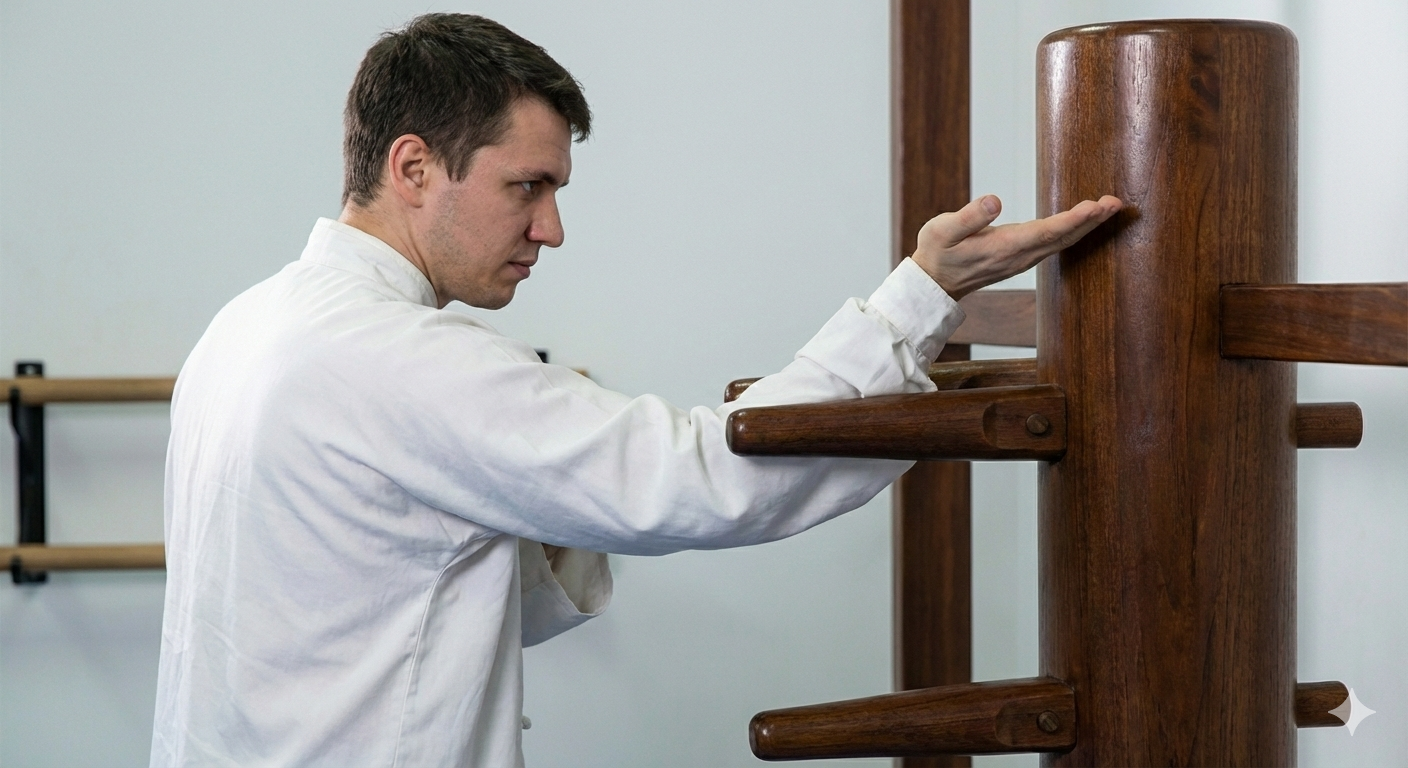
The two upper arms and the single middle arm are the primary focus for hand techniques, representing the opponent’s arms and torso. 🧐
The lower leg simulates the opponent’s lead leg, providing a target for footwork and low-line attacks. 🦵
The Essential 30-Degree Arm Angle
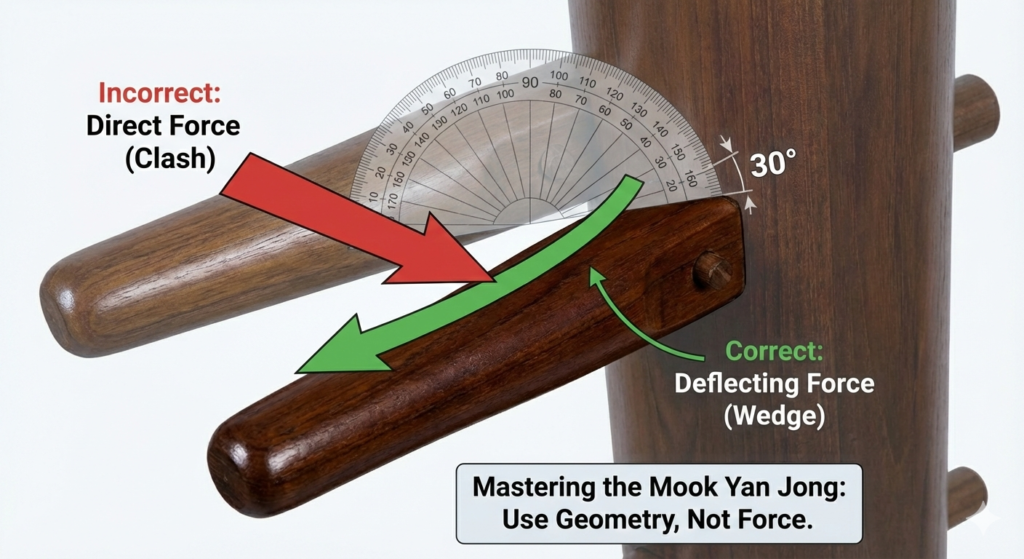
The most crucial specification for the upper arms is their angle relative to the dummy’s central post. 📐
Each of the two upper arms is angled outwards at approximately 15 degrees from the center line, resulting in a total angle of 30 degrees between the two arm tips. [1]
This angle is not arbitrary; it is a direct reflection of the ideal defensive and offensive structure in Wing Chun. 🛡️
When the practitioner faces the dummy, this 30-degree spread forces them to maintain a narrow, central-line-focused stance and structure. 🎯
It ensures that all techniques, such as the Tan Sau (Dispersing Hand) and Bong Sau (Wing Arm), are executed with the correct inward energy and angle of deflection. 💥
The Significance of Arm Offset
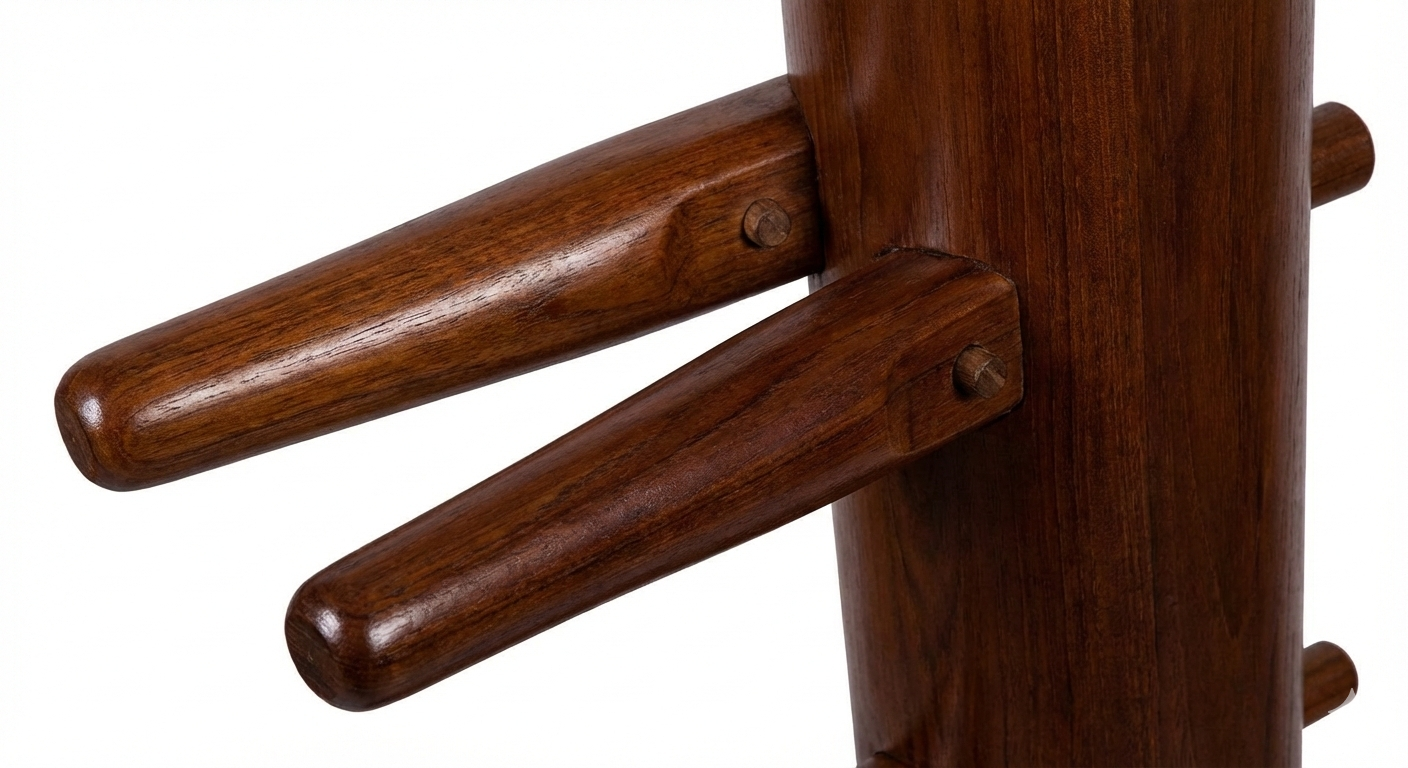
The arms are also typically offset, meaning the tenon (the part that goes into the dummy) is not perfectly centered on the arm. 🔄
This offset allows the arms to be inserted in two ways: with the tips level, or with one arm slightly higher than the other. ⬆️⬇️
The traditional setup often has the left arm slightly higher, which is believed to represent the natural asymmetry of a fighting opponent. [2]
The space between the tips of the two upper arms is generally around 8.5 inches, which corresponds to the width of a human shoulder structure. [3]
Proper Alignment: Height and Spacing
Beyond the angles, the vertical alignment of the arms and leg is paramount for developing correct body mechanics and footwork. 👣
The height of the dummy must be calibrated to the individual practitioner’s body. 📏
A common guideline is that the top two arms should be level with the practitioner’s collarbone or mid-chest. [4]
This alignment ensures that the practitioner trains their techniques at the correct height for striking and controlling an opponent’s upper gate. 🚪
Vertical Spacing and Training Focus
The vertical distance between the arms and the leg dictates the focus of the training drill. 🎯
The space between the upper arms and the middle arm is typically about 8.5 inches, while the space between the middle arm and the leg is wider, around 11 inches. [3]
This spacing is designed to train the practitioner to transition smoothly between high, middle, and low-line attacks and defenses. 🌊
The middle arm is often set straight out, representing a central attack or a barrier that must be overcome with a direct, forward-moving force. ➡️
The Impact of Incorrect Setup
Training on a dummy with incorrect arm angles or poor alignment can be detrimental to a student’s progress. ⚠️
If the angle is too wide, the practitioner will develop a flawed, wide-reaching structure that is easily exploited in a real confrontation. ❌
If the height is too low, the student will habitually drop their elbows and shoulders, compromising their central line defense. 📉

The dummy is a tool for precision, and its setup must reflect the absolute necessity of maintaining a correct, compact, and powerful structure. 💪
Key Specifications for the Mook Yan Jong
To summarize the critical dimensions, the following table outlines the essential specifications for a standard Wing Chun wooden dummy. 📋
| Component | Specification | Purpose in Training |
|---|---|---|
| Upper Arm Angle (Total) | 30 degrees (15 degrees from center) | Forces central line structure and narrow stance. |
| Upper Arm Tip Spacing | ~8.5 inches | Simulates opponent’s shoulder width. |
| Upper Arm Height | Collarbone/Mid-chest level of practitioner | Ensures correct striking and controlling height. |
| Middle Arm to Leg Spacing | ~11 inches | Trains smooth transition to low-line techniques. |
Integrating Dummy Training into Your Practice
The wooden dummy form, traditionally consisting of 116 movements, is the culmination of the open-hand forms: Siu Lim Tao, Chum Kiu, and Biu Jee. [5]
It is the final stage of solo training, where the principles learned in the forms are applied to a solid, unmoving object that provides resistance. 🧱
Focusing on the angles and alignment is not just about hitting the wood; it is about developing tactile sensitivity and energy transfer. ⚡
The spring-like action of the arms, when struck correctly, provides immediate feedback on the quality of your structure and force. 👂
Drills Focused on Arm Angles
To specifically train the correct arm angles, focus on drills that emphasize the inward and downward energy of your blocks and strikes. ⬇️
The goal is to occupy the space between the dummy’s arms, effectively “controlling the gate” of the opponent. 🔑
Here are some key areas to focus on during your practice: 📝
- Centerline Control: Always aim your strikes and blocks towards the center of the dummy’s trunk, which is the opponent’s vital area.
- Elbow Energy: Ensure your elbows are always pointing down and in, maintaining the triangular structure that gives Wing Chun its power.
- Simultaneous Attack and Defense: Use the dummy’s arms to practice simultaneous blocking and striking, a hallmark of the Wing Chun system.
- Footwork Integration: The leg of the dummy is there to force you to use correct stepping and turning, integrating your whole body into the technique.
Remember, the dummy does not move, but it teaches you how to move correctly against an opponent who does. 🚶
Further Resources for Mastery
For those seeking to deepen their understanding of the Mook Yan Jong, exploring the history and application of the form is highly recommended. 📚
The principles of the dummy are universal to Wing Chun, and studying them will enhance every aspect of your practice. 🌟
Here are some resources that can provide further insight into the form and its technical details: 🌐
External Links:
- The Wikipedia entry on Mu ren zhuang (Wooden Dummy) provides a good historical and technical overview.
- Sifu Gary Lam’s insights on Wooden Man Training emphasize the importance of facing the dummy squarely.
- Kwok Wing Chun’s page details the 116-movement form as taught by Grandmaster Ip Man.
- The Art of Mook Yan Jong offers a unique perspective on one-arm and two-arm drills.
- West Coast Wing Chun provides a brief history of the dummy according to Ip Ching and Ip Chun.
Video Resources:
This video offers simple drills for footwork and position, which are essential for correct alignment. 🦶
An explanation of the arm setup and their purpose in guiding hand techniques. 🖐️
A guide on the correct height for the Wing Chun dummy, a key aspect of proper alignment. ⬆️
By respecting the precise geometry of the Mook Yan Jong, you transform a piece of wood into a dynamic training partner that will refine your Wing Chun to a level of true mastery. 🏆
Keep practicing with focus, precision, and dedication, and the secrets of the dummy will be revealed to you. 🌟
Happy training! 🤓
[1] The 30-degree angle is a widely accepted standard in Wing Chun dummy construction, as noted in various blueprints and construction guides.
[2] The offset arm is a feature of many modern dummies, allowing for the simulation of an opponent’s natural fighting stance.
[3] Specifications for the dummy’s dimensions, including the 8.5″ and 11″ spacing, are based on common industry standards for Wing Chun equipment manufacturers.
[4] The height alignment to the collarbone or mid-chest is a common teaching point to ensure proper structure and centerline engagement.
[5] The 116-movement form is the standard curriculum for the wooden dummy in the Ip Man lineage of Wing Chun.