The Mook Yan Jong: Your Indispensable Silent Training Partner
The Wing Chun Wooden Dummy, or Mook Yan Jong (literally “Wooden Man Post”), is perhaps the most recognizable symbol of the art, second only to the legend of Ip Man himself. It is a unique and sophisticated training tool that serves as a tireless, uncomplaining stand-in for a human opponent. However, to view the dummy as a mere punching bag is to fundamentally misunderstand its purpose. Training on the dummy is not about hitting a static object; it is a dynamic practice focused on developing precise angles, flawless structural alignment, powerful short-range striking, and continuous, flowing transitions between techniques. The dummy’s specific design, with its three arms and one leg, is a brilliant piece of martial engineering, mimicking the limbs of a person in a fighting stance and forcing the practitioner to move with absolute correctness.
Mastering the dummy form is considered the pinnacle of the Wing Chun empty-hand curriculum. It is the final and most crucial step in translating the abstract principles of the hand forms (Siu Lim Tao, Chum Kiu, and Biu Jee) into practical, physical application. The dummy provides a non-yielding partner that instantly exposes flaws in your technique and structure. If your angle is wrong, you will jam your own arm. If your structure is weak, the dummy’s “resistance” will throw you off balance. This guide will take you on a deep dive into the world of the Mook Yan Jong, exploring its history, design philosophy, training methodology, and its irreplaceable role in forging a Wing Chun practitioner.
History and Design of the Wooden Dummy
The exact origins of the dummy are shrouded in martial arts lore, but it is widely believed to have been developed in the Southern Shaolin Temple as a tool for monks to train martial techniques without harming one another. Legend states there were 108 different dummies, each designed to teach a specific technique, and a student had to pass through them all to graduate. The Wing Chun dummy is said to be a consolidation of these concepts into a single, efficient training apparatus, refined by the art’s founder, the nun Ng Mui.
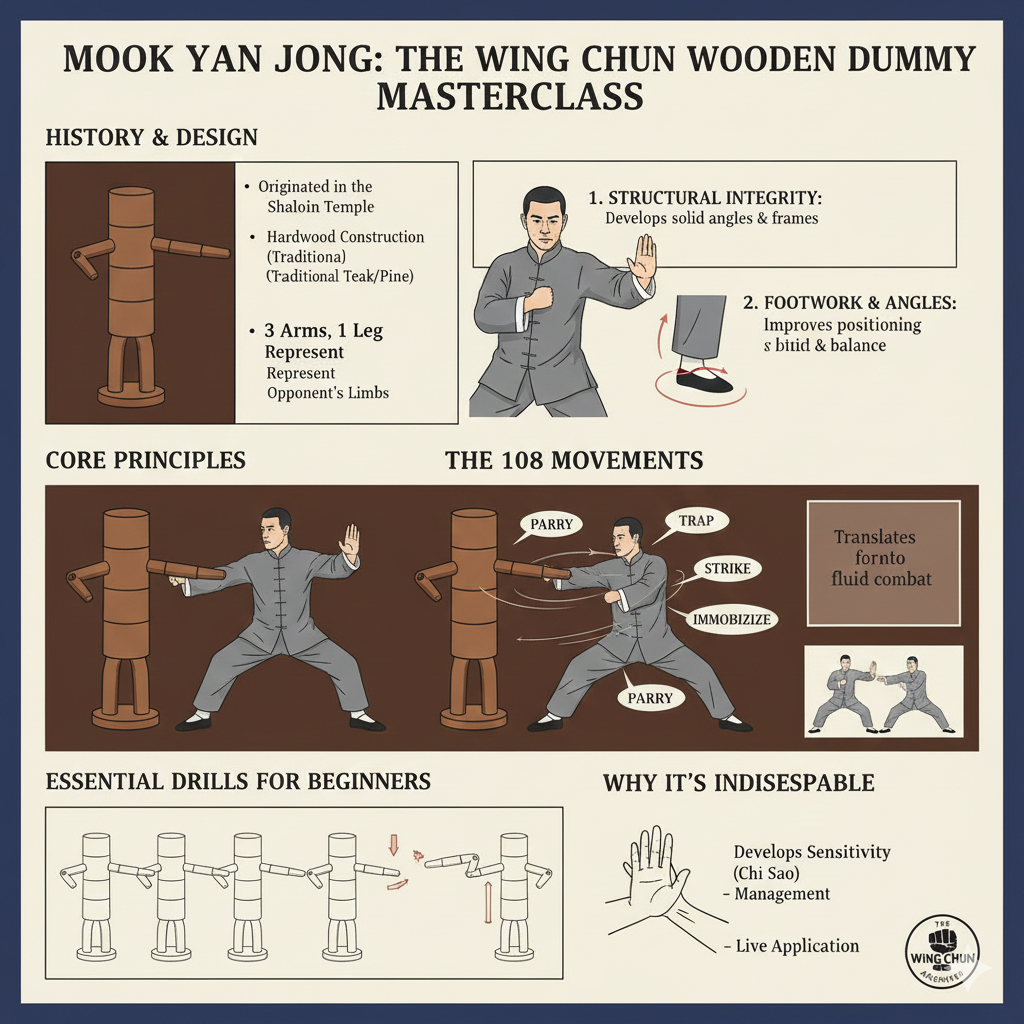
The modern design, popularized by Grandmaster Ip Man, typically consists of a cylindrical trunk made of a hard, dense wood, mounted on a frame. The key components are:
- The Trunk (Jong身): Represents the opponent’s body. Its cylindrical shape teaches the practitioner to work around a surface rather than just hitting it flatly.
- The Three Arms (Jong Sau): The two upper arms are on the same level, representing high attacks or the opponent’s shoulders and arms. The single middle arm represents a low punch or an obstacle to the practitioner’s centerline. The spacing and angles of these arms are meticulously calculated to represent the ideal striking and trapping zones of a human opponent.
- The Leg (Jong Gerk): A single, bent leg that forces the practitioner to use proper footwork, practice leg destructions, and develop sweeps and trapping techniques without over-committing their balance.
- The Mounting System: Crucially, the dummy is not rigid. It is traditionally mounted on two wooden slats that pass through the back, allowing for a slight spring or give. This provides essential kinetic feedback to the practitioner. This feedback is vital for developing the “listening energy” (Ting Ging) of Chi Sao, teaching you to feel the force and react to it, even from an inanimate object. The wooden construction ensures that poor technique—hitting with the wrong part of the arm or having a collapsed structure—is immediately penalized with jarring, painful feedback.
The Purpose of Wooden Dummy Training: Beyond Conditioning
A common misconception is that the dummy is primarily for conditioning the arms. While it does condition the forearms, shins, and hands, this is a secondary benefit, not the main purpose. The dummy serves several critical functions that cannot be replicated by solo forms or even partner drills alone.
It is the bridge between the theoretical movements of the empty-hand forms and their practical, forceful application. The 108 movements of the dummy form are a pre-arranged sequence of attacks, defenses, and counter-attacks that teach the practitioner how to apply their techniques against a resisting, structured opponent. The training develops “iron bones and silk sinews”—a body that is structurally powerful yet relaxed and flowing. It also refines the Wing Chun footwork, forcing the practitioner to use side-stepping (Seung Ma) and turning (Yiu Ma) to constantly maintain the correct angle and distance relative to the “opponent.”
The primary purpose is not to build brute strength, but to perfect the *application* of Wing Chun principles under pressure. It teaches the practitioner to enter, control, and exit the opponent’s space with maximum efficiency and safety. It is a tool for programming the body’s reflexes.
Key Benefits of Consistent Dummy Work
- Structural Alignment and Rooting: The dummy instantly exposes flaws in your stance and body structure. It demands that you use your whole body, rooted from the ground up, to absorb and issue force, not just your arms.
- Correct Angles and Positioning: The dummy is a geometric teacher. It forces you to learn the precise angles needed to deflect and attack simultaneously, ensuring your techniques are always directed at the centerline while keeping you safe.
- Footwork and Distance Management: You cannot be lazy with your feet on the dummy. It forces you to move constantly to maintain the optimal distance and angle, preventing you from becoming a static target and teaching you to “chase” the opponent’s blind spots.
- Continuous Flow and Transitions: The dummy form is a continuous sequence. It trains the ability to transition seamlessly from one technique to the next without hesitation, fostering the continuous, chain-like attack characteristic of Wing Chun.
- Power Generation: It teaches how to generate “short power” or “inch power” from the entire body structure, not just muscular force. You learn to issue power from a very close range by unifying your stance, hips, and shoulders.
- Contact Reflexes and Trapping: It develops the tactile sensitivity needed to respond to contact without relying on sight, a precursor to advanced Chi Sao. You learn how to trap, pin, and control the opponent’s limbs to create openings.
For a deeper understanding of the dummy’s role in developing tactile sensitivity, read this article on The Art of Mook Yan Jong.
Essential Beginner Drills on the Dummy
A beginner should not attempt the full 108-movement form immediately. This would be like trying to read a novel before learning the alphabet. The journey begins with simple, isolated drills to build muscle memory, condition the arms, and understand the basic angles of the dummy.
The following table outlines four essential starting drills. Practice them slowly, focusing on structure and relaxation, not power.
| Drill Name | Focus | Description |
|---|---|---|
| Pak Sao / Da (Slap / Hit) | Deflection and Simultaneous Attack | Practice a slapping block (Pak Sao) on one of the upper arms while simultaneously delivering a straight punch (Yat Chi Kuen) to the trunk. This is the essence of simultaneous block/strike. |
| Tan / Da (Dispersing Hand / Hit) | Receiving Force and Countering | Use a Tan Sao to “receive” the energy of one of the upper arms, rotating your body to redirect it, while simultaneously punching with the other hand. This teaches you to use structure over muscle. |
| Bong Sao / Lap Sao (Wing Arm / Grabbing Hand) | Close-Range Deflection and Control | Practice rolling from a Bong Sao on an upper arm into a Lap Sao (grabbing/pulling hand) followed by a punch. This is a fundamental trapping combination. |
| Gaan Sao / Da (Splitting Block / Hit) | Covering High and Low Gates | Use a splitting block (one arm high, one arm low) to cover the space between the upper and middle arms, followed by a step and a punch. This teaches you to control multiple lines of attack. |
These drills should be performed with a focus on relaxation and proper structure. Power will naturally develop as the structure becomes more refined and efficient. For a visual guide on beginner drills, watch this video on Intro To Wing Chun Wooden Dummy.
Translating Form to Function: The 108 Movements
The full 108-movement form is a continuous, flowing sequence that integrates all the principles of the hand forms into a coherent combat simulation. It is designed to be practiced as a single, uninterrupted drill, moving around the dummy from different angles. The movements are divided into sections, each focusing on a different aspect of combat, such as entering, trapping, controlling the opponent, and recovering from a bad position.
The ultimate goal of dummy training is to internalize the movements so they become spontaneous reflexes. The dummy is a mirror that shows you where your technique is weak. If you are hitting the dummy and your structure collapses, you know where to focus your attention. If a technique feels awkward or jams, it means your angle or distance is incorrect. It is a tool for self-correction and continuous improvement. The dummy is often called the “third form” of Wing Chun, after Siu Lim Tao and Chum Kiu, and it is the final exam for the empty-hand system.
For a look at the three perspectives of dummy training, see Everything Wing Chun’s analysis. Embrace the challenge of the Mook Yan Jong, and you will unlock a new level of proficiency in Wing Chun. You can find a detailed breakdown of the form’s sections on WingChun.com.
The dedication required for dummy training is immense, but the rewards are unparalleled. It is the final piece of the Wing Chun puzzle, integrating mind, body, and technique into a formidable whole. For a historical perspective on the dummy, read this article from Kung Fu Magazine. It is through countless hours with this silent partner that a student truly begins to understand the depth and genius of the Wing Chun system.