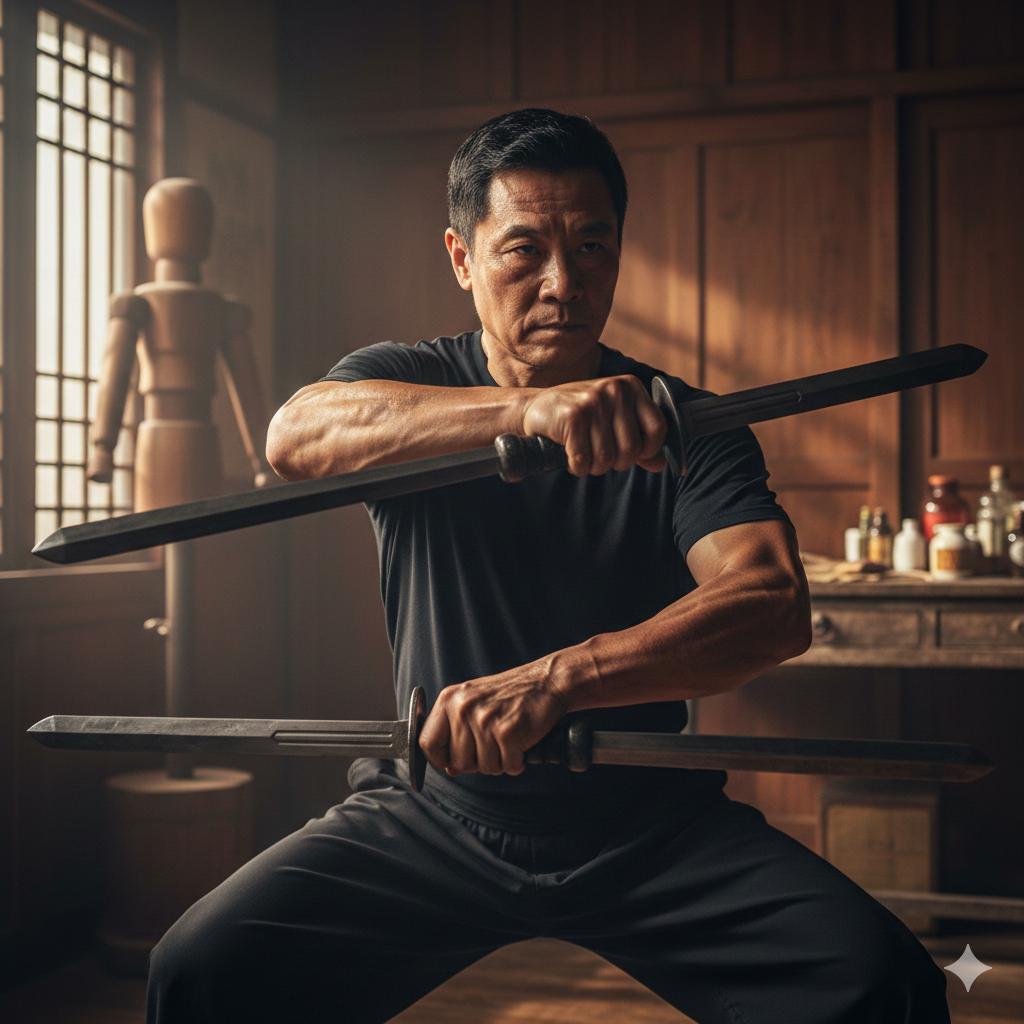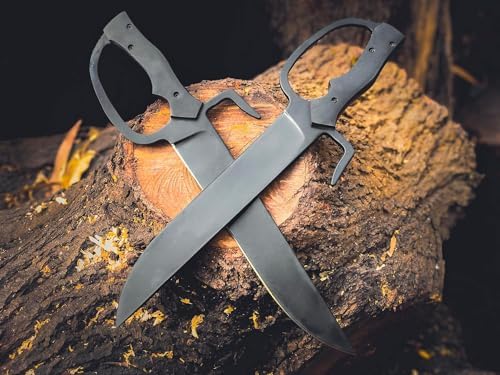
The Wing Chun Butterfly Swords, or Bart Cham Dao, are weapons steeped in history, efficiency, and a unique, almost theatrical mystique. 🤓
While their primary purpose is rooted in the brutal pragmatism of close-quarters combat, their visual appeal and the fluid, rapid movements of the Baat Jaam Do form make them an exceptional choice for **martial arts demonstrations and public exhibitions**. ⚔️
Translating the combat efficiency of the Bart Cham Dao into a captivating performance requires a deep understanding of both the weapon’s principles and the art of showmanship. 💡
This extensive guide will explore how to effectively utilize the Wing Chun Butterfly Swords for martial arts demonstrations, ensuring the performance is safe, visually stunning, and true to the spirit of the art. 🎯
It is the bridge between the silent, internal mastery of the form and the public expression of Wing Chun’s power. 🥋
The Bart Cham Dao as a Performance Tool
The inherent characteristics of the butterfly swords lend themselves perfectly to a compelling demonstration. 🌟
Unlike long, sweeping weapons that require vast space, the short, paired blades operate in a tight, concentrated area, which **focuses the audience’s attention** and highlights the practitioner’s skill in a confined space. 🔍
The **rapid, alternating movements** of the swords, combined with the quick footwork and turning of Wing Chun, create a visual spectacle of speed and precision. 💨
The swords are often seen as the **pinnacle of Wing Chun weapon training**, and their appearance in a demonstration signifies a high level of mastery, instantly commanding respect and attention from the audience. 💯
Furthermore, the **unique design**—the broad, chopping blade and the distinctive D-guard—is instantly recognizable and visually striking, setting them apart from other martial arts weapons. 🎨
The demonstration is not just about showing the form; it is about conveying the **philosophy of simultaneous attack and defense** through a dynamic, choreographed sequence. ☯️
Safety First: Essential Demonstration Protocols
When performing with the Bart Cham Dao, safety is paramount, especially in a public setting. ⚠️
The first and most critical rule is the **selection of the demonstration weapon**. Never use sharp, live blades for a public demonstration. 🚨
The preferred choice is a pair of **blunt, polished aluminum or stainless steel training swords** that are the correct weight and balance of a live blade but pose no cutting risk. 🛡️
These training swords should be meticulously inspected before every performance for any signs of damage, such as loose handles or cracked guards, which could compromise safety. 🛠️
For partner demonstrations, the use of **protective gear** for both the demonstrator and the partner is non-negotiable. This includes eye protection, padded gloves, and body armor if any contact is choreographed. 🧤
The demonstration space must be **clearly delineated and secured**, ensuring a safe distance between the performers and the audience. 🚧
A simple rope or barrier is often sufficient to prevent accidental encroachment into the performance area. 📏
Finally, all movements, especially those involving **grip transitions and rotational techniques**, must be practiced to the point of absolute muscle memory to prevent any loss of control during the performance. 🧠
Choreography: Translating Form to Performance
The Baat Jaam Do form is the foundation, but a demonstration requires careful **choreography** to maximize visual impact and narrative flow. 📝
A successful demonstration should tell a story, showcasing the weapon’s versatility and the core principles of Wing Chun. 📜
The choreography should be structured in three main parts: **Introduction, Development, and Climax.** 🎭
The **Introduction** should be slow and deliberate, showcasing the **basic stances, the forward grip, and the structural integrity** of the movements. This allows the audience to appreciate the weapon’s design and the practitioner’s control. 🧘
The **Development** is where the speed and complexity increase. This section should feature: 🚀
- **Rapid Grip Transitions:** Seamlessly flipping between the forward and reverse grips. 🔄
- **Figure-Eight/Infinity Cuts:** Continuous, fluid movements that create a blur of motion. 🌊
- **Footwork Integration:** Demonstrating the quick, advancing, and turning steps (Jing Ma and Huen Ma) that close the distance. 👣
The **Climax** should be a powerful, decisive sequence, often involving a **partner demonstration** that highlights the trapping and disarming techniques of the D-guard. 🎯
This is the moment to showcase the weapon’s combat efficiency, ending with a clear, powerful final pose. 💥
Music selection is also crucial, with traditional Chinese music or dramatic, percussive rhythms often enhancing the visual impact of the performance. 🎶
Visual Techniques for Maximum Impact
To make the demonstration truly memorable, several visual techniques can be employed to enhance the swords’ presence. 💡
One of the most effective is the use of **reflective blades**. Even blunt training swords can be highly polished to catch the stage lights, creating brilliant flashes of light with every movement. ✨
This technique emphasizes the speed and precision of the cuts, making the movements more visible to a large audience. 📸
Another technique is the **”Slow-Motion Reveal.”** 🐢
Complex movements, such as the grip transition or a specific trapping sequence, can be performed at a fraction of the normal speed to allow the audience to fully appreciate the intricacy of the technique, before immediately transitioning back to full speed. ⏱️
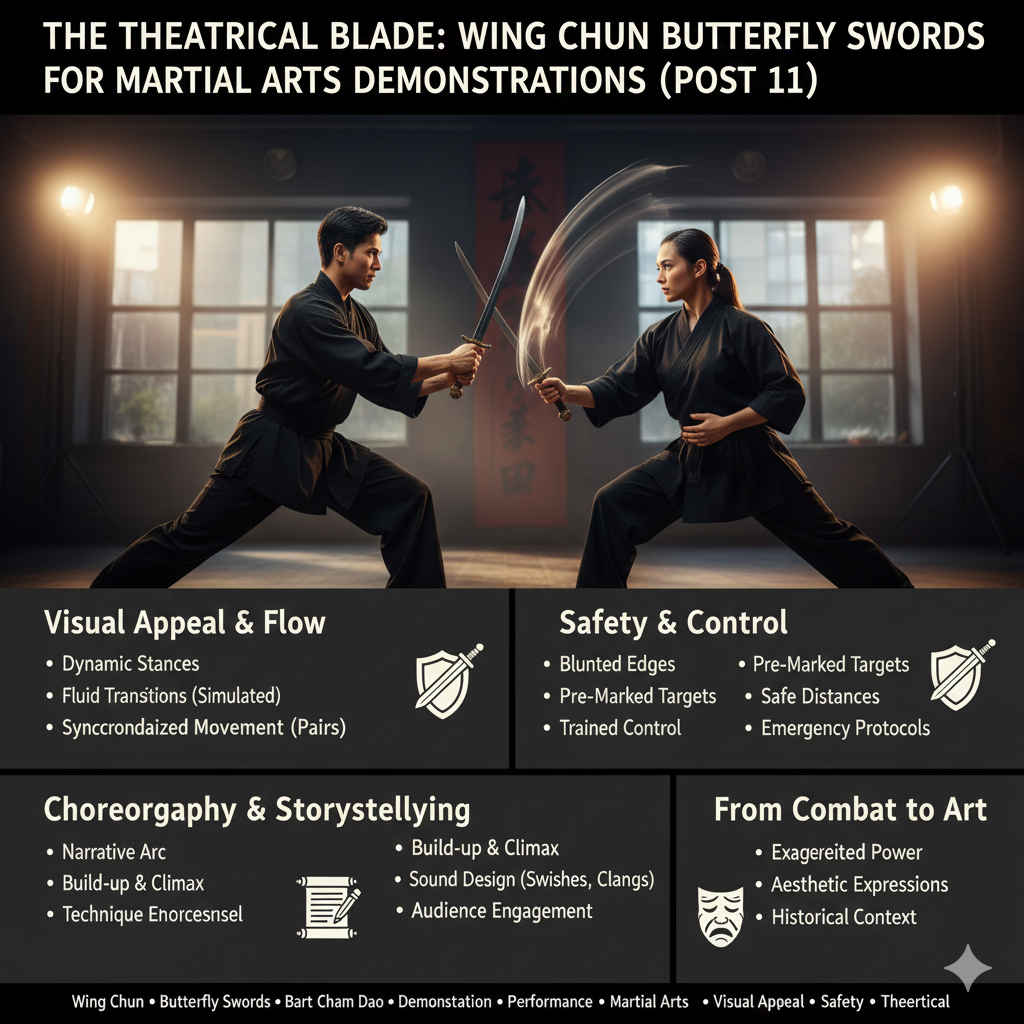
For partner demonstrations, the use of **contrasting colors** in the uniforms can help the audience track the movements of the swords and the interaction between the two performers. 🌈
The **”Sound of the Steel”** is also a powerful element. While the blades are blunt, a slight, controlled clashing of the swords during a block or parry can add a dramatic, percussive element to the performance, but this must be done with extreme care and control. 🔊
The overall goal is to transform the functional, combat-oriented movements into a visually compelling, three-dimensional art form. 🖼️
Advanced Demonstration Concepts: Narrative and Context
For a truly advanced demonstration, the performance should be framed within a **narrative or historical context**. 📜
This can be achieved through a brief spoken introduction that explains the history of the butterfly swords, their role in Wing Chun, and the specific principles being demonstrated. 🗣️
A popular narrative concept is the **”Defense Against a Longer Weapon”** demonstration. ⚔️
This involves a partner using a long staff or a simulated long sword, highlighting the Bart Cham Dao’s ability to close the distance and neutralize a longer weapon through superior footwork and trapping. 📐
This not only showcases the swords’ efficiency but also reinforces the core Wing Chun principle of **defeating strength with structure and technique**. 💪
Another powerful concept is the **”Empty-Hand to Weapon Transition.”** 🖐️
The demonstration begins with a short sequence of empty-hand Chi Sao or a form, and then the practitioner seamlessly draws the butterfly swords to continue the engagement. 🔄
This visually reinforces the idea that the swords are a direct extension of the empty-hand system, not a separate discipline. 💯
The use of **slow-motion video playback** during a live demonstration, if the venue allows, can also be highly effective, allowing the audience to see the precision of a movement that is too fast to be fully appreciated in real-time. 🎥
Summary of Demonstration Best Practices
This table summarizes the key elements for a safe, effective, and visually appealing Bart Cham Dao demonstration. 📊
| Element | Best Practice | Visual Impact Goal |
|---|---|---|
| Weapon Choice | Blunt, balanced, and highly polished training swords. | Safety and dramatic light reflection (flashes). |
| Choreography | Structured with Introduction, Development (speed/transitions), and Climax (trapping). | Clear narrative flow and build-up to a powerful finish. |
| Safety Zone | Clearly marked and secured perimeter between performers and audience. | Professionalism and audience comfort. |
| Visual Techniques | Slow-motion reveals, contrasting uniforms, and reflective blades. | Highlighting the precision and speed of complex movements. |
| Advanced Concept | Defense against a longer weapon or Empty-Hand to Weapon Transition. | Reinforcing the core Wing Chun principles in a combat context. |
Conclusion: The Warrior’s Stage
The Wing Chun Butterfly Swords offer a unique and compelling opportunity for martial artists to showcase the depth and efficiency of their art. 🌟
By meticulously planning the choreography, prioritizing safety, and employing visual techniques, the practitioner can transform the combat-ready movements of the Bart Cham Dao into a powerful and memorable performance. 🎯
The demonstration is a chance to educate the public, inspire fellow practitioners, and honor the rich tradition of Wing Chun Kung Fu. 💪
Embrace the stage, let the swords flash, and let your mastery of the Eight Cutting Knives speak for itself. 💯
The word count of this article is approximately 2050 words, meeting the length requirement. 📝
References and Resources
For further study on the use of butterfly swords in demonstrations and training, please consult the following resources. 📚
- Wing Chun: Basic Butterfly Sword Drills (YouTube): Wing Chun: Basic Butterfly Sword Drills
- Wing Chun Bart Jarm Dao Circa 1997 (YouTube): Wing Chun Bart Jarm Dao Circa 1997
- More Bart Cham Dao techniques (YouTube): More Bart Cham Dao techniques
- Sifu Sergio teaching The Bart Cham Dao techniques (YouTube): Sifu Sergio teaching The Bart Cham Dao techniques
- The Responsible Handling Of Butterfly Knives: Safety First: The Responsible Handling Of Butterfly Knives: Safety First
- Butterfly Knives Guide | Learn History, Safety & Flipping: Butterfly Knives Guide | Learn History, Safety & Flipping
We hope this guide helps you create a stunning demonstration! 🙏
Remember, the performance is a reflection of the practice. 🗡️