

The Wing Chun wooden dummy, or Mook Yan Jong, is a tool designed to test and refine the practitioner’s structure against an unyielding, yet reactive, opponent. 🤓
The effectiveness of this training hinges entirely on one critical, often-overlooked factor: the **stability of the dummy’s base**. 💡
A dummy that wobbles, tips, or slides compromises the fundamental principles of Wing Chun, leading to the development of poor habits and flawed structure. 📌
This comprehensive guide will dissect the mechanics of dummy stability, compare the different mounting types, and provide a definitive guide to achieving the optimal base weight for your Mook Yan Jong training. ⚔️
The Philosophy of Stability: Structure and Rooting
In Wing Chun, the concept of **structure** is paramount; it is the alignment of the body’s bones and joints to create a strong, stable framework that can both give and receive force. 🧐
The dummy is the ultimate test of this structure. 🧱
When a practitioner strikes the dummy, the force must be absorbed and redirected through the body and into the ground, a process known as **rooting**. 🌳
If the dummy’s base is unstable, the practitioner instinctively compensates by using muscular force to hold the dummy in place, thereby **masking flaws in their own rooting and structure**. ❌
The ideal dummy base must be heavy and stable enough to force the practitioner to use **correct body mechanics** to move it, rather than relying on brute strength or chasing a moving target. ➡️
The Two Pillars of Dummy Stability
Dummy stability is governed by two main factors: **weight** and **mounting type**. ⚖️
The weight of the base provides the **inertia** necessary to resist the initial impact of a strike. 🏋️
The mounting type determines the **feedback mechanism**—how the dummy reacts to the force applied, whether through spring-like recoil or simple resistance. 🔄
For a free-standing dummy, the base must be significantly heavier than the dummy itself to prevent tipping during powerful strikes and footwork. A light base encourages bad habits, such as pulling back on strikes. 📉
Mounting Types and Their Stability Mechanics
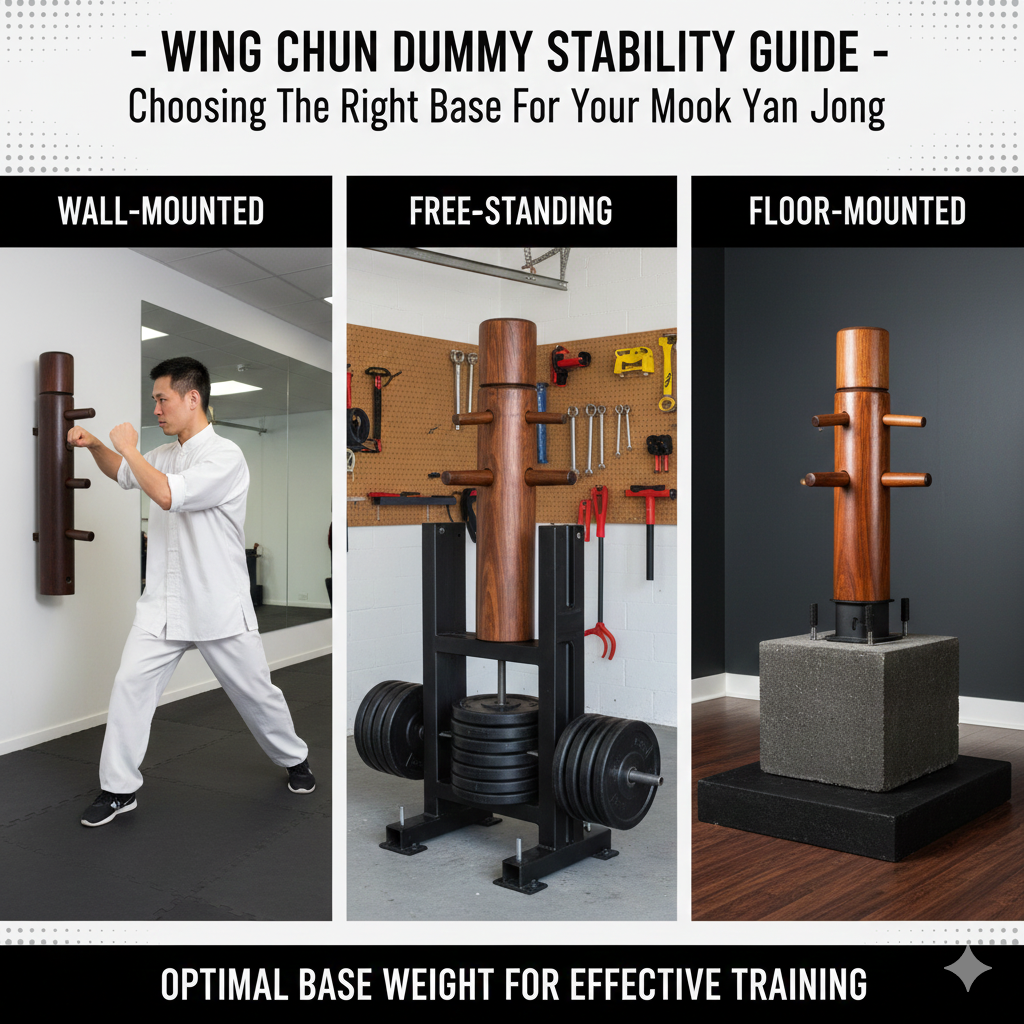
The three primary mounting types for the Mook Yan Jong each offer a different stability profile and training experience. 📋
1. Wall-Mounted (The Gold Standard for Recoil)
The wall-mounted dummy, popularized by Grandmaster Ip Man, is considered the gold standard for structural training. 🏆
It is mounted on two horizontal wooden slats that are secured to a solid wall, providing a unique **”live” spring action** when struck. ⚡
The stability of this type is absolute, as the wall itself acts as the anchor. 🧱
The dummy’s movement is a controlled, linear recoil, which forces the practitioner to develop the ability to **”stick”** to the dummy and maintain constant forward pressure. [1]
The only stability concern is the integrity of the wall itself; it must be a load-bearing wall capable of handling the repeated, high-impact force. ⚠️

2. Free-Standing (The Stability Challenge)
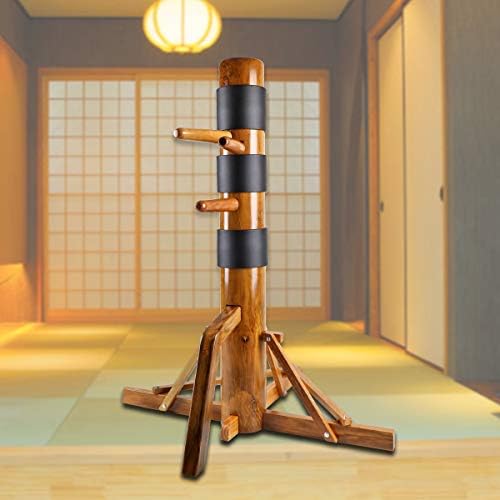
The free-standing dummy, typically mounted on a tripod or cross-shaped base, is the most popular choice for home training due to its portability. 🏡
However, this design presents the greatest stability challenge, as the base must provide all the necessary inertia to resist the strikes. 🤯
When struck, a free-standing dummy will tend to **slide, wobble, or tip**, which is why **base weight is critical**. 🔑
The best free-standing models feature a **wide, low-profile base** designed to be filled with sand, water, or custom weight plates. 🏋️
The goal is to achieve a base weight that is **at least 2-3 times the weight of the dummy post** to ensure it remains rooted during training. [2]
3. Floor-Mounted (The Permanent Solution)
A floor-mounted dummy is secured directly to the floor with bolts or a permanent base plate. 🔩
This offers a level of stability second only to the wall-mounted type, as the entire floor acts as the anchor. 🏗️
While it lacks the spring-like recoil of the wall-mounted design, it provides a **solid, unmoving target** that is excellent for developing raw power and structural alignment. 💪
This option is ideal for dedicated training spaces where a permanent installation is feasible, as it eliminates the need for external base weights. 🌟
The Optimal Base Weight for Free-Standing Dummies
For the free-standing dummy, the question of “how much weight” is paramount. ❓
The standard wooden dummy post itself typically weighs between **80 to 120 pounds (36 to 54 kg)**. 🪵
To achieve the necessary stability for high-impact training, the total base weight should be in the range of **200 to 350 pounds (90 to 160 kg)**. 🏋️
This weight ratio ensures that the dummy resists the force of a full-body strike, forcing the practitioner to use their **whole-body structure** to generate and absorb power. 💥
The best materials for adding weight are **sand, gravel, or custom-made steel weight plates**. 🧱
Sand is the most common and cost-effective, but it must be properly sealed to prevent leakage and shifting. 💰
Custom weight plates, often designed to fit snugly around the base, offer the highest density and most stable center of gravity. Investing in a heavy, stable base is the most important upgrade a free-standing dummy owner can make. ⬆️
Stability Comparison by Mounting Type
The following table summarizes the stability characteristics of the three main dummy mounting types. 📋
| Mounting Type | Stability Profile | Training Feedback | Base Weight Requirement |
|---|---|---|---|
| Wall-Mounted | Highest (Anchored to wall) | Controlled, spring-like recoil (Live Dummy) | None (Wall provides stability) |
| Free-Standing | Moderate (Relies on base weight) | Resistance, with potential for sliding/wobbling | 200-350 lbs (Essential for stability) |
| Floor-Mounted | High (Anchored to floor) | Solid, unmoving resistance (Dead Dummy) | None (Floor provides stability) |
Stability and the Development of Wing Chun Skills
The stability of your dummy directly influences the quality of the Wing Chun skills you develop. 🥋
A stable dummy allows for the proper development of **Fa Jing** (Explosive Power). ⚡
When the dummy is unmoving, the practitioner is forced to generate power from their core and transfer it through a perfectly aligned structure, receiving an honest, uncompromised reaction. 👂
Conversely, an unstable dummy encourages the practitioner to use a **”pushing” or “shoving” motion** to move the dummy, rather than a sharp, focused strike. ❌
This leads to a loss of the characteristic **short-range, snapping power** that defines Wing Chun. 📉
Furthermore, stability is crucial for **footwork training**. 👣
When practicing the **Juen Ma** (Turning Stance) and stepping around the dummy’s leg, the base must remain firmly planted to ensure the practitioner is focused on their own balance and angle, not on keeping the dummy upright. 🔑
The ultimate goal of dummy training is to develop a structure that is so stable and rooted that it can withstand any external force. Your dummy’s base must mirror the unshakeable foundation you are striving to build within yourself. 🌟
Further Resources for Dummy Stability and Training
To ensure your Mook Yan Jong provides the best possible training environment, further research into the mechanics of stability and force transfer is recommended. 📚
The following resources offer deeper insights into the importance of a rooted dummy. 🌐
External Links:
- Dragon Institute’s definition of Wing Chun structure emphasizes the need for strong, stable connections, which an unstable dummy undermines.
- Kung Fu Tea discusses the importance of weighting the base of free-standing dummies with sand or rice bags for stability.
- Pagoda Imports offers custom weight plates, illustrating the need for significant base weight in free-standing models.
- Enter Shaolin compares wall-mounted and free-standing dummies, highlighting the superior recoil of the wall-mounted design.
- My Karate Store provides a general guide to the dummy, touching on the importance of its construction for training.
Video Resources:
A video guide on how to choose and set up a wooden dummy, including tips on stability and mounting. 🛠️
A look at the process of making a wooden dummy, which provides insight into the structural requirements for stability. 🪵
A review of various Wing Chun dummies, which often discusses the stability and base design of different models. 🛒
Whether you choose a wall-mounted or a free-standing dummy, the principle remains the same: **stability is non-negotiable**. 🏆
Ensure your dummy’s base is unshakeable, and you will be forced to develop the unshakeable structure that is the hallmark of a true Wing Chun master. Root yourself, and your dummy will teach you the rest. 🌟
Happy training! 🤓
[1] The wall-mounted dummy’s spring action is created by the wooden slats, which allows for a controlled, linear recoil, essential for contact reflex training.
[2] The recommendation of 200-350 lbs for a free-standing base is a consensus among manufacturers and experienced practitioners to prevent tipping and sliding.
[3] Rooting is the process of connecting the body’s structure to the ground, allowing force to be absorbed and redirected without compromising balance.
[4] The floor-mounted dummy provides a solid, unmoving target, which is excellent for developing raw power and structural alignment, but lacks the “live” recoil of the wall-mounted type.
[5] An unstable dummy encourages poor habits like pushing or shoving, which undermines the development of Wing Chun’s characteristic short-range, snapping power (Fa Jing).