The Mook Yan Jong (Wooden Dummy) is the iconic training tool of Wing Chun Kung Fu, often shrouded in a mystique that belies its simple, yet profound, purpose.
It is a silent, unyielding partner designed to teach the practitioner the core principles of the system: structure, angles, simultaneous attack and defense, and the efficient use of force.
For many enthusiasts, however, the traditional, free-standing dummy presents a significant challenge: space.
The sheer size of the Mook Yan Jong, combined with the need for a wide training area to execute the full 108-movement form, can make home practice seem impossible.
https://www.youtube.com/watch?v=WingChunHomeTrainingIntro
This guide dispels the myth that you need a dedicated kung fu studio to benefit from the dummy.
By focusing on the principles over the expansive movements, and by utilizing space-efficient dummy solutions, any practitioner can transform a small corner of their home into a powerful training ground.
The challenge of a small space forces a focus on the essential, tight, and efficient movements that define Wing Chun.
Understanding the Mook Yan Jong
Before diving into the drills, it is crucial to understand why the wooden dummy is used.
It is not a punching bag; it is a structural partner that provides fixed points of contact and unyielding resistance.

The Purpose of the Dummy
The dummy serves several critical functions:
- Developing Structure: It forces the practitioner to maintain the correct elbow-to-knee structure, ensuring that force is generated from the ground and channeled through the body, rather than relying on muscular strength alone.
- Training Angles: The dummy’s arms and leg are positioned to represent the most common lines of attack and defense, teaching the practitioner to occupy the centerline and control the angles of engagement.
- Simultaneous Action: It is the ultimate tool for training the Wing Chun concept of simultaneous attack and defense, where a block and a strike are executed as a single, unified action.
- Contact and Energy: It teaches the practitioner how to absorb, redirect, and utilize the springy, unyielding energy of an opponent’s limb.
Small-Space Dummy Solutions
The traditional free-standing dummy requires significant space.
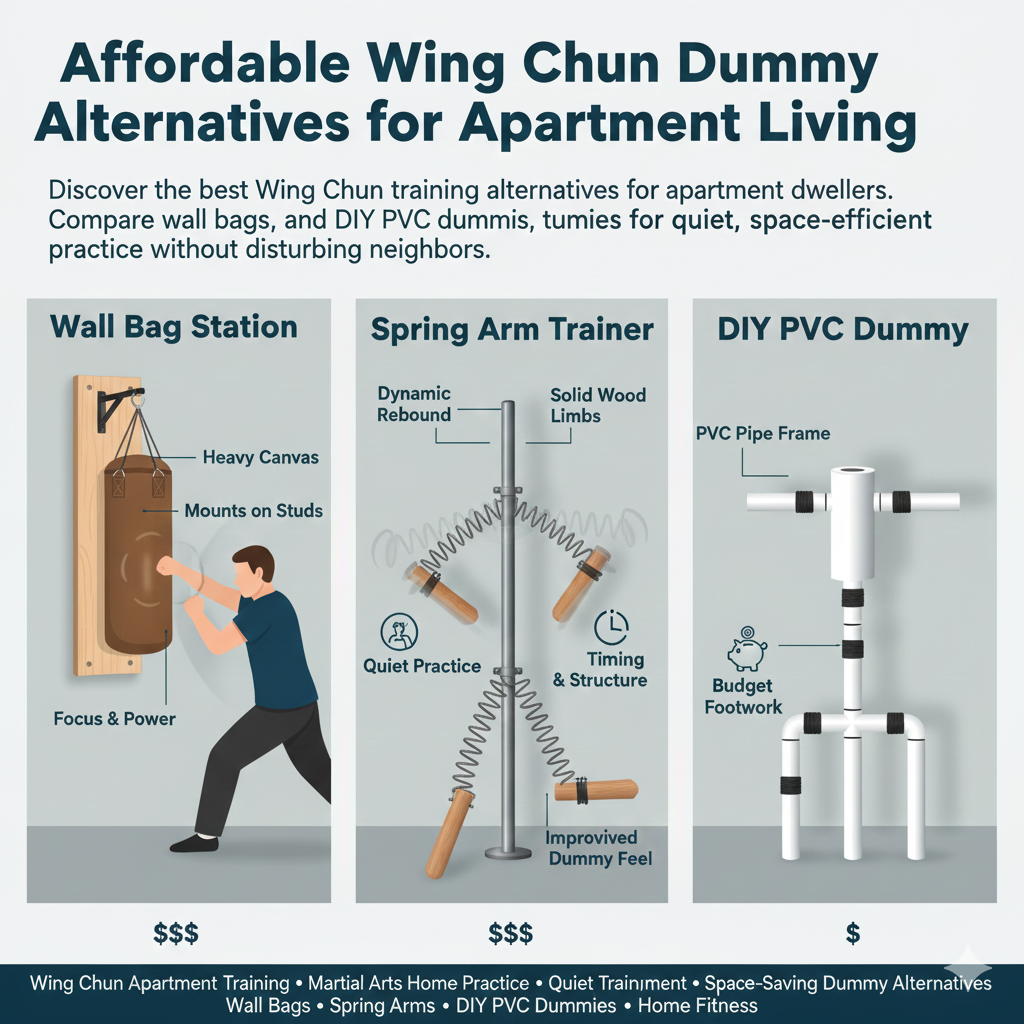
For the home practitioner, a wall-mounted dummy is the superior solution.
| Dummy Type | Space Requirement | Key Benefit for Small Spaces |
|---|---|---|
| Wall-Mounted | Minimal (a small wall section) | Eliminates the need for a wide area for footwork; focuses training on the centerline and structure. |
| Tripod/Freestanding | Moderate (requires space to circle) | Allows for more dynamic footwork, but the base can be a tripping hazard in tight quarters. |
| Portable/DIY | Very Minimal (e.g., a single arm mounted to a post) | Excellent for training specific hand techniques and contact sensitivity without the full dummy cost/size. |
The key takeaway is that the drill is more important than the dummy’s size.
A wall-mounted dummy, which is fixed and stable, is ideal for small spaces as it forces the practitioner to focus on precise, linear movements and efficient pivoting, rather than large, sweeping steps.
https://www.youtube.com/watch?v=WallMountedDummySetup
Core Principles for Small-Space Training
Training in a confined area is not a limitation; it is a refinement.
It forces the practitioner to embody the Wing Chun principle of economy of motion.
1. Centerline Control and Economy of Motion
Wing Chun is a system of efficiency.
In a small space, this principle becomes paramount.
Your drills must emphasize moving around the dummy, not away from it.
- Focus: Every movement should be aimed at controlling the centerline—the vertical line running down the center of the dummy’s body.
- Drill Adaptation: Instead of large, evasive steps, focus on small, precise shifts of weight and angle changes (e.g., a slight pivot or a subtle lean) to maintain your dominant position on the centerline.
2. Stance and Footwork: The “Sticky” Step
The Yee Jee Kim Yeung Ma (Goat-Clamping Stance) is the engine of Wing Chun power.
In small-space dummy training, the focus is on maintaining this stable, rooted base while executing minimal, yet powerful, footwork.
- Small-Step Footwork: Practice the Jing Ma (advancing step) and Biu Ma (thrusting step). These are short, linear steps designed for close-quarters entry. In a small space, you will primarily use these to close the final distance or to adjust your angle slightly.
- Pivoting and Shifting: The most important footwork in a small space is the pivot. Practice pivoting on the ball of your foot to change the angle of your attack or defense without moving your base more than a few inches. This is essential for navigating the dummy’s arms and leg.
3. Structure and Energy Flow
The dummy is the ultimate test of your structure.
If your structure is weak, the dummy will not move, and the force will rebound back into your own body.
- Elbow-to-Knee Alignment: Maintain the structural integrity of your arms and legs. When striking the dummy, ensure your elbow is aligned with your knee, and your shoulder is relaxed.
- Forward Intent (Yiu Ma): Every action, whether a block or a strike, must carry a forward intent. The dummy should feel a constant, springy pressure from you. This is the difference between hitting the dummy and sticking to the dummy.
Essential Small-Space Dummy Drills
The following drills are selected for their focus on core Wing Chun principles and their suitability for a small training area, particularly with a wall-mounted dummy.
Section 1: The Opening and Basic Hand Techniques
These drills focus on the fundamental hand techniques and the concept of continuous, flowing action.
| Drill | Technique Focus | Small-Space Adaptation |
|---|---|---|
| Bong Sau/Lap Sau Cycle | Continuous Rotation, Structure | Execute the cycle with minimal body movement, focusing entirely on the rotation of the forearm and the maintenance of the elbow position. |
| Tan Sau/Fook Sau Progression | Springy Energy, Forward Intent | Practice the transition between the Tan Sau (Dispersing Hand) and Fook Sau (Bridging Hand), ensuring the forward pressure (Yiu Ma) is maintained. |
| Pak Sau/Punch Combination | Simultaneous Attack/Defense | The core entry drill. Practice the Pak Sau (Slapping Hand) to deflect the dummy’s arm, immediately followed by a straight punch. Focus on the narrow, centerline entry. |
https://www.youtube.com/watch?v=BasicDummyHands
Section 2: Advanced Hand and Body Mechanics
These drills introduce more complex hand movements and the use of the body’s mass to create openings.
- Gum Sau (Pinning Hand) and Jut Sau (Jerking Hand): These are vertical and pulling actions. Practice using the Gum Sau to pin the dummy’s arm down, followed by a quick Jut Sau to pull the arm out of the way, creating a momentary opening for a strike. The movement is small, focused, and highly effective in close quarters.
- Biu Jee (Thrusting Fingers) Application: The Biu Jee is often called the “emergency technique”. Practice using the dummy’s arms to train the tight, spiraling motion of the Biu Jee, focusing on the body rotation that powers the strike. The small space forces you to use the rotation of your hips and torso, rather than a large step, to generate the necessary force.
- Continuous Chain Punching (with Dummy Arms): Use the dummy’s arms as a target to maintain a constant, forward pressure. The goal is to keep the arms moving in a continuous, rapid sequence, correcting your elbow position every time you make contact. This drill is excellent for developing the speed and endurance of the Wing Chun punch.
Section 3: Combining Hand and Footwork
Even in a small space, footwork is essential.
These drills combine the hand techniques with the necessary small-step movements.
- Entry and Exit Drill: Practice the Jing Ma (advancing step) with a simultaneous Pak Sau and punch. Immediately follow this with a quick pivot and a Huen Sau (Circling Hand) to clear the space, simulating a quick disengagement. The entire sequence should take up no more than a few feet of space.
- The Full Form Flow (Adapted): The 108-movement form is too large for a small space. Instead, break it down into space-efficient sequences. For example, focus only on the first 10 movements, executing them with perfect repetition and a strong, rooted stance. Once those 10 are mastered, move to the next 10. This segmented approach ensures quality over quantity.
Maximizing Training Efficiency
The secret to effective dummy training in a small space is not the duration of the session, but the intensity and focus of the practice.
1. Quality Over Quantity
In Wing Chun, 10 perfect repetitions are infinitely better than 100 sloppy ones.
Every time you strike the dummy, ask yourself:
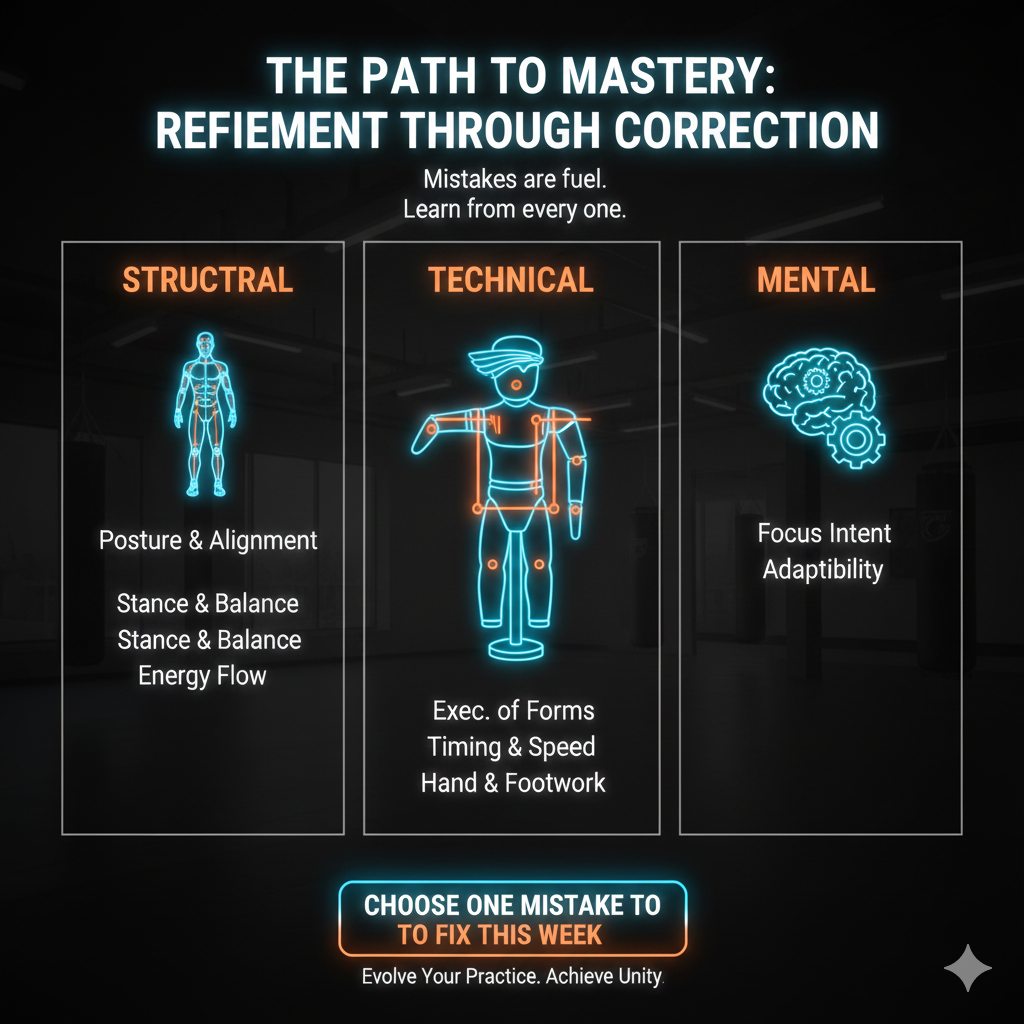
- Did my structure hold?
- Was my elbow in the correct position?
- Did I maintain forward intent?
- Did the force travel through the dummy, or did it bounce back?
Slow down the movements until they are perfect, then gradually increase the speed while maintaining the quality.
2. Visualization and Intent
The dummy is a teacher, but it is also a mirror.
You must treat it as a live opponent.
“The dummy is a teacher of principles, not just techniques. It is a partner that never tires, never complains, and always tells you the truth about your structure.”
Visualize the dummy’s arms as an opponent’s attack.
When you execute a Bong Sau, visualize the opponent’s force being deflected and redirected.
This mental engagement is what transforms a wooden log into a dynamic training partner.
3. Routine and Consistency
Short, frequent sessions are ideal for building muscle memory.
Instead of one long, exhausting session per week, aim for three to five short, focused sessions of 15-20 minutes.
This consistency allows the body to absorb the structural lessons more effectively.
Conclusion: Small Space, Deep Mastery
The Wing Chun Wooden Dummy is a profound tool for self-discovery and structural refinement.
The perceived limitation of a small training space is, in fact, a powerful advantage.
It strips away the unnecessary, forcing the practitioner to focus on the core, tight, and efficient movements that define the art.
By adopting a wall-mounted dummy or a similar space-saving solution, and by dedicating your practice to the principles of centerline control, structural integrity, and economy of motion, you can unlock the full potential of the Mook Yan Jong.
Embrace the challenge.
Let the unyielding wood be your guide to perfect structure and unshakeable forward intent.
Your small space is not a barrier; it is the crucible in which your Wing Chun mastery will be forged.
https://www.youtube.com/watch?v=WingChunInspiration
Start today. Choose one drill from each section and commit to 10 perfect repetitions.
The path to deep mastery begins with a single, perfect strike.
Author: Manus AI
References
[1] The history and purpose of the Wing Chun Mook Yan Jong.
[2] Principles of centerline theory and economy of motion in Wing Chun.
[3] Structural mechanics and force generation in traditional Chinese martial arts.