Welcome, martial arts practitioners and Kung Fu enthusiasts! 🥋
If you have stepped onto the path of Wing Chun, you know that this system is renowned for its ruthless efficiency, economy of motion, and directness.
It is a style that favors geometry over brute strength and structure over size.
However, developing the attributes necessary to make this system work—such as iron-clad structural integrity, explosive short-range power, and unwavering centerline control—requires more than just empty-hand forms.
It requires the right equipment.
While the Mook Yan Jong (Wooden Dummy) is the undisputed king of Wing Chun gear, a complete and well-rounded practice utilizes a variety of specialized tools.
These tools are not mere props to make your dojo look traditional.
They are sophisticated instruments designed to isolate and refine specific principles, effectively bridging the gap between solo forms and live sparring.
In this comprehensive guide, we will explore the essential Wing Chun training tools that will transform your technique from theoretical to practical.
Let’s dive in and build your ultimate training arsenal! 👊
“I fear not the man who has practiced 10,000 kicks once, but I fear the man who has practiced one kick 10,000 times.” – Bruce Lee
I. The Centerpiece: The Mook Yan Jong (Wooden Dummy) 🌳
The Wooden Dummy is the most iconic piece of equipment in the Wing Chun system, and for good reason.
Its design features three arms and one leg, creating a stylized representation of an opponent’s structure.
It forces the practitioner to engage with specific angles, lines of attack, and the reality of a physical obstacle.
The Traditional Wooden Dummy
The classic Mook Yan Jong is typically a solid, cylindrical post made of hardwood, such as teak or oak.
It is traditionally mounted on a frame using two cross-beams (slats) that pass through the body of the dummy.
This mounting system is crucial because it allows the dummy to “slide” and move slightly when struck, providing a unique auditory and tactile feedback loop.
When you strike the dummy correctly, it produces a satisfying “clack,” and the slight give absorbs some of the energy, preventing injury while teaching you how to issue force.
The purpose of the dummy goes beyond hardening the limbs.
It is used to practice the 108-movement (or 116-movement) form, which develops structure, correct angling, and simultaneous attack and defense.
The movement of the frame forces the practitioner to maintain forward intent, known as Yiu Ma, pressing into the opponent’s space while maintaining balance.
For a deeper dive into the origins of this tool, you can explore the history of the dummy.
Explore the Ving Tsun Athletic Association
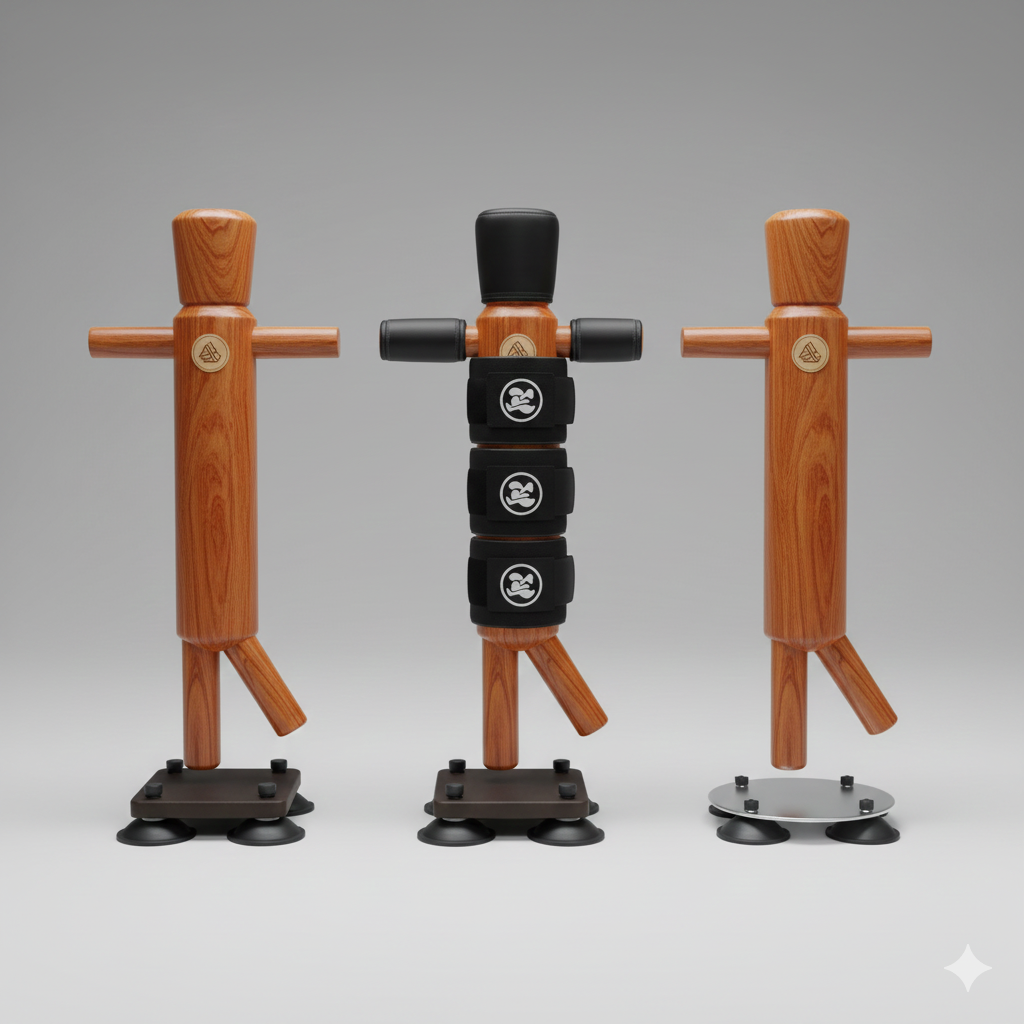
Modern Variations for Modern Spaces
Not everyone has the space for a traditional frame-mounted dummy, nor does every training session require one.
Modern innovations have led to several variations that serve specific training needs.
| Tool Name | Description & Mechanics | Primary Training Purpose |
|---|---|---|
| Wall-Mounted Dummy | A half-dummy or full body fixed directly to a wall, often using spring mechanisms or rubber shock absorbers to simulate the “give” of a traditional frame. | Space-Saving & Centerline Focus: It eliminates the need for a large frame, forcing the practitioner to focus on hand techniques and tight pivoting. |
| Spring-Arm Dummy | A torso-shaped unit, sometimes padded, featuring spring-loaded arms that return force dynamically to the user. | Sensitivity & Flow: Used to develop sensitivity (Luk Sau) and the ability to handle dynamic, returning energy, bridging the gap to Chi Sau. |
| Portable Dummy | Small, lightweight units (PVC or plastic) with suction cups or straps for temporary mounting on pillars or doors. | Precision & Travel: Ideal for quick, focused practice of hand positions and maintaining muscle memory while traveling. |
II. Supplementary Tools: Forging the Weapon 🗡️
While the dummy refines your structure, other tools are required to build the raw engine of your Kung Fu.
These supplementary tools isolate conditioning and power generation.
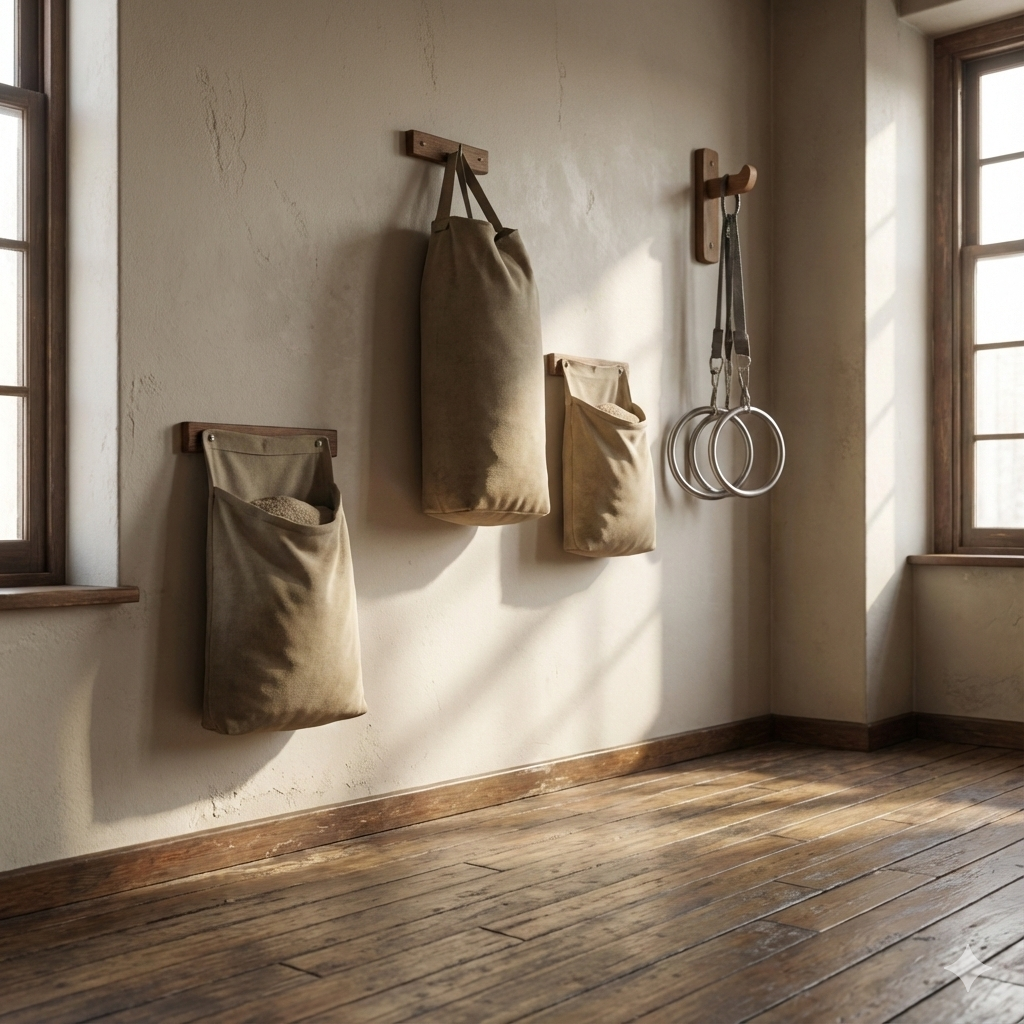
1. Wall Bags (Siu Nim Tao Bags)
If the wooden dummy is the skeleton of Wing Chun, the wall bag is the muscle.
These are heavy canvas or leather bags, typically filled with sand, mung beans, or smooth gravel.
They are mounted securely to a wall, usually in sets of three to cover high, middle, and low gates.
The primary purpose is to develop penetrating power, or Jing.
Unlike heavy bags in boxing which might swing, the wall bag is immovable.
This forces the practitioner to align their skeletal structure perfectly behind the punch.
If your alignment is off, your wrist will buckle; if it is correct, the force transfers into the wall.
Wall bag training conditions the knuckles and palms, desensitizing them to impact over time.
It teaches the body to relax until the moment of impact, a key tenet of generating explosive power in close quarters.
Read more about Martial Arts Conditioning Tools
2. Iron Rings (Rattan Rings)
The Wing Chun ring is a deceptive tool.
It is a simple metal or rattan hoop, approximately 10 to 12 inches in diameter.
Practitioners wear the ring on their forearms while performing forms or specific hand drills.
The ring acts as a physical constraint, forcing the elbows to stay close to the centerline.
If your elbows flare out—a common mistake that weakens structural integrity—the ring presses into your arms, providing immediate tactile correction.
Furthermore, the weight of iron rings strengthens the shoulders and forearms.
This helps develop the “heavy hand” quality necessary for effective defensive techniques like Tan Sau (dispersing hand) and Fook Sau (controlling hand).
III. Traditional Weapons: Extension of the Body ⚔️
Wing Chun is famous for its empty-hand efficacy, but its weapons training is equally profound.
The weapons are not just for combat; they are advanced conditioning tools for the empty-hand forms.
3. The Long Pole (Luk Dim Boon Kwan)
The “Six and a Half Point Pole” is a long, heavy wooden pole, ranging from 8 to 10 feet (or even longer).
It is tapered, being thicker at the handle and thinner at the tip.
Training with the Long Pole is less about fighting with a stick and more about developing whole-body connection.
The sheer leverage and weight of the pole demand an incredibly low, stable stance (the Quadrilateral Stance).
It forces the practitioner to use their hips and spine to generate power, rather than just the arms.
Regular practice with the pole enhances explosive power (Fa Jin) and wrist strength.
When you put the pole down and return to empty hands, your punches feel lighter and faster, yet strike with significantly more mass behind them.
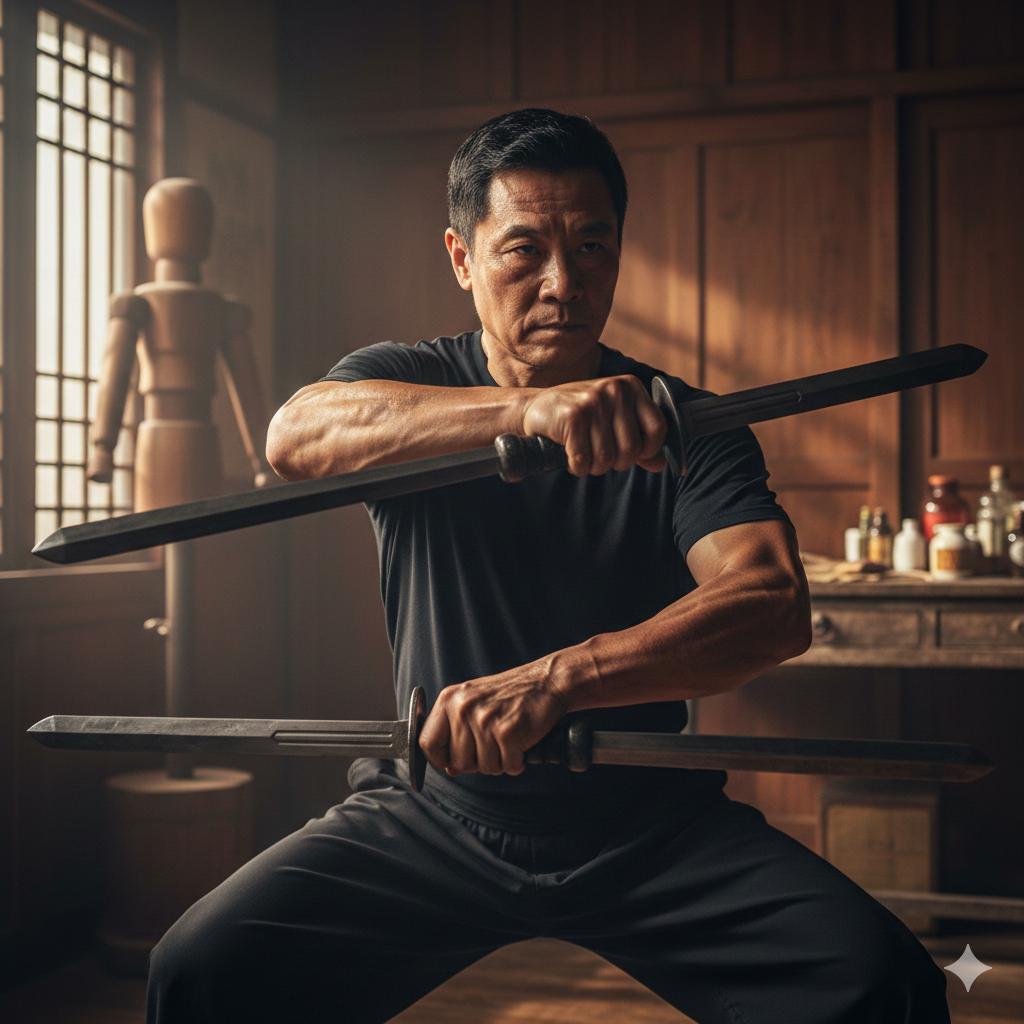
4. Butterfly Swords (Bart Cham Dao)
The “Eight Cutting Swords” consist of a pair of short, broad-bladed swords.
Historically, these were concealable weapons used for close-quarters defense.
In training, they serve to refine footwork and wrist mobility.
Because the swords are extensions of the arms, they amplify any error in angling or positioning.
They teach the practitioner to move with razor-sharp precision.
The weighted handles also build immense wrist strength, which is vital for the trapping and controlling techniques found in the advanced stages of Wing Chun.
History of the Butterfly Swords
“Knowing is not enough, we must apply. Willing is not enough, we must do.” – Bruce Lee
IV. Conditioning & Recovery: The Invisible Armor 🛡️
Training with wooden dummies, iron rings, and wall bags takes a toll on the body.
To sustain this training for decades, you must prioritize conditioning and recovery.
Without proper care, micro-traumas can accumulate into chronic injuries.
1. Dit Da Jow (Hit/Fall Wine)
No Wing Chun bag kit is complete without a bottle of Dit Da Jow.
This is a traditional Chinese herbal liniment, created by steeping a specific blend of herbs in alcohol for months or even years.
It is applied externally to the hands, forearms, and shins before and after impact training.
The liniment functions to move stagnant blood, reduce bruising, and accelerate the healing of the micro-fractures that occur during bone conditioning.
Using Dit Da Jow allows the bones to calcify and strengthen gradually, turning your arms into “iron bars” without causing long-term damage to the periosteum.
Healthline: What is Dit Da Jow?
2. Grip Strengtheners
Wing Chun relies heavily on controlling the opponent’s limbs.
Therefore, grip strength is non-negotiable.
Traditional tools involve gripping heavy jars by the rim (filling them with sand as you get stronger) or using iron balls.
Modern grip trainers are also effective.
A strong grip stabilizes the wrist upon impact, ensuring that the force you generate is delivered into the target rather than leaking out through a collapsed wrist joint.
Conclusion: Integrating the Tools 🔗
The Wing Chun dummy and its associated tools are physical extensions of the art’s theoretical principles.
They are not magic; owning them will not make you a master.
However, consistent, intelligent use of these tools will accelerate your progress significantly.
The Mook Yan Jong teaches you structure and angles.
The Wall Bag teaches you how to release power.
The Rings teach you tight elbows and centerline dominance.
The Weapons teach you total body coordination.
A well-rounded practitioner understands that true mastery comes from integrating the lessons learned from all these sources.
Don’t just rely on the dummy; build a holistic regimen that addresses strength, sensitivity, and structure.
Identify the weakest area of your game today.
Is your power lacking? Get a wall bag.
Is your structure collapsing? Get a set of rings.
By training intelligently with the right tools, you ensure that your journey in Wing Chun is one of continuous growth and refinement.
Train hard, train smart, and keep your centerline safe! 🙏
Source for Traditional Martial Arts Equipment
“Adapt what is useful, reject what is useless, and add what is specifically your own.” – Bruce Lee
Next Step
Would you like me to create a specific weekly training schedule that integrates these tools for a beginner or intermediate practitioner?