The Wing Chun Wooden Dummy (Mook Yan Jong) is an icon of martial arts, its three arms and single leg representing the distilled essence of a human opponent’s structure and attack lines. 🥋
For centuries, it has served as the ultimate tool for refining the Wing Chun principles of centerline control, structural integrity, and simultaneous attack and defense. 🎯
However, the world of martial arts training is not static, and innovation occasionally challenges tradition. 💡
One such challenge comes in the form of the “Octopus” Dummy, an innovative design that dramatically expands the number of limbs, offering a new perspective on Wing Chun training. 🐙
This comprehensive analysis will compare these two distinct training partners, dissecting their structural differences, the philosophies they embody, and how each can contribute to the development of a complete Wing Chun practitioner. 🤓
The Traditional Mook Yan Jong: Distilled Essence
The traditional Mook Yan Jong is a study in economy and precision. 📐
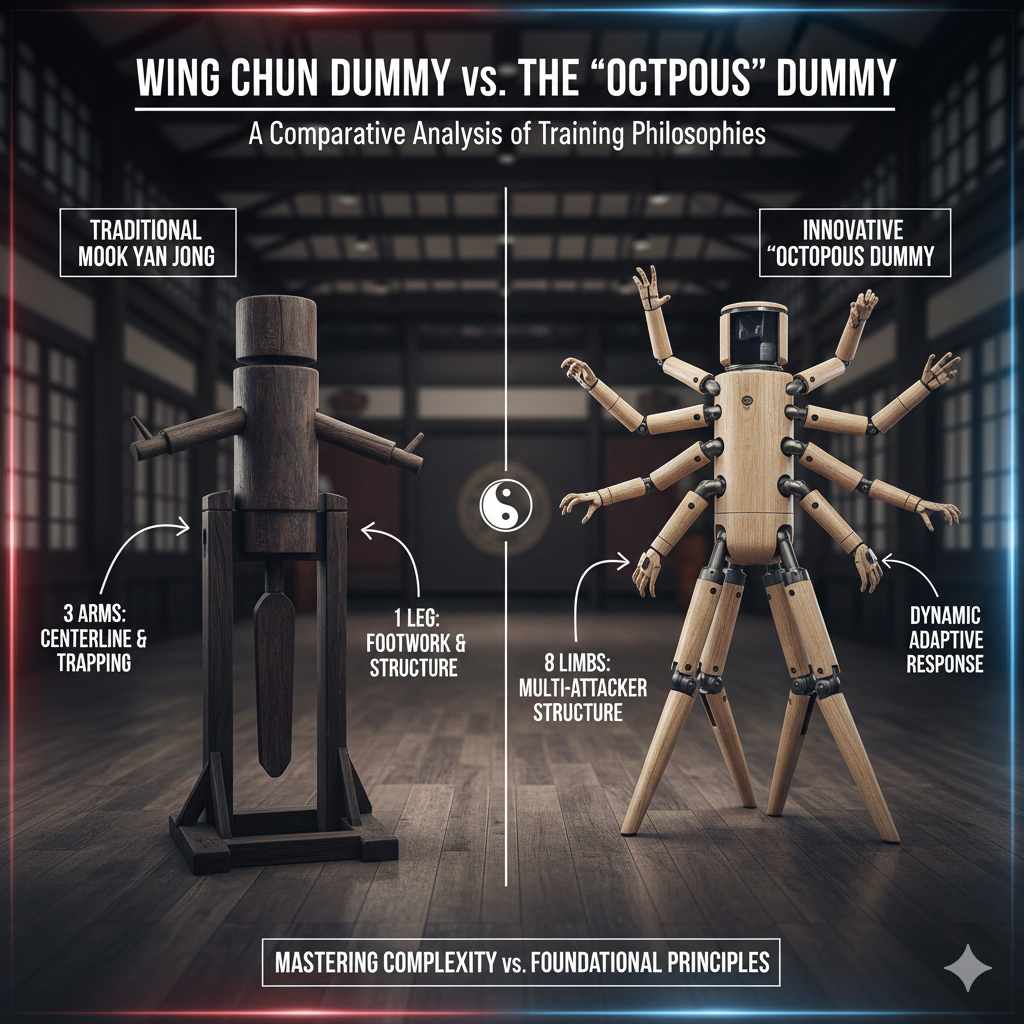
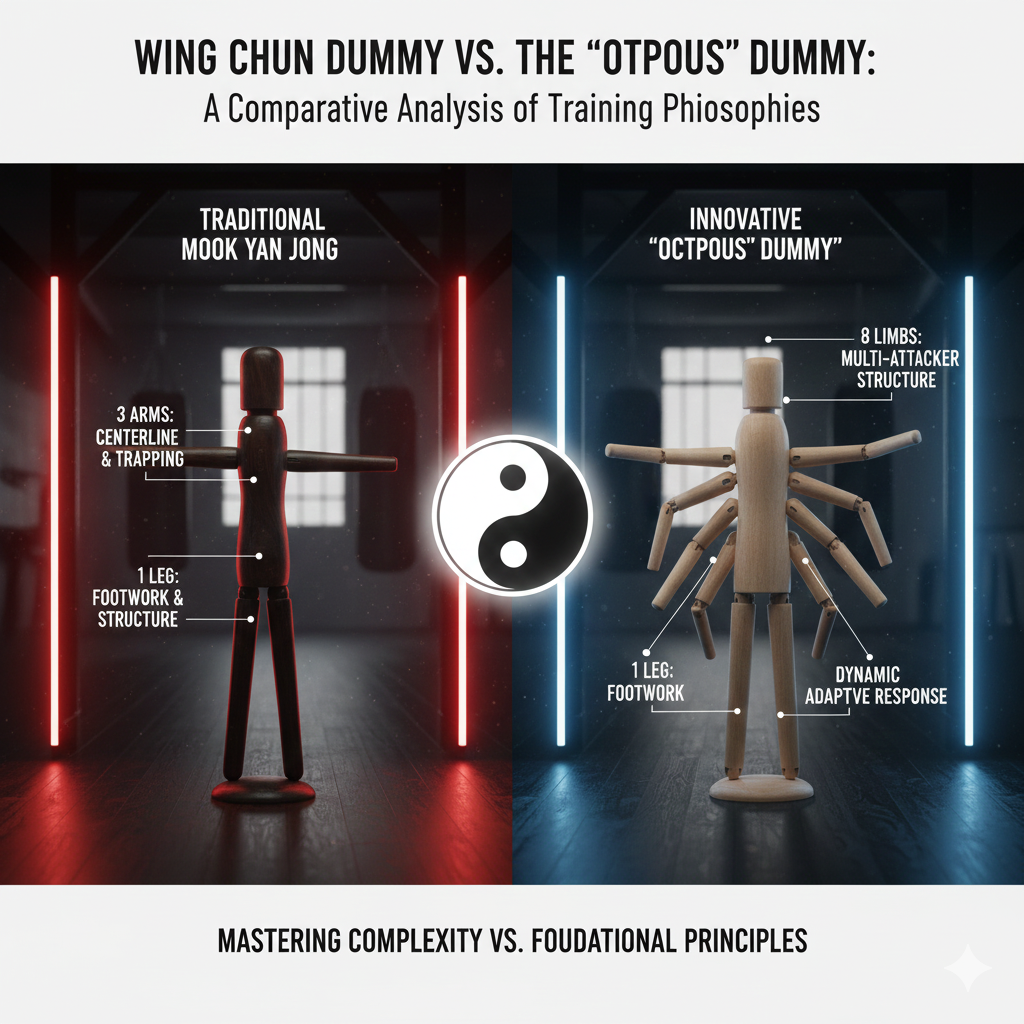
Its design is intentionally minimalist, featuring three arms (two upper, one middle) and one leg, all strategically placed to represent the most common lines of attack and defense. 🔗
The philosophy behind this design is that by mastering the principles on this simple, unyielding structure, the practitioner can apply them to any complex, real-world scenario. 🧠
Structural Integrity and Feedback
The Mook Yan Jong’s primary function is to provide honest, immediate feedback on the practitioner’s structure. 🌳
Any misalignment in stance, angle, or force will result in a jarring impact, forcing the practitioner to correct their form instantly. 🤕
The arms are positioned to train the crucial trapping and bridging techniques, teaching the practitioner to control the opponent’s limbs while simultaneously striking the centerline. 🎯
The traditional dummy is a master of the single-opponent, close-range fight, focusing on the shortest path to victory through structural dominance. 🏆
Its unyielding nature forces the practitioner to develop internal power and the ability to “borrow” the dummy’s resistance to fuel their next movement. 🔄
The Form as a Blueprint
The 116 movements of the Mook Yan Jong form are a codified system that integrates the principles of the three empty-hand forms (Siu Nim Tau, Chum Kiu, Biu Gee). 📜
The dummy provides the physical framework for this form, ensuring that the movements are practiced with the correct angles and distances. 📏
The training is sequential and focused, building a deep, reflexive understanding of Wing Chun’s core combat strategy. 🧠
This video showcases the traditional Mook Yan Jong form, demonstrating the precise, economical movements the dummy is designed to cultivate. 🎥
The “Octopus” Dummy: Expanding the Possibilities
The “Octopus” Dummy, designed by Sifu Randy Williams, is a modern evolution of the traditional design. 🐙
Its most striking feature is its expanded number of limbs—eight arms—which dramatically increases the complexity and training possibilities. 🤯
The philosophy behind the Octopus is to prepare the practitioner for a wider range of scenarios, particularly those involving multiple lines of attack or multiple opponents. ⚔️
Simulating Multiple Attackers and Angles
With eight arms, the Octopus dummy can simulate a more chaotic and complex environment than the traditional model. 🌪️
The additional limbs allow for the practice of simultaneous control over multiple lines of force, which is essential for dealing with an opponent who is grappling, striking, or even two opponents at once. 🤝
This design opens doors for more techniques and footwork, allowing the practitioner to drill movements that might be considered “outside” the traditional form. 🚀
The Octopus is a tool for training adaptability and peripheral awareness, forcing the practitioner to manage a wider field of contact and threat simultaneously. 🧠
Versatility and Partner Training
Another key advantage of the Octopus design is its versatility. 🔄
The expanded limb configuration allows for two practitioners to train on the dummy simultaneously, working on partner drills, Chi Sau concepts, and coordinated attacks. 👯
Furthermore, the extra arms can be used to simulate different types of attacks, such as a high guard, a low grab, or a weapon, making the training more scenario-specific. 🚨
The Octopus is often built with interchangeable arms, allowing for the addition of padded or spring-loaded limbs to further customize the training experience. 🛠️
This video provides a preview of the Octopus dummy, highlighting its unique multi-limbed structure and potential for advanced, complex training. 🎥
Comparative Analysis: Philosophy and Application
The choice between the two dummies is not about which is “better,” but which aligns more closely with the practitioner’s current training goals and philosophical approach to Wing Chun. ⚖️
The traditional dummy is about depth; the Octopus is about breadth. 🌊
Depth vs. Breadth of Training
The Traditional Mook Yan Jong forces the practitioner to find the most efficient solution within a highly constrained environment. 🎯
It demands structural perfection and a deep understanding of the core principles, which is why it is often introduced later in the curriculum. 📜
The Octopus Dummy encourages exploration and adaptability. It allows the practitioner to experiment with a wider range of techniques and to develop the ability to manage complex, multi-faceted threats. 🤯
It is an excellent tool for bridging the gap between the controlled environment of the form and the chaos of a real fight. ⚔️
The traditional dummy teaches you why a technique works; the Octopus teaches you where else it can work. 💡
The Question of Authenticity
Some traditionalists argue that the Octopus dummy deviates too far from the original design, potentially diluting the core lessons of Wing Chun. 🙅
They contend that the extra limbs introduce unnecessary complexity and distract from the focus on the centerline and the three primary attack lines. ❌
Conversely, proponents of the Octopus argue that the traditional dummy is an abstraction, and the Octopus is a more realistic abstraction, better preparing the student for the unpredictable nature of modern combat. 🛡️
Ultimately, the authenticity of the training lies not in the number of limbs, but in the principles the practitioner applies. 💯
This video showcases a custom Octopus dummy with interchangeable padded spring arms, demonstrating the high degree of customization possible with this design. 🎥
Structural and Training Comparison
The table below provides a side-by-side comparison of the two dummy designs. 📊
| Feature | Traditional Mook Yan Jong | “Octopus” Dummy |
|---|---|---|
| Number of Limbs | 3 Arms, 1 Leg (4 total points of contact) | 8 Arms, 1 Leg (9 total points of contact) |
| Primary Training Focus | Structural perfection, centerline control, form choreography. | Managing multiple lines of attack, adaptability, complex scenarios. |
| Feedback Mechanism | Subtle recoil from frame movement; honest structural jarring. | High complexity of contact; excellent for peripheral awareness. |
| Best For | Deepening foundational principles and internal power. | Advanced students seeking to apply principles in chaotic, multi-limbed exchanges. |
| Partner Training | Single practitioner only. | Can accommodate two practitioners simultaneously. |
Conclusion: The Future of Wing Chun Training
The comparison between the traditional Mook Yan Jong and the “Octopus” Dummy is a fascinating look at the evolution of martial arts training tools. 📈
The traditional dummy remains the essential tool for building the core structural foundation of Wing Chun. It is the necessary starting point for any serious practitioner. 🌳
The Octopus dummy, however, represents a valuable advanced training tool, offering a unique way to test the principles learned on the traditional dummy against a far more complex and demanding structure. 🤯
For the complete practitioner, the ideal scenario involves training on both: mastering the economy of motion on the Mook Yan Jong, and then testing that mastery against the chaos of the Octopus. 🏆
The Octopus is not a replacement for the Mook Yan Jong; it is a challenging, modern supplement that pushes the boundaries of Wing Chun adaptability. 🚀
Embrace the challenge of both, and let your training evolve to meet the demands of any opponent, no matter how many limbs they present. 🙏
References
[1] WING CHUN WOODEN DUMMY: Warrior – OCTOPUS – Everything Wing Chun
[2] THE OCTOPUS ” with Modern Free Stand” – Warrior Martial Art Supply
[3] ” THE OCTOPUS ” with Modern Free Stand – Wing Chun Kwoon