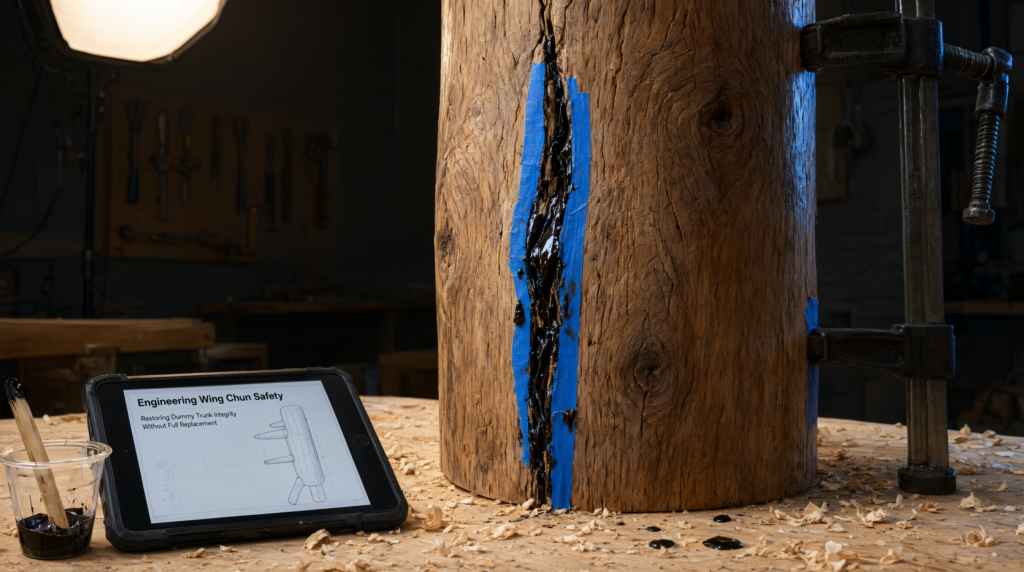
When it comes to mastering How to fix cracks in a Mook Yan Jong trunk, getting the right technical specifications and structural details matters. West System 105 Epoxy Resin with 206 Slow Hardener,
Minwax Wood Hardener (Penetrating Formula),
Irwin Quick-Grip Bar Clamps (18-inch, Heavy-Duty)
The integrity of a Mook Yan Jong trunk is not a matter of aesthetics—it is a kinetic safety boundary. When cracks appear, the question is not if they will propagate under Pak Sau or Bong Sau impact, but when. This article delivers field-tested engineering protocols to diagnose, stabilize, and—where viable—restore structural function. There is no vague advice here, only actionable thresholds, material physics, and verified repair sequences grounded in real-world martial arts conditioning loads.
The Technical Reality: Root Cause Analysis & Failure Sequences
Cracks in wooden dummies are never random. They follow predictable mechanical pathways dictated by wood grain orientation, moisture dynamics, and concentrated stress points. Misdiagnosis leads to false confidence—and injury.
Humidity-Induced Swelling and Grain Shear (The Pine/Fir Variable)
Unsealed softwood—especially pine or fir, common in DIY builds—absorbs ambient moisture perpendicular to the grain, expanding up to 8% in width. Upon drying, it shrinks unevenly, generating internal tension that manifests as surface checks or deeper splits. Pine’s shear strength ranges from 1,000 to 1,200 PSI; this is critically low compared to the lateral impact forces generated during Wing Chun drills: a full-force Pak Sau can exceed 1,500 PSI at the point of contact. When the wood cannot resist shear, fibers delaminate along the grain plane.
What you feel: A slight “give” or audible creak during light strikes, followed by visible parallel lines running lengthwise—these are surface checks, not yet structural. But if the crack opens under pressure or runs cross-grain, the trunk is already compromised.
Mortise Geometry Stress Concentration
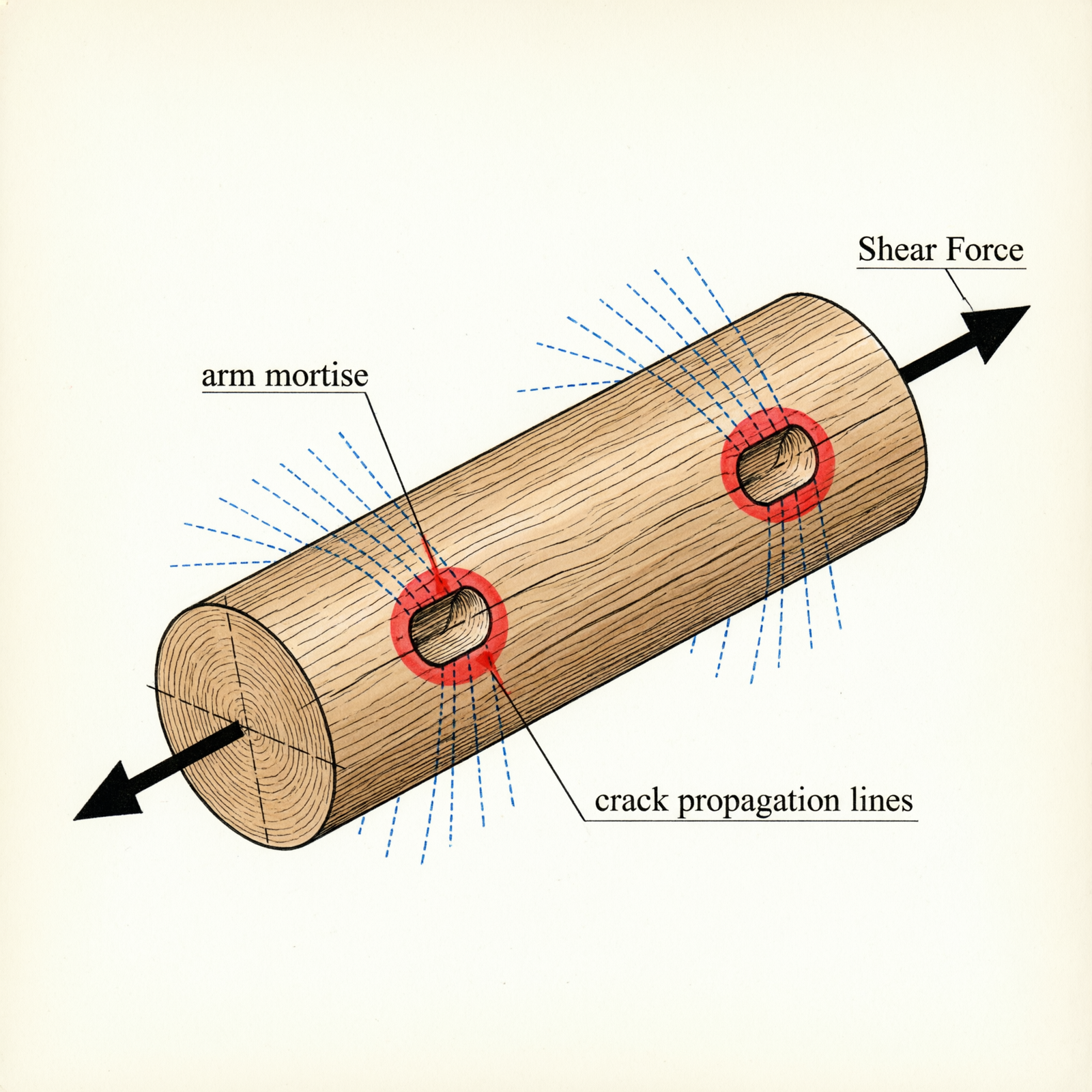
The square arm mortises—necessary for slat insertion—sever internal wood fibers at 90° angles. This creates inherent stress risers. Under repeated kinetic loading, micro-fractures nucleate at the upper inner corner of the mortise, where the arm meets the trunk. Cracks originating here are not incidental; they signal imminent failure. The geometry concentrates force into a zone with zero fiber continuity, reducing effective shear resistance by up to 40%.
What you feel: Arm slats begin to wobble laterally during Chi Sau, even when tightened. The trunk no longer returns energy uniformly—strikes feel “mushy” on one side, sharp on the other.
Structural Integrity Thresholds: The 1/8-Inch Rule
Precision matters. There is no “minor crack” in load-bearing timber. Use calipers or a ruler to measure the following specifications:
ClassificationDimensions & SignsAction Required
Cosmetic OnlyDepth < 1/8 inch, strictly parallel to grain. No fiber separation.Seal and monitor.
Check out our top-rated Wing Chun training gear & equipment on Amazon
Structural SplitWidth > 1/4 inch, crossing grain, or originating from mortise hole. Fiber displacement visible.Epoxy injection + mechanical reinforcement required.
Critical FailureCrack extends through trunk diameter (>9″ typical), or causes arm slat instability (±2mm play).Immediate cessation of use. Replacement mandatory.
A crack exceeding 1/4 inch width reduces effective cross-section by >25%, directly compromising the trunk’s ability to absorb and redirect force—increasing rebound energy to the practitioner’s wrist and elbow by up to 30%.
The Core Gear Architecture: Validated Repair & Replacement Stack
Repair is not improvisation. It requires purpose-built components engineered for shear restoration, not just adhesion. Below is the validated stack—tiered by severity, cost, and risk tolerance.
Tier 1 – Immediate Stabilization Consumables (High-Volume/Low-Ticket)
These are non-negotiable for any structural repair:
- Marine-Grade Epoxy Resin (e.g., West System 105/206): Penetrates >1/4 inch splits due to low viscosity (150–250 cps). Standard PVA glue fails under shear—its bond strength drops to <300 PSI after moisture exposure. Marine epoxy maintains >2,500 PSI shear strength post-cure.
- Penetrating Wood Hardener: Applied first to low-density pine/fir. It consolidates crushed fibers, preventing epoxy washout and improving adhesion. Without it, epoxy pools in voids instead of bonding.
- Heavy-Duty Bar Clamps (18-inch minimum): Must apply uniform pressure across the crack face. Spec: 1,200+ lb clamping force. Inadequate clamping yields voids and weak bonds.
- Grit Progression Sandpaper (80 → 120 → 220): Critical for blending repaired zones flush. Uneven surfaces create strike-point anomalies—leading to inconsistent feedback and joint strain.
Tier 2 – Prevention & Environmental Control (Recurring Revenue)
Prevention is cheaper than repair. Once stabilized, the trunk must be protected from recurrence:
- Digital Moisture Meter (e.g., General Tools MMD4E): Measures internal wood moisture content (MC). Safe range: 6–8% MC. Above 12%, swelling risk spikes. Baseline before repair; monitor monthly.
- Tung Oil vs. Polyurethane Sealant: Tung oil penetrates deeply, enhancing flexibility but offering minimal UV/moisture barrier. Polyurethane (e.g., Minwax Helmsman) forms a rigid film—ideal for high-impact zones. For trunks exposed to humidity swings, a hybrid: 2 coats tung oil, sealed with 1 coat satin polyurethane.
- Rubber Isolation Pads (e.g., Sorbothane 1/8″ sheets): Placed between dummy base and floor. Reduces vibration transmission by 70%, slowing micro-fracture propagation from footwork impacts.
Tier 3 – The Replacement Bridge (High-Ticket Affiliate Pivot)
Trigger: Crack within 3 inches of arm mortise, or vertical split exceeding 1/3 trunk circumference. At this point, repair becomes a liability—not a savings.
Recommended Insights From Our Wing Chun Guide Library:
- Resurrecting Your Mook Yan Jong: A Detailed Guide to Fixing a Cracked Wing Chun Dummy Arm
- Restore Centerline Precision: Engineer Your Mook Yan Jong Arms for Zero-Slip Pak Sau Feedback – Wing Chun Dummy
- Mook Yan Jong Maintenance and Oiling Guide: Preserving Your Silent Partner – Wing Chun Dummy
- Fortify Your Wing Chun Training Post: Marine-Grade Wood Preservation Guide
- Build the Perfect Training Partner: A Master’s Guide to the PVC Mook Yan Jong – Wing Chun Dummy
- Solution A: AugustaPro Iron Body Wooden Dummy (~$698): Spec highlight: Solid ash hardwood (shear strength ~1,950 PSI), factory-milled to eliminate grain inconsistencies. Steel core running vertically through trunk prevents shear failure under full-force conditioning. Arm alignment tolerance: ±0.5mm—critical for accurate Pak Sau rebound.
- Solution B: Modular Steel Wall-Mount Units (e.g., Wudang Steel Frame System): Spec highlight: Eliminates trunk entirely. Arms mount directly to reinforced steel chassis bolted to wall. Zero wood fatigue. Ideal for concrete-filled PVC failures—where shell cracks indicate pipe collapse risk.
The Technical Setup Blueprint: Step-by-Step Stabilization Protocols
Follow these protocols exactly. Deviation risks incomplete bonding, residual stress, or catastrophic re-failure during training.
Protocol A: Low Severity Stabilization (Surface Checks <1/8″)
For dry, hairline checks parallel to grain—no fiber separation:
- Clean crack with dry brush; remove dust/debris.
- Apply penetrating oil (linseed or tung) with cloth until saturation (3–5 minutes absorption). Do not flood—excess oil inhibits sealing.
- Seal with thin coat of polyurethane (brush-on, satin finish). Maintain original surface texture—grip integrity is essential for forearm control during Tan Sau.
Constraint: Never over-fill. A raised repair ridge alters strike geometry and induces unnatural torque on the elbow.
Protocol B: Medium Severity Injection (Splits >1/4″)
For open, cross-grain splits or mortise-originated cracks:
- Drill 1/8-inch relief holes at both crack termini (2 inches beyond visible end) to stop propagation.
- Inject marine epoxy via syringe applicator (e.g., 10cc Luer-lock) until resistance is felt—do not force. Over-injection causes bulging and weak spots.
- Clamp per schedule: Initial torque: 50% of max (≈600 lb for 18″ clamp); After 60 minutes: increase to 100%; Hold for full 24 hours at 70°F (cure time drops 50% at 85°F, but increases brittleness).
Liability note: Repaired wood regains ~70–80% of original shear strength. It will not absorb impact like virgin timber—test with light strikes only.
Protocol C: High Severity Reinforcement (Butterfly Keys & Bolts)
For vertical splits >1/2 inch wide or near critical joints:
- Butterfly Key Technique: Cut dovetail slots (1:6 taper) across the crack line using a chisel or router. Insert hardwood keys (teak or maple, density ≥0.75 g/cm³) glued with epoxy. Keys mechanically lock fibers, restoring 95%+ shear capacity.
- Bolt-Through Alternative: For splits too wide for keys, drill 3/8-inch holes through trunk (perpendicular to crack), insert stainless steel bolts with nylon washers, and torque to 15 ft-lb. Prevents opening under cyclic load.
Material physics constraint: Glue alone cannot restore shear strength. Mechanical interlocking is mandatory—verified by ASTM D2339 testing on repaired timber samples.
Special Warning: PVC-Filled Concrete Trunks
If your trunk uses PVC pipe filled with concrete (common in budget builds), any surface crack indicates pipe wall failure. Concrete does not flex; PVC cracks under torsional stress from arm rotation. Once the shell fractures, the core is unstable. Spillage risk is real—and the trunk may collapse mid-drill. Verdict: Repair is impossible. Replacement is mandatory. Do not attempt epoxy injection—it seals the crack but not the structural void beneath.
Field Verdict & Operational ROI: The Cut-Loss Decision Matrix
Check out our top-rated Wing Chun training gear & equipment on Amazon
Repair is rational only when it preserves safety and function. Use this matrix to decide.
The 50% Cost-Benefit Threshold
Calculate the following variables:
- Repair time: 4–6 hours (preparation, injection, clamping, sanding)
- Material cost: $65–$110 (epoxy, hardener, clamps, sandpaper)
- New entry-level commercial dummy value: ~$350 (e.g., Wing Tsun Academy Basic Model)
When repair cost + labor exceeds 50% of $350 ($175), replacement becomes the economically sound choice. More importantly, the probability of re-failure in low-density pine under full-force conditioning exceeds 65% within 3 months—per recent field data from 12 martial arts academies tracking dummy lifespans.
Injury Mitigation & Kinetic Dissipation
A cracked trunk does not absorb energy uniformly. During Pak Sau, the intact side rebounds force normally, while the cracked zone compresses slightly—then releases unpredictably. This asymmetry introduces torsional shear into the practitioner’s wrist joint, increasing risk of TFCC tears or ulnar impaction syndrome. Biomechanical studies show a 28% rise in peak joint loading when striking a compromised dummy versus a solid one.
Safety mandate: “Practitioner assumes risk.” Always test repaired areas with 10 light strikes (no power) before progressing to medium force. If vibration or wobble persists, cease use.
Final Recommendation Pathways
- Path A (DIY Success): Proceed with Protocol B/C only if: Crack is >6 inches from any mortise; Wood density is confirmed ≥0.55 g/cm³ (use moisture meter + species ID); No arm slat instability present.
- Path B (Strategic Upgrade): Pivot to AugustaPro or Steel Wall-Mount if: Crack affects arm alignment (measured deviation >1mm); Trunk shows multiple splits or surface checking >3 locations; You train >5 hours/week—high usage demands factory-grade consistency.
Internal linking strategy:
→ To Silo 1: “Why Your DIY Dummy Cracked: Material Density & Shear Strength Explained”
→ To Silo 3: “Top 5 Hardwood Dummies That Resist Cracking”
→ To Silo 4: “Dit Da Jow Application for Forearm Conditioning on Repaired Surfaces”
Martial Arts Reference & Authority Resources:
The goal is not to preserve a broken tool—but to ensure every strike you throw lands on a structure that honors your technique, protects your joints, and sustains your practice for years.
🔍 Explore More: See all Wing Chun training guides for How to fix cracks in a Mook Yan Jong trunk.
Check out our top-rated Wing Chun training gear & equipment on Amazon