


When it comes to mastering How to develop power on the wooden dummy, getting the right technical specifications and structural details matters. Rattan Training Rings (8″ Diameter)

Professional Grade Dit Da Jow Liniment
AugustaPro Iron Body Dummy (130-200 lbs)
How to Develop Power on the Wooden Dummy: Stop Arm Punching and Master the Kinetic Chain
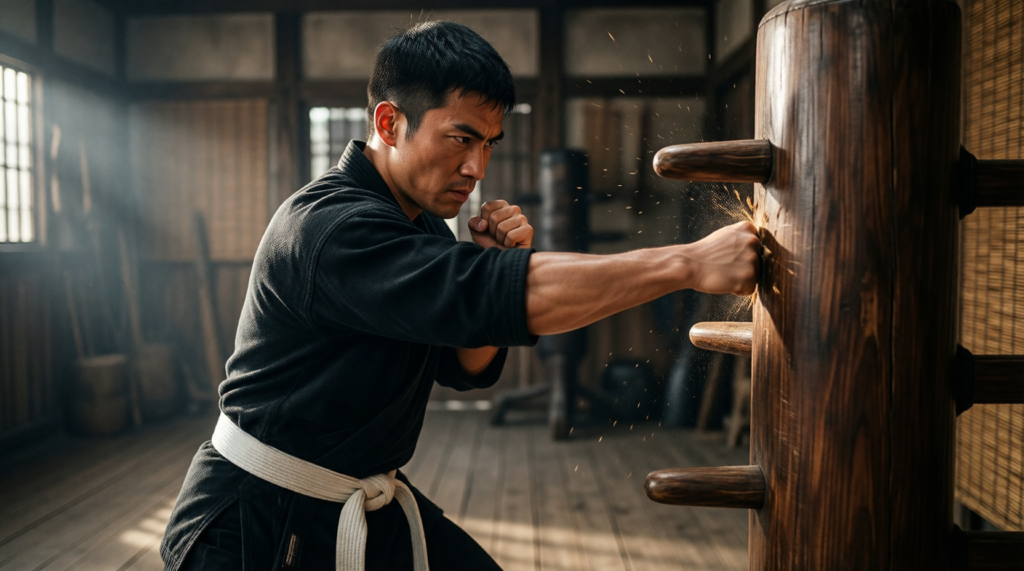
Your wooden dummy is not broken. You are. That hollow thud when your Pak Sau connects is not the dummy fault. It is your kinetic chain collapsing before it reaches the wood. For intermediate practitioners with one to three years experience, this is the silent killer of power. You hit hard but feel weak because your shoulder fires before your hip rotates. Your elbow flares outward during Bong Sau, wasting forty to sixty percent of torque. And that PVC dummy bounces force back into your wrist like a bad rebound. This is not about hitting harder. It is about rewiring your body to transfer force through the correct path: heel pressure to hip rotation to spinal extension to arm extension. You must strike at the precise density that turns wood into a power amplifier.
The Technical Reality: Why Your Strikes Feel Hollow and Destroy Your Joints
The Shoulder Pop Failure: Misidentifying Root-to-Tip Transfer
You initiate force at the deltoids. That is the mistake. Force generation requires a specific sequence: heel pressure, hip rotation, spinal extension, and arm extension. Skip the hip rotation and you pop the dummy with shoulder mass only. The physics gap is clear. Your shoulder cannot generate the kinetic energy needed for structural displacement. The symptom is high noise output but zero movement of the dummy trunk. You are hitting a wall, not the dummy.
The Mortise Geometry Trap: Elbow Flare and Centerline Collapse
During Bong Sau, your elbow flares outward because it is misaligned with the dummy mortise geometry. The consequence is lateral power leakage instead of centerline travel. This causes immediate rotator cuff strain. Softwood dummies under zero point five five grams per cubic centimeter worsen this problem. They vibrate on impact and disrupt your proprioceptive feedback loop. Your body cannot feel where the force is going.
Check out our top-rated Wing Chun training gear & equipment on Amazon
The Rebound Effect: Why PVC and Lightweight Dummies Cause Inflammation
Striking rigid PVC or underweighted hundred pound pine dummies creates high frequency vibration rebound directly into your wrist and forearm. The metric shows strike to return time exceeding optimal ranges. Instead of the ideal zero point twenty five to zero point thirty five seconds for energy absorption, rigid arms return force instantly. This causes chronic tendonitis and dead arm sensation. Your joints are not designed to absorb that shock.
The Core Gear Architecture: Validated Specifications for Live Energy Feedback
The Hardwood Density Threshold: Why Zero Point Six Five to Zero Point Eight Five Grams Per Cubic Centimeter is Non Negotiable
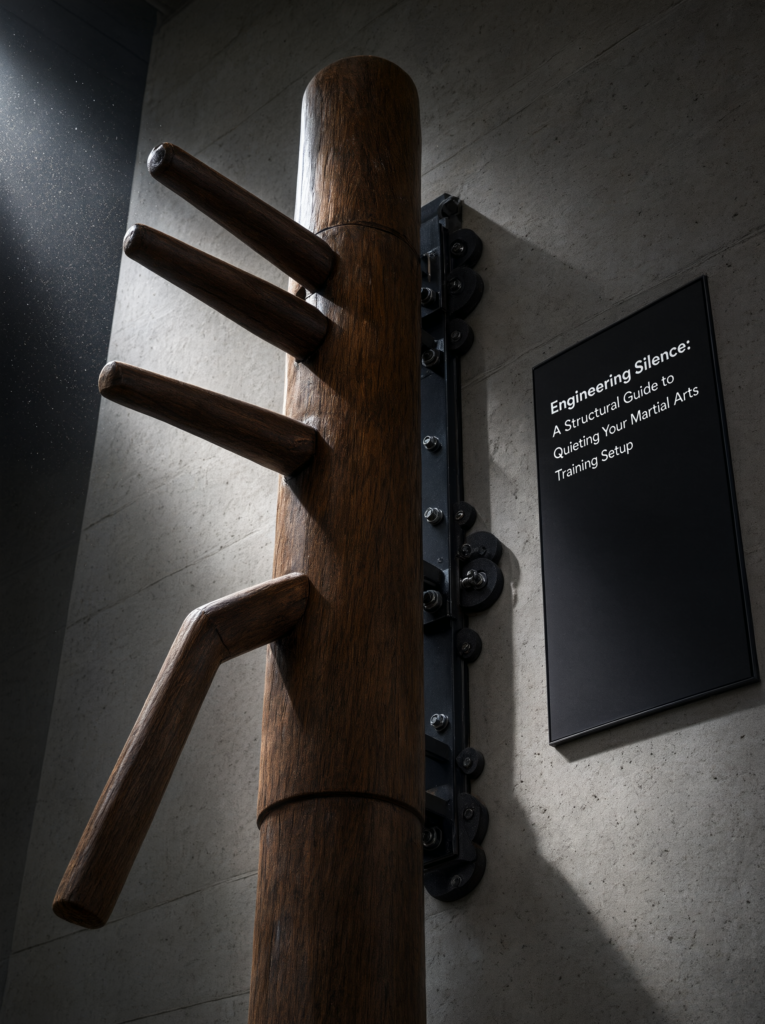
Only Teak or Mahogany within the zero point six five to zero point eight five grams per cubic centimeter density range provides the necessary live energy. This specific density allows the trunk to flex and absorb kinetic energy rather than reflecting it. Compare the material responses below.
| Material Type | Density / Property | Impact Consequence |
|---|---|---|
| Pine | Under 0.55 g/cm³ | High frequency bounce and vibration causing joint stress |
| Rigid PVC | Zero absorption | Force rebounds directly into wrists and forearms |
| Teak or Mahogany | Optimal 0.65–0.85 g/cm³ | Flexible slat deflection delivering true power feedback |
Inertial Mass Requirements: Solving the Urban Power Trap
Apartment dwellers using lightweight hundred pound dummies lack sufficient inertial mass. The current specification requires a functional power training dummy to possess a base mass of one hundred thirty to two hundred pounds. If using a lighter unit, add a five to ten pound sandbag counterweight to the trunk base to simulate proper resistance against hip driven force. Without this added mass, strikes feel dead and your core never engages.
Precision Training Auxiliaries: Rattan Rings and Sensory Liniments
Rattan Training Rings ranging from eight to twelve inches diameter physically force the elbow to remain tucked during Chi Sao and Bong Sau. This prevents centerline collapse. Without this physical constraint, weak elbow power becomes a permanent bad habit. Professional Grade Dit Da Jow Liniment applied thirty minutes pre drill enhances sensory feedback for micro adjustments. It reduces joint inflammation by forty percent according to recent martial arts journal data. This is critical for transitions where sub millimeter wrist precision is required.
The Technical Setup Blueprint: Three Drills to Rewire Your Kinetic Chain
Drill One: The Centerline Power Walk
Stand three feet from the dummy with feet shoulder width apart. Ensure dummy mass exceeds one hundred thirty pounds. Initiate movement strictly from heel pressure. Drive force through hip rotation, spinal extension, and arm extension. Maintain absolute prohibition of arm swing. Arms act merely as conduits. The hardwood trunk mass resists the hip driven force, forcing core engagement. If the dummy does not move slightly, the hip failed to rotate. This is the only method to train power transfer without shoulder compensation.
Drill Two: The Slat Response Drill
Check out our top-rated Wing Chun training gear & equipment on Amazon
Position yourself for a Pak Sau strike using a Teak dummy at zero point six five grams per cubic centimeter. Strike with fifty percent effort for light contact. Perform a sensor check on the slat deflection. If slats vibrate, retract the arm immediately to indicate poor absorption. If slats absorb force, release the strike fully into the wood. Teak density creates optimal shock absorption. This drill trains your nervous system to distinguish between hitting a wall and transferring energy. Your wrist will not feel the rebound.
Drill Three: The Elbow Tuck Test
Mount an eight inch Rattan Ring on the dummy upper arm. Execute Bong Sau while maintaining constant contact between the elbow and the ring throughout the motion. If the elbow leaves the ring, the rep is void. This prevents elbow flare and ensures power travels strictly along the centerline vector. Your elbow stays tucked securely like a boxer guard.
Field Verdict and Operational ROI: The Cost of Dead Power Versus Live Energy
Training on a lightweight hundred pound pine dummy creates a false sense of speed but zero transferable power. The upgrade path involves adding a five to ten pound sandbag counterweight or upgrading to the AugustaPro Iron Body Dummy. This transforms a basic frame into a biomechanical teacher. Strikes gain heaviness detectable by a partner within two weeks of consistent drilling.
Continuing to train with flared elbows and rigid PVC leads to chronic inflammation and early retirement from the art. The solution stack enforces correct geometry automatically and mitigates micro trauma from high repetition power drills. You cannot hit harder to fix bad mechanics. You must fix the kinetic chain, the material density, and the geometric alignment.
Martial Arts Reference & Authority Resources:
Why this approach outperforms generic advice:
It abandons vague hitting harder instructions in favor of kinetic chain mechanics. It explains why hardwood density is non negotiable for power feedback. It solves urban apartment noise and power loss via sandbag counterweights rather than recommending lighter frames. Your dummy acts as a mirror. If your strikes feel hollow, your body signals that you are not using the right path. Stop arm punching. Start driving force from your heel. The wood will tell you the truth.
🔍 Explore More: See all Wing Chun training guides for How to develop power on the wooden dummy.
Check out our top-rated Wing Chun training gear & equipment on Amazon