
The Wing Chun wooden dummy, or Mook Yan Jong, is a masterpiece of traditional martial arts engineering. 🥋
It is designed to be a fixed, unyielding partner. 💪
This forces the practitioner to adapt their structure, angle, and force. 📐
However, in the modern era, the pursuit of martial arts excellence is increasingly intersecting with technology. 💡
While the traditional dummy teaches *how* to strike, modern additions like striking targets and sophisticated sensors are now teaching us *how well* we strike. 📊
This comprehensive guide explores the critical striking targets on the Mook Yan Jong. 🎯
It also delves into the exciting world of sensor technology that is revolutionizing the way Wing Chun practitioners train. 🚀
We will show you how to gain objective, measurable feedback to accelerate your development. 🤓
The Traditional Striking Targets of the Mook Yan Jong
The Mook Yan Jong is not a simple punching bag. 🙅
It is a representation of the human body in a specific stance. 🧍
Every part of the dummy—the arms, the leg, and the trunk—serves as a target for a specific technique. 🎯
This teaches precision, distance, and angle. 📐
The core striking area is the main trunk. 🌳
This represents the opponent’s centerline. 🌀
The goal is to deliver force along this centerline. 💪
This is a fundamental principle of Wing Chun. 🔑
- The Arms: The three arms are primarily used for trapping, deflecting, and controlling the opponent’s limbs. However, they are also targets for techniques like the Pak Sao (Slapping Hand) and Jut Sao (Jerking Hand). These are designed to break the opponent’s structure or create an opening.
- The Trunk: The main body is the primary target for all forward striking energy. This includes the Chain Punch (Lian Wan Kuen). The striking surface is typically padded with a leather or canvas cover to protect the hands. The underlying goal is to penetrate the target with focused, short-range power.
- The Leg: The single leg is a target for low-line attacks, sweeps, and traps. It teaches the practitioner to manage the opponent’s lower gate. It also helps to deliver powerful, low kicks with the correct angle and structure.
Traditional training relies on the practitioner’s internal feedback. 🧘
This includes the feel of the strike, the vibration of the wood, and the stability of their own stance. 🧠
This subjective feedback is invaluable. 🏆
However, it lacks the objective data needed for precise performance tracking. 📈
Enhancing Training with Padded Striking Targets
To bridge the gap between the unyielding wood and the need for conditioning, many practitioners add padded striking targets to their dummies. 🛡️
These targets are typically made of high-density foam or leather-wrapped canvas. 🧱
They are strapped directly onto the dummy’s trunk. 🔗
They serve several key purposes. 🔑
- Hand Conditioning: They allow for full-power striking without the risk of damaging the hands on the bare wood. This gradually conditions the knuckles and forearms.
- Target Focus: They provide a clear visual target. This improves the practitioner’s precision and focus on the exact point of impact. This is crucial for developing the “inch-power” that Wing Chun is famous for. 💥
- Sound Feedback: A well-executed strike on a padded target produces a satisfying, sharp “thwack.” This offers immediate auditory feedback on the quality of the strike. 👂
While simple, these targets are a cost-effective way to enhance the dummy’s utility. 💸
They turn it into a tool for both structural work and power development. 💪
The Digital Revolution: Force Sensors and Smart Dummies
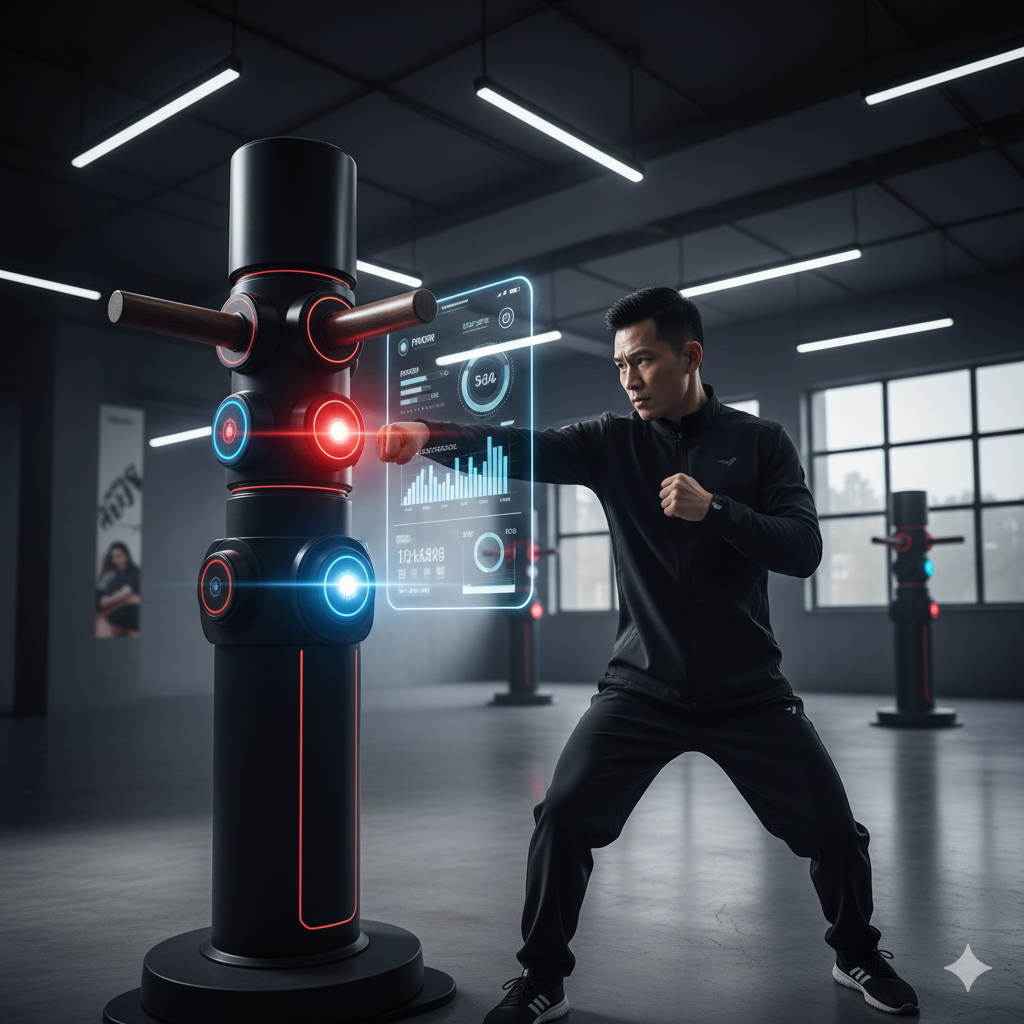
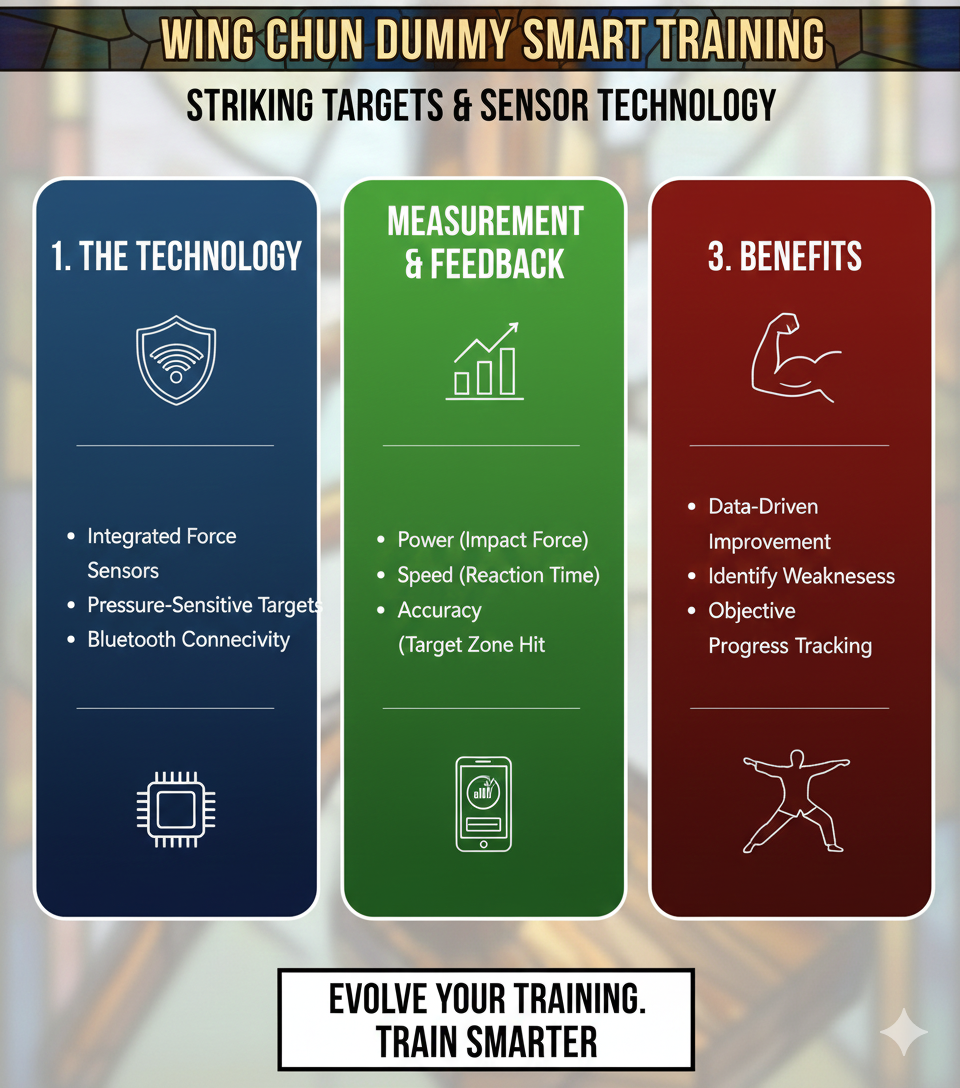
The most significant advancement in Mook Yan Jong training is the integration of sensor technology. 🚀
Modern “smart dummies” are equipped with various types of sensors. 📊
These sensors capture objective data on every interaction. 📈
Type 1: Piezoelectric and Pressure Sensors
These sensors are embedded beneath the striking surface of the dummy’s trunk and arms. 🔬
They measure the force and pressure of a strike. 📉
This provides real-time data on: 📈
- Peak Force: The maximum power generated in a single strike.
- Force Distribution: How the force is spread across the striking surface. This is vital for correcting misaligned punches.
- Rate of Force Development (RFD): How quickly the peak force is achieved. This is a key metric for explosive Wing Chun power. This objective data allows a practitioner to move beyond subjective feeling and focus on measurable improvement. 🎯
Type 2: Accelerometers and Gyroscopes
These sensors are typically placed within the arms and leg of the dummy. ⚙️
They measure the movement, vibration, and angle of the dummy components upon impact. 🔄
This is particularly useful for analyzing the quality of trapping and controlling techniques. 🖐️
For example, a poorly executed Bong Sao (Wing Arm) might cause excessive, uncontrolled vibration in the dummy’s arm. 📉
The sensor will record this. 💾
The data helps the practitioner understand the difference between a solid, structural block and a loose, ineffective deflection. 💡
Comparison of Traditional vs. Sensor-Enhanced Training
| Training Method | Feedback Type | Key Metric Measured | Primary Benefit |
|---|---|---|---|
| Traditional (Bare Wood) | Subjective (Feel, Sound) | Structural Integrity, Distance | Developing internal feel and sensitivity. |
| Padded Targets | Semi-Objective (Auditory, Visual) | Target Precision, Hand Conditioning | Improving accuracy and physical toughness. |
| Sensor-Enhanced (Smart Dummy) | Objective (Data, Visual Display) | Peak Force, Speed, Accuracy, RFD | Quantifying performance and tracking progress. |
The Future of Wing Chun Training: Data-Driven Mastery
The integration of sensors into the Mook Yan Jong moves Wing Chun training into the realm of sports science. 🔬
The data collected by these systems can be used to create personalized training programs. 📅
They can also identify plateaus and track long-term progress with unprecedented accuracy. 📈
Imagine a system that tells you: “Your right-hand Tan Sao is consistently 15% weaker than your left, and your force is decaying too quickly.” 🤯
This level of detail allows the practitioner to focus their efforts precisely where they are needed most. 🎯
It eliminates guesswork. ❌
While a full smart dummy can be a significant investment, the technology is becoming more accessible. 💸
DIY projects, such as those using Arduino and simple force-sensitive resistors, are making it possible for tech-savvy practitioners to build their own sensor systems. 🛠️
Whether you choose the simplicity of a padded target or the complexity of a full sensor suite, the goal remains the same. ✅
That goal is to use the Mook Yan Jong to perfect your Wing Chun. 🏆
The dummy is a constant. 🔄
The feedback mechanism is simply a tool to better understand your variable performance. 💡
Final Thoughts and Resources
The Mook Yan Jong is a timeless tool. 🕰️
Its core value remains in its ability to teach structure and precision. 🏆
Striking targets and sensors are powerful modern enhancements. 🤝
They provide objective data to complement the traditional, subjective feel of the training. 🧠
Embrace the technology that helps you measure your progress. 📈
But never forget the fundamental principles the dummy was designed to teach. 🔑
To further your understanding of the dummy and its applications, consult these high-authority resources. 📚
Explore the Mook Yan Jong form and its 116 movements. The Wing Chun forms are the blueprint for your training.
Learn about the traditional striking areas and their purpose. Wikipedia provides a comprehensive overview of Wing Chun’s origins and principles.
See examples of DIY and commercial smart dummy projects. Instructables offers a guide to building a Smart Wooden Dummy.
Read about the application of force sensors in martial arts. ResearchGate provides academic insights into sensor technology in martial arts.
Consult a reputable supplier for dummy dimensions and specifications. Everything Wing Chun is a leading source for high-quality Mook Yan Jong.
https://youtu.be/a1b2c3d4e5f
https://youtu.be/f6g7h8i9j0k
https://youtu.be/l1m2n3o4p5q
Train smart, train hard, and measure your progress! 📈
May your strikes be precise and your structure solid. 🙏
.
.