The Science of the Strike: A Tale of Two Punches
The punch is the universal language of striking, a fundamental tool of combat found in nearly every martial art across the globe. Yet, its dialect changes dramatically with every system. In Western combat sports like Boxing and MMA, the punch is a rotational, power-focused weapon, designed to generate maximum kinetic force for a knockout blow. In Wing Chun, the punch is a linear, structure-focused tool, engineered for rapid, continuous attack along the most direct path possible. Understanding the mechanical, philosophical, and tactical differences between these two primary punching methods—the horizontal fist of Boxing and the vertical fist of Wing Chun—reveals the distinct combat philosophies of each system.
This analysis will dissect the two primary punching methods, exploring the biomechanics, power generation, defensive implications, and strategic applications of each. The choice of punching style is not arbitrary; it is deeply rooted in the strategic goals of the martial art itself. One prioritizes a single, fight-ending blow from a distance, while the other favors a continuous, overwhelming barrage of structural attacks at close range. By the end of this guide, you will understand not just *how* they are different, but *why* they are different.
The Horizontal Fist: The Engine of Torque and Power
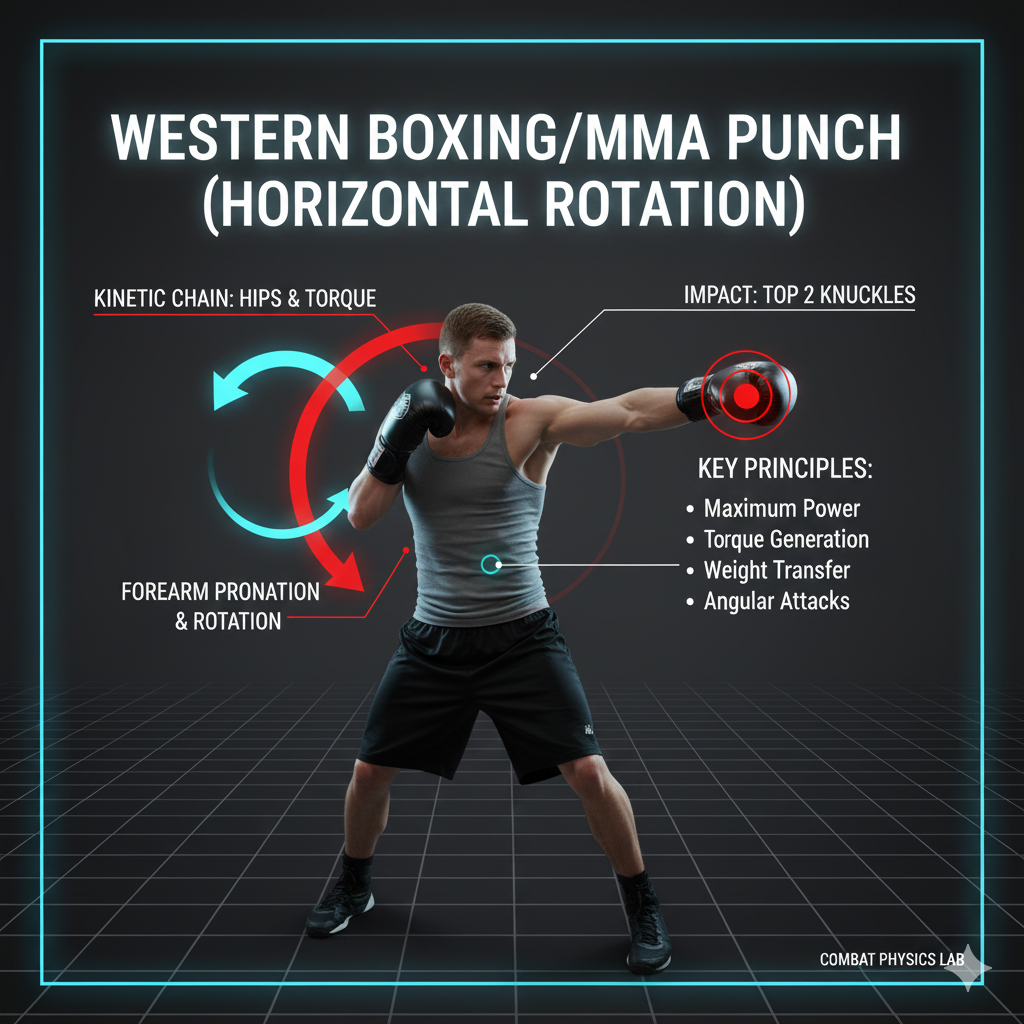
The standard punch in Boxing, Muay Thai, and most modern combat sports is delivered with a horizontal fist, where the knuckles are parallel to the ground upon impact. This technique is the result of centuries of refinement with one primary goal: maximizing knockout power.
The Mechanics of the Rotational Punch
The power of the horizontal punch is generated from the ground up, through a kinetic chain that involves the entire body. It is an engine of torque. The process begins with a pivot on the ball of the back foot, which initiates a powerful rotation of the hips. This hip rotation pulls the shoulder into the punch, creating a whip-like effect that accelerates the arm towards the target. The arm itself remains relatively relaxed until the final moment of impact, where the fist rotates from a vertical or angled position to a fully horizontal one. This final rotation, or “snap,” not only adds to the impact force but also aligns the two largest knuckles (the index and middle) for a solid, stable point of contact, reducing the risk of hand injury.
The key elements are:
- Ground Force Reaction: The push from the floor is the start of all power.
- Hip and Torso Rotation: This is the main engine, transferring the power from the legs to the upper body.
- Shoulder Girdle Protraction: The shoulder extends forward, adding reach and velocity.
- Arm Extension and Pronation: The arm extends and the fist rotates to horizontal, completing the kinetic chain.
This method is optimized for delivering devastating single blows, such as the jab, cross, and hook, typically from a medium to long range. The rotation also serves a crucial defensive purpose: as the punch is thrown, the shoulder rolls forward and upward, tucking the chin behind it for protection from counter-punches. The weight transfer involved ensures the full mass of the body is committed to the strike.
The Vertical Fist: The Spear of Structure and Efficiency
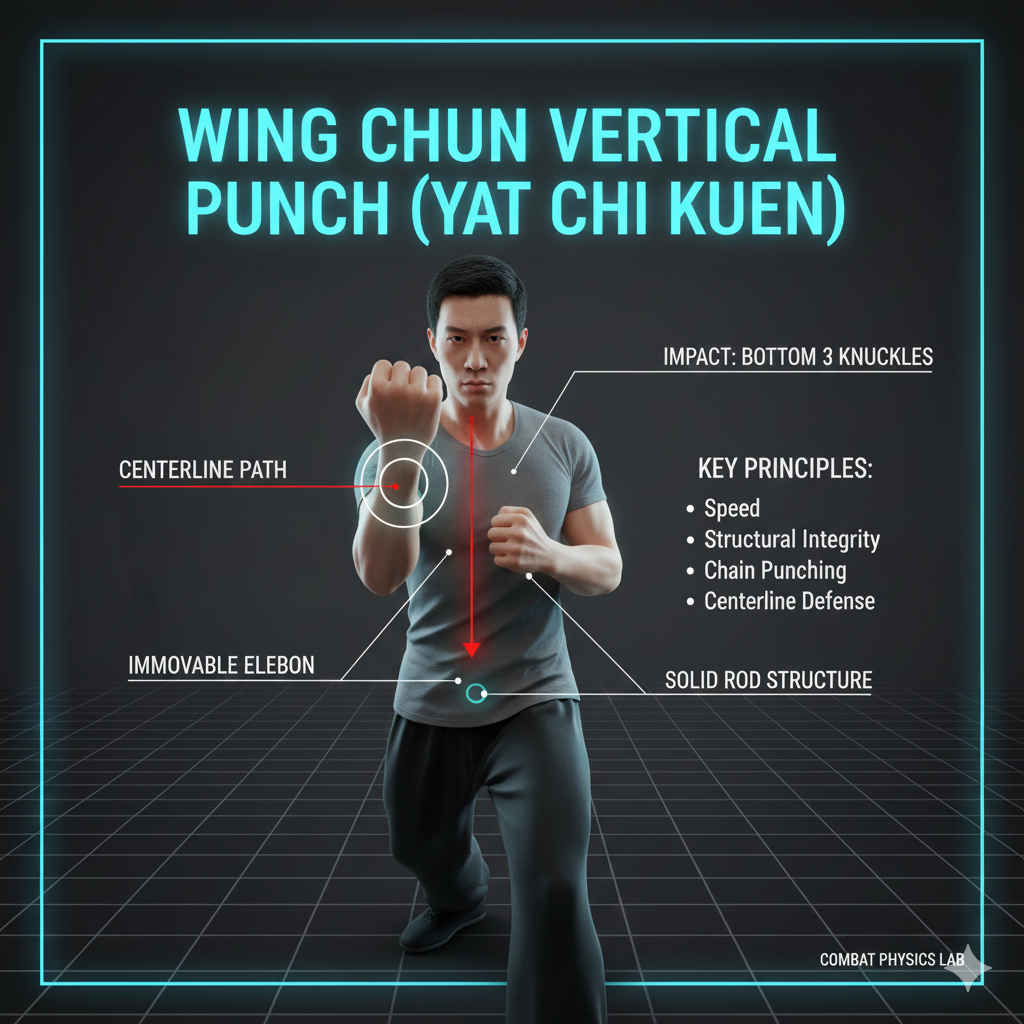
The Wing Chun punch, known as Yat Chi Kuen (“Sun Character Punch”), is delivered with a vertical fist, meaning the knuckles are stacked vertically, perpendicular to the ground. This punch is the physical embodiment of Wing Chun’s core principles: directness, efficiency, and centerline control.
The Mechanics of the Linear Punch
Unlike the rotational punch, the Wing Chun punch is almost entirely linear. It travels in a straight line from the center of the chest to the target, adhering to the principle of economy of motion. The power is not generated from rotational torque, but from the elbow dropping and the entire body structure moving forward as a single unit. It is often described as a “falling elbow” or “dropping elbow” punch.
The elbow remains pointed down and close to the body throughout the movement, acting as a pivot and a guard. This is a critical distinction. By keeping the elbow down, the punch protects the practitioner’s own ribs and centerline, even during the attack. The power is generated by the forward movement of the entire body mass, rooted in the stance and driven forward. The vertical fist naturally aligns the bones of the forearm and hand for maximum structural support, creating a spearing effect that is designed to penetrate the opponent’s structure rather than relying on blunt force trauma alone.
This structural integrity allows for the famous “chain punching,” where multiple strikes are delivered in rapid, piston-like succession along the same path. Because there is no hip rotation and chambering required between punches, the time between strikes is dramatically reduced. The vertical fist is designed to be delivered from a closer range, often inside the opponent’s guard, where rotational punches are less effective.
A Comparative Breakdown of Punching Mechanics
The following table highlights the fundamental differences in the two approaches, which stem from their different strategic objectives.
| Feature | Wing Chun (Vertical Fist) | Boxing/MMA (Horizontal Fist) |
|---|---|---|
| Fist Orientation | Vertical (knuckles stacked) | Horizontal (knuckles side-by-side) |
| Power Source | Forward body mass, structural alignment, elbow drop | Rotational torque (ground, hips, and shoulders) |
| Path of Motion | Linear, straight from center | Rotational, often from the side of the face |
| Range | Close to mid-range (infighting) | Mid to long-range |
| Primary Goal | Speed, continuous pressure, structural penetration | Knockout power, single-strike impact |
| Defensive Posture | Elbow stays down, protecting the ribs and centerline | Shoulder rolls forward, protecting the chin |
The choice between the two is a choice between raw power and structural efficiency. For a discussion on how Wing Chun handles the jab, see this Reddit thread on Wing Chun vs Boxing.
The Context of Combat and Practical Application
It is crucial to remember that each punching style is optimized for its own context and rule set. The Boxing punch is perfect for a sport where only punches are allowed, gloves are worn, and the opponent is typically at a distance. The wide stance and rotational power are ideal for covering distance and delivering knockout blows.
The Wing Chun punch, on the other hand, is designed for a chaotic, no-rules self-defense scenario where grappling, trapping, and elbows are imminent. In a close-quarters situation (like a crowded bar or an elevator), the vertical fist’s ability to maintain structure, protect the centerline, and fire rapidly without chambering is invaluable. It is designed to function in the “trapping range,” where a boxer’s hooks and crosses become smothered and ineffective. The debate between the two styles often misses this point of context, as seen in this Martial Talk discussion.
By studying both, you gain a deeper appreciation for the engineering of the human body in combat. A boxer learns how to generate incredible power from nothing, while a Wing Chun practitioner learns how to turn their entire body into a unified, impenetrable structure. For a detailed look at the differences, check out Expert Boxing’s analysis.
Conclusion: Integrating the Knowledge for the Modern Martial Artist
Neither punching style is inherently “better”; they are simply different tools designed for different jobs. The Wing Chun punch is a specialized tool for maintaining relentless forward pressure and exploiting the centerline in a close-range, self-defense fight. The Boxing punch is a versatile tool for delivering maximum kinetic energy from a distance in a sporting context. The modern martial artist, especially in the context of MMA, often seeks to integrate the best of both worlds. They might use the rotational power of a cross to close the distance, then transition to the structural efficiency of vertical-fist strikes in the clinch.
Understanding the underlying principles of structure, power generation, and strategic application is the key takeaway. Whether you are generating torque or driving forward with structure, the goal is the same: to deliver force efficiently and effectively. For a final comparison, read this article from Black Belt Magazine. The journey to mastering the strike is a journey into the physics of human movement. Continue to train diligently, and your punches will carry not just power, but intelligence.
https://www.youtube.com/watch?v=v09x9-l125k