

In the realm of self-defense, the goal is always to neutralize a threat as quickly and efficiently as possible. 🛡️
For women, who may face attackers with significant advantages in size and brute strength, the training must focus on leverage, structure, and technique—not muscle. 💡
This is precisely where the Wing Chun Wooden Dummy (Mook Yan Jong) shines, offering a training methodology perfectly aligned with the principles of using minimum force for maximum effect. 💥
The dummy is not a tool for building brute strength; it is a master instructor in structural integrity and economy of motion. 📐
However, choosing the best dummy for women’s self-defense training requires careful consideration of features that ensure proper alignment and realistic application for a smaller practitioner. 🤓
This guide will explore the core Wing Chun principles that make it ideal for women, the specific self-defense skills the dummy develops, and the essential features to look for when selecting your ultimate training partner. 🥋
The Wing Chun Advantage: Negating the Size Difference
The foundation of Wing Chun’s effectiveness for women lies in its philosophical rejection of strength-versus-strength combat. 🙅
The system was, according to legend, developed by a Buddhist nun, Ng Mui, and is designed to allow a smaller, weaker person to overcome a larger, stronger assailant. 🕊️
This is achieved through three core principles that the Mook Yan Jong is uniquely designed to instill. 💯
Principle 1: Centerline Control
The centerline is the most direct and vulnerable line of attack on the human body. 📍
Wing Chun teaches the practitioner to relentlessly attack and defend this line, minimizing the distance traveled for strikes and maximizing the effectiveness of blocks. 🎯
The dummy’s trunk represents this centerline, and its arms force the practitioner to maintain constant control over the opponent’s limbs while simultaneously striking. 🔗
For women’s self-defense, this means ignoring the attacker’s size and focusing only on the shortest path to a vital target. ➡️
The Mook Yan Jong trains the muscle memory to occupy and dominate this central space, a skill that is entirely independent of physical strength. 🧠
Principle 2: Economy of Motion
Wing Chun promotes efficient and economical movements, ensuring that no energy is wasted. 🔋
This is the concept of minimum use of brute strength, where every movement is powered by the entire body’s structure and momentum, not isolated muscle groups. The Wing Chun system allows smaller exponents to easily overcome larger and stronger attackers through its non-reliance on physical size or strength. [1]
The dummy’s rigid nature forces the practitioner to find the most efficient angle and structure for every strike and block. 📐
If a movement is inefficient, the dummy will jar the practitioner, providing immediate, painful feedback. 🤕
This training cultivates a powerful, whipping force that comes from the ground up, allowing a smaller person to generate surprising power. ⚡
Principle 3: Simultaneous Attack and Defense
In a self-defense situation, time is the most precious commodity. ⏱️
Wing Chun’s principle of simultaneous attack and defense means that the practitioner is never purely blocking or purely attacking; every defensive action is also an offensive one. ☯️
The dummy’s arms are used to train this concept, where a block (like Pak Sau) instantly creates an opening for a counter-strike (like a chain punch). 🔄
This reflexive, two-way action is vital for women’s self-defense, as it allows for a swift, decisive end to the confrontation before the attacker can fully commit to their assault. ⚔️
Essential Dummy Features for the Female Practitioner
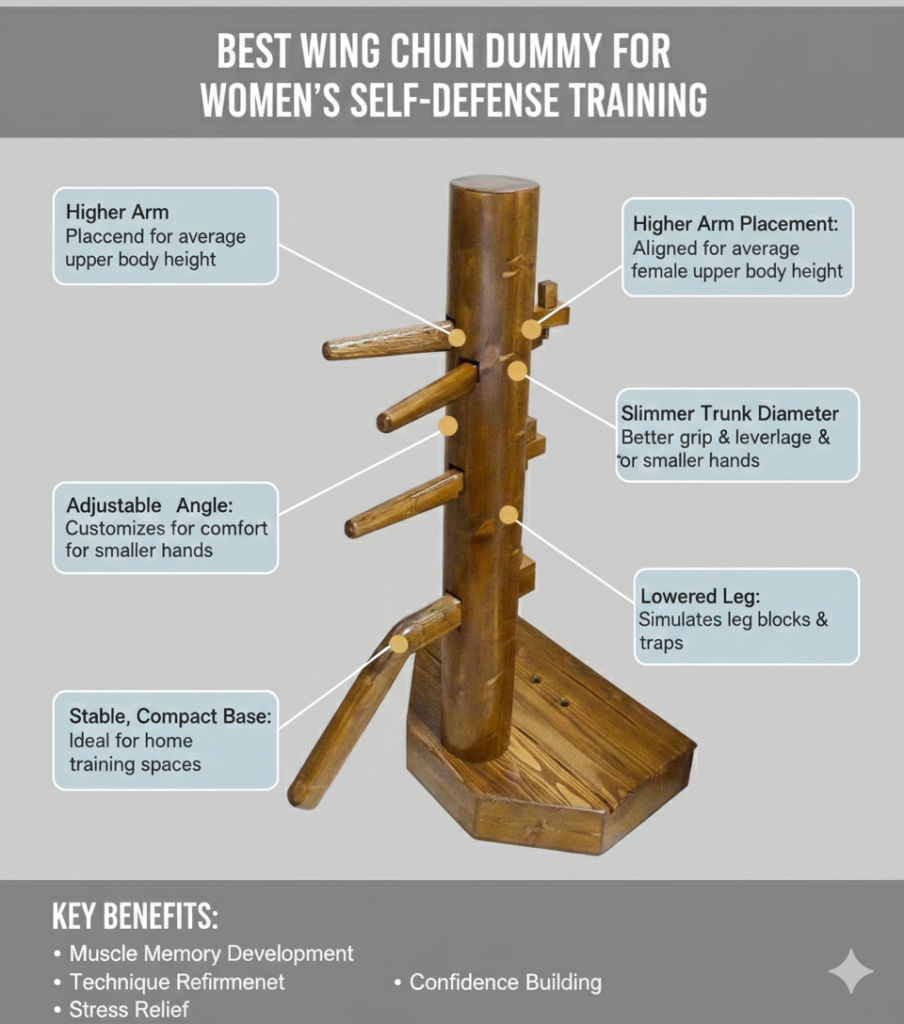
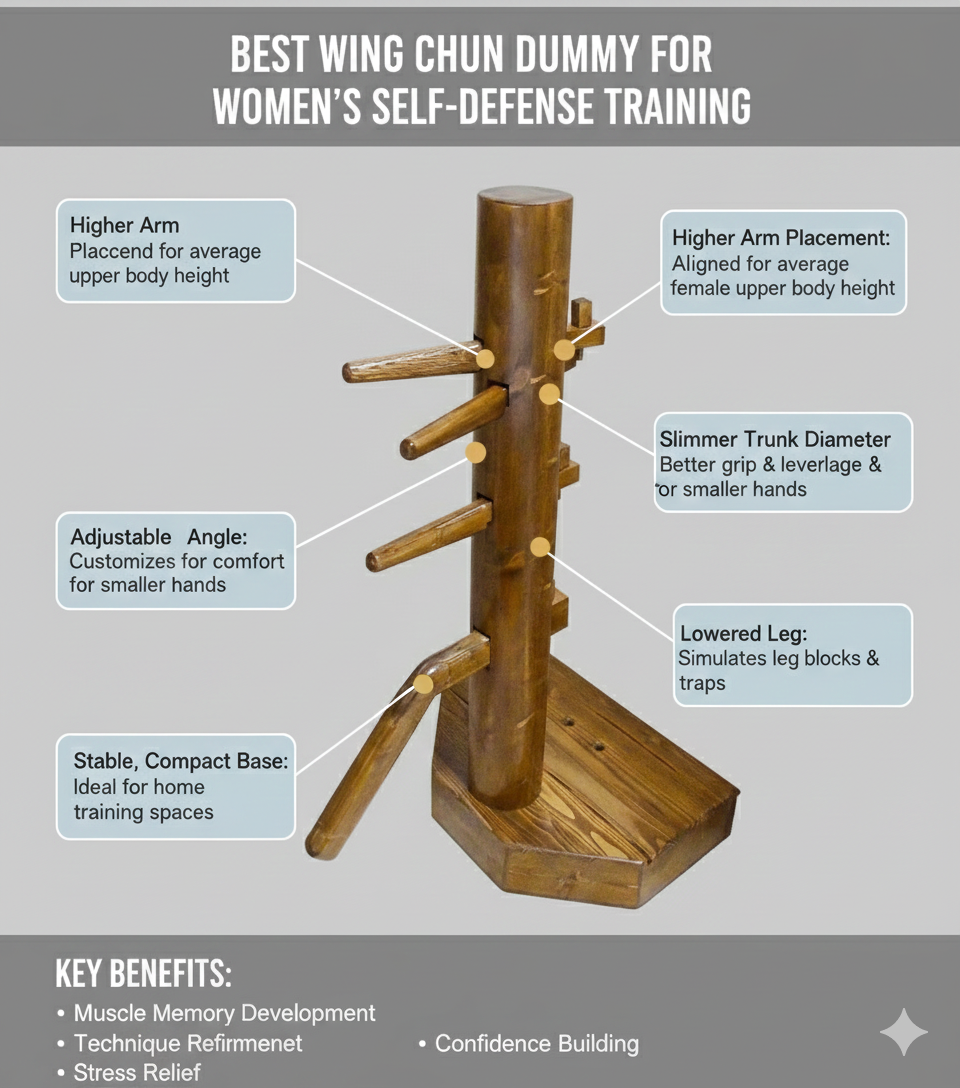
While the principles are universal, the physical dimensions of the Mook Yan Jong must be tailored to the individual to ensure the training is structurally correct. 📏
For women, who are typically shorter than the average male practitioner, height and adjustability are the most critical factors. 🔑
Feature 1: Adjustable Height and Mounting
The most important structural alignment in Wing Chun is the relationship between the practitioner’s centerline and the dummy’s arms. 🎯
The top two arms of the dummy should align with the practitioner’s mid-chest or shoulder level. 🧍
Since standard dummies are often set for an average male height, an adjustable dummy is paramount. 📈
The best options include:
- Adjustable Free-Standing Dummies: These models allow the entire dummy to be raised or lowered on its base, ensuring the arms are at the correct height regardless of the practitioner’s stature.
- Wall-Mounted Dummies: These are excellent as they can be mounted at any height, offering complete customization. They also save floor space, which is a practical benefit.
Training on a dummy that is too tall will force the practitioner to raise their shoulders, compromising their structure and leading to bad habits that rely on muscular effort. ❌
The best dummy is one that can be precisely calibrated to the individual’s body, ensuring that every movement reinforces correct structural alignment. 🛠️
This video explains the critical importance of setting the correct Wing Chun dummy height for proper training. 🎥
Feature 2: Spring and Give
Traditional dummies are mounted on two cross-pieces that allow the dummy to move slightly, simulating the resistance and recoil of a human body. 🤸
This “give” is crucial for women’s self-defense training, as it teaches the practitioner to “borrow” the force of the dummy’s recoil to power their next strike. 🌊
It also conditions the joints to absorb impact without fighting it, which is a key component of using leverage over strength. 🦴
Look for dummies with a well-designed frame that allows for this subtle, yet essential, movement. 🔄
Feature 3: Standard Arm and Leg Placement
While height is adjustable, the placement and angle of the arms and leg should adhere to the traditional Ip Man specifications. 📐
The angles of the arms are specifically designed to train the practitioner to find the gaps in an opponent’s guard and to practice trapping techniques. 🔗
Deviations from the standard placement can compromise the structural lessons the dummy is meant to teach. 🙅
The leg, in particular, is vital for training low-line kicks and for practicing the footwork necessary to maintain a strong base while dealing with an attacker’s lower body. 🦵
Self-Defense Drills on the Dummy: Focus on Leverage
Once the correct dummy is selected, the training must focus on drills that maximize the Wing Chun advantage for self-defense. ⚔️
These drills emphasize quick, decisive action and the use of leverage to overcome a larger opponent. 🏆
Drill 1: The Centerline Overwhelm
This drill focuses on the rapid, reflexive use of the chain punch to overwhelm the attacker’s defenses. 💥
The practitioner engages the dummy’s upper arms with a simultaneous Pak Sau and strike, immediately following with a continuous chain of vertical punches to the trunk. 🎯
The goal is to deliver multiple strikes before the dummy’s arms can recover, simulating the speed needed to shut down an attacker’s ability to react. ⏱️
This drill reinforces the mindset of pre-emptive, decisive action, which is a cornerstone of effective self-defense. 🧠
Drill 2: The Low-Line Disruption
The dummy’s leg is an excellent tool for training low-line kicks to the knee or shin, which are highly effective for disrupting a larger attacker’s balance and mobility. 🦶
The drill involves engaging the dummy’s arms with a control technique (like Lap Sau or Jut Sau) and simultaneously delivering a quick, sharp kick to the dummy’s leg. 🦵
This teaches the practitioner to use all available weapons and to attack the attacker’s base, which is often their weakest point. 📉
The focus is on the speed and surprise of the kick, not the power, as a quick strike to a joint can instantly compromise an attacker’s structure. 🚨
This video demonstrates basic Wing Chun defense techniques that are directly applicable to the dummy and essential for women’s self-defense. 🎥
Beyond the Wood: Mindset and Awareness
While the Mook Yan Jong is a physical training tool, its greatest contribution to women’s self-defense is the mindset it instills. 🧠
Wing Chun training fosters confidence, discipline, and mental resilience. 🌟
The dummy teaches the practitioner to trust their structure and reflexes, which translates into a calm, decisive demeanor in a threatening situation. 🧘
This mental preparedness is just as important as the physical skills. Women should train with the mindset of using the minimum force necessary to escape danger, avoiding excessive aggression that could lead to legal consequences. [4]
The dummy is a constant reminder that the fight is won not by being the strongest, but by being the most structurally sound and the most efficient. 🏆
The confidence gained from knowing your structure will hold against the unyielding wood is the most powerful self-defense tool of all. 💪
Summary of Ideal Dummy Features
To summarize, the ideal Wing Chun dummy for women’s self-defense training is one that prioritizes adjustability and structural feedback. 🔑
| Feature | Why It Matters for Women’s Self-Defense |
|---|---|
| Adjustable Height | Ensures the dummy’s arms align perfectly with the practitioner’s centerline, reinforcing correct, strength-independent structure. |
| Wall-Mounted Option | Allows for maximum height customization and is often more stable, providing better feedback for structural integrity. |
| Spring/Recoil Mechanism | Teaches the crucial skill of “borrowing force” and joint conditioning, which is essential for overcoming a larger opponent. |
| Standard Arm Angles | Preserves the integrity of the Wing Chun system, ensuring that trapping and control techniques are trained correctly. |
Conclusion: Your Path to Empowerment
The Wing Chun Wooden Dummy is an unparalleled tool for women seeking effective self-defense skills. 🏆
It bypasses the need for brute strength, focusing instead on the timeless principles of leverage, structure, and economy of motion. 💡
By selecting a dummy that is correctly sized and mounted, and by focusing your training on the principles of centerline control and reflexive action, you are investing in a skill set that is both practical and profoundly empowering. 🌟
Embrace the wood, trust the principles, and let the Mook Yan Jong guide you to a level of self-protection that is unshakeable. 🙏
This video provides a final look at how the dummy is used to develop the precision and reflexes needed for real-world self-defense. 🎯
References
[1] Minimum Use of Brute Strength Video – Wing Chun Kung Fu
[3] How High to Mount Your Wing Chun Dummy – Shop Wing Chun
[4] Women learn self-defense skills in Wing Chun – WSL Wing Chun Online
[5] Women in Wing Chun? : r/WingChun