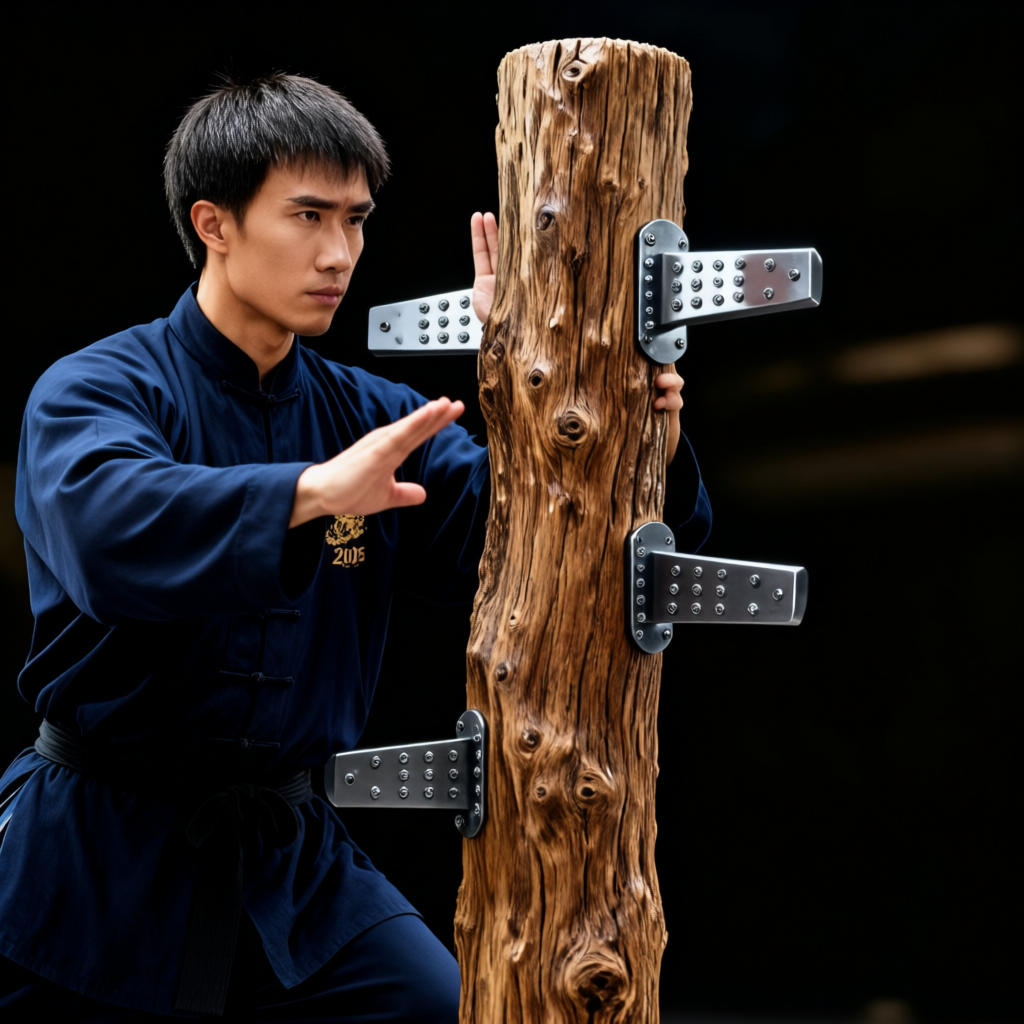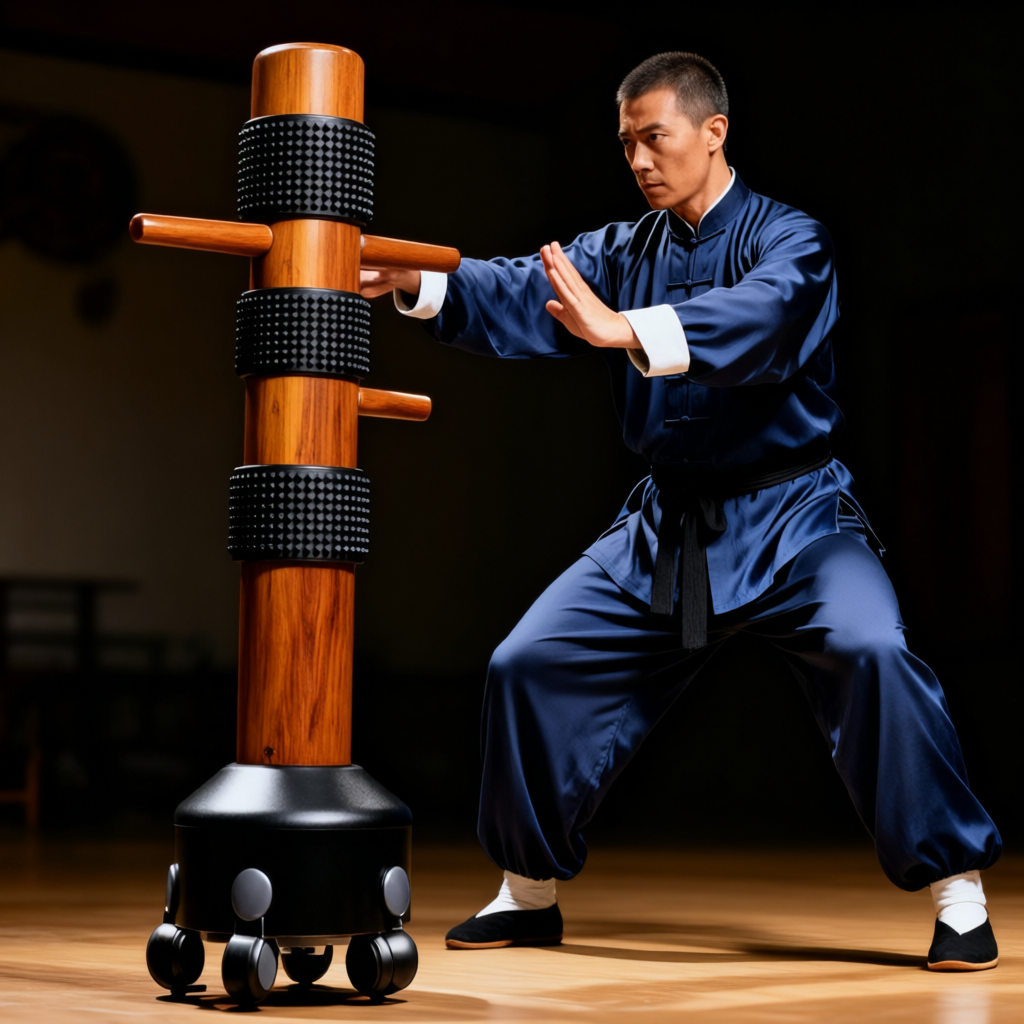
The Rebound Problem: Why Plastic Fails the Live Energy Test
A traditional Wing Chun dummy relies on specific material density to absorb and return force. Solid hardwood like Teak or Oak sits between 0.65 and 0.85 g/cm³. This density allows the trunk to flex microscopically under impact, storing kinetic energy and releasing it back into your stance. PVC pipe has a solid density of 1.3 to 1.45 g/cm³, but its hollow structure drops the effective density to less than 0.1 g/cm³.
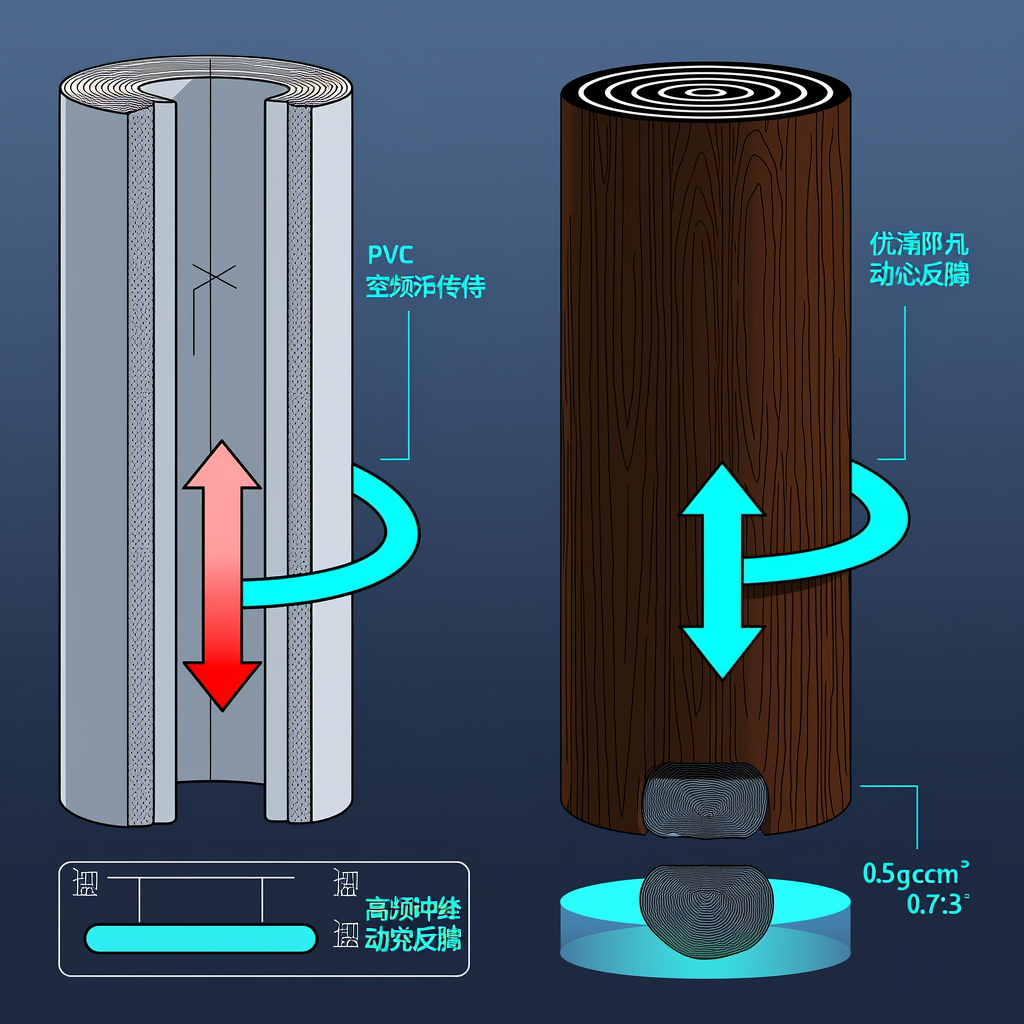
When you strike a hollow PVC trunk, the material cannot absorb the impact. Instead, it transmits high-frequency vibration directly into your wrist and elbow joints. You will feel a sharp, jarring rebound after just twenty strikes. Hardwood dampens this shock through its cellular structure. PVC amplifies it. The result is not better conditioning. It is accelerated joint fatigue and compromised technique.
Mortise Geometry Failure: The Square Hole Paradox
Authentic dummy construction requires precise mortise and tenon joints. The upper arm channels must be offset, with the left arm positioned higher than the right. The leg channel demands a strict 15-degree downward angle to simulate a realistic knee joint and proper stance geometry. Cutting these intersecting channels into round PVC is mechanically hostile.
PVC has high tensile strength but extremely low shear resistance in thin walls. When you force a chisel or router into the pipe to carve a square mortise, the inner layers tear out. The wall collapses. You lose the structural integrity needed to hold the arms under lateral pressure. Hardwood resists shear through its continuous grain structure. PVC relies on uniform wall thickness, which shatters under cross-grain cutting. Without specialized jigs and track saws, your mortises will warp, your arms will loosen, and your training will degrade into fighting unstable hardware.
Weight & Base Instability: The Liquid Column Effect
A functional dummy requires 130 to 200 pounds of fixed mass to anchor your strikes and ground your footwork. A standard four-inch PVC post weighs almost nothing. To compensate, builders fill the pipe with concrete or sand. This creates a dangerous physics problem.
Filling PVC creates a liquid column effect where the center of gravity shifts unpredictably upon impact. The post rocks, wobbles, or slides across your training surface. Hardwood maintains a fixed center of mass, providing immediate inertial resistance. You can drive a palm strike or a low kick into a wooden trunk and feel the energy transfer cleanly into the floor. PVC absorbs that stability. You end up stabilizing the dummy instead of refining your structure.
Acoustic Resonance: The Apartment Violation
PVC acts as a drum. Every strike generates a loud, hollow thwack that resonates through walls and floors. Hardwood naturally dampens acoustic feedback. PVC amplifies it. If you train in an apartment or shared space, the noise alone will force you to pull your strikes, which defeats the purpose of the dummy. Wrapping the post in high-density EVA foam skins or neoprene isolator washers can deaden the sound, but it does not fix the underlying joint rebound or instability issues.
The Tool Gap: Forcing PVC to Function
If you are determined to proceed with a plastic post build, you must bridge the engineering gap with professional-grade tools. Standard drill bits will splinter the PVC and ruin your mortise angles. You need an 18-Inch Spade Bit Sets to drill the leg channel at the required 15-degree downward angle without tearing the inner wall. You will need woodworking chisels to clean up the mortise edges and a track saw to cut precise, level arm channels.
Even with these tools, you must seal the entire assembly with water-resistant polyurethane sealants to prevent moisture from degrading the concrete fill or warping the pipe joints. You will also need heavy-duty sandbag bases or Olympic weight plate pegs to anchor the post. This approach turns a simple weekend project into a complex engineering task. The time, tool cost, and physical risk often exceed the price of a purpose-built dummy.
Tiered Recommendation System: Matching Your Reality to Your Training
Not every practitioner needs a commercial dummy on day one. Your training environment, budget, and long-term goals should dictate your equipment path.
Tier 1: Budget DIY (High Friction, High Risk)
Building a dummy from a plastic post works only as a temporary placeholder. It teaches you basic arm positions but fails to provide live energy feedback. You will experience joint shock, unstable footing, and excessive noise. Use this tier only if you are strictly testing your commitment before investing in proper gear. Supplement your training with traditional Dit Da Jow, such as the Shen Formula aged 3+ years, to manage the increased impact stress on your forearms and wrists.
Tier 2: Intermediate Hybrid (Stability Focused)
Check out our top-rated Wing Chun training gear & equipment on Amazon
If you want to keep a DIY approach but eliminate the worst flaws, switch to a half-sized or compact steel wall-mount dummy, or use modular spring-loaded arm attachments. These systems bypass the need for a heavy trunk entirely. You mount them to a reinforced wall stud or heavy timber frame. The spring-loaded arms provide consistent tension and return, mimicking live energy without the weight or noise. Pair this setup with solid bamboo or rattan training rings (Solid Bamboo / Rattan Training Rings (Jook Wan Heun)) in 8 to 12-inch diameter options. These rings force you to develop precise Chi Sao mechanics and tactile sensitivity that a rigid PVC arm simply cannot replicate.
Tier 3: Pro Commercial (Engineered for Longevity)
The AugustaPro Iron Body Wooden Dummy represents the correct engineering solution for serious practitioners. Priced around $698, it stands 67 inches tall and weighs approximately 133 pounds. The solid hardwood build and yellow wood base eliminate the need for concrete filling, complex mortising, or acoustic dampening. The trunk density matches traditional specifications, providing authentic kinetic feedback from day one. The pre-routed mortises guarantee proper arm alignment and leg channel angles. You trade months of trial-and-error for immediate, joint-safe training.
PVC Build vs. Hardwood Build: The Decision Matrix
MetricPVC DIY BuildHardwood Commercial Build
Initial Cost$40 to $100$600 to $800
Recommended Insights From Our Wing Chun Guide Library:
- Build Wing Chun dummy Out of Household Items
- How to Build a Wooden Dummy at Home at Very Low Cost: The DIY Mook Yan Jong
- DIY PVC Wing Chun Dummy Plans for Beginners: The Low-Cost Mook Yan Jong
- Crafting Your Own Soft Wing Chun Dummy: A Step-by-Step Guide
- How to Build a Custom Wing Chun Dummy
Total WeightUnstable (requires added mass)130 to 200 lbs fixed
Joint SafetyHigh shock transmissionOptimized flex modulus
Noise LevelLoud acoustic resonanceDamped, quiet impact
DurabilityUV degradation, wall tearing
Check out our top-rated Wing Chun training gear & equipment on Amazon
Decades of outdoor use
Training FeedbackRigid or floppy slatsAuthentic live energy
Maintenance & Long-Term Viability
Weather resistance is often cited as the main advantage of PVC. While plastic will not rot, UV exposure breaks down the polymer chains over time, making the pipe brittle and prone to catastrophic cracking under impact. Sealed hardwood, when maintained with water-resistant polyurethane sealants, withstands rain, sun, and temperature swings for decades.
For indoor training, unfilled heavy-duty vinyl or leather grappling dummies from brands like Meister or Ring to Cage offer a safe alternative for close-quarters drills. They absorb impact without the joint stress of rigid materials. However, they cannot replace the structural conditioning of a traditional dummy. Use them for ground transition drills and clinch work, but keep the wooden dummy for your core Wing Chun development.
The Verdict: Engineering Over Economy
Martial Arts Reference & Authority Resources:
A DIY Wing Chun dummy from a plastic post is an exercise in compromise. The physics of hollow polymers, thin-wall shear failure, and shifting mass directly contradict the biomechanical requirements of authentic training. You can force the materials to work with specialized spade bits, track saws, and heavy anchoring systems. You will still sacrifice joint safety, acoustic control, and kinetic feedback.
Martial arts equipment is an investment in your body and your progression. The AugustaPro Iron Body Wooden Dummy, Solid Bamboo / Rattan Training Rings (Jook Wan Heun), and 18-Inch Spade Bit Sets are engineered to eliminate the friction points that break DIY builds. They provide the density, geometry, and stability your nervous system needs to develop real skill. Start with the right tool, protect your joints, and let the dummy do its job.
🔍 Explore More: See all Wing Chun training guides for DIY Wing Chun dummy from a plastic post.
Check out our top-rated Wing Chun training gear & equipment on Amazon