The Biomechanics of Sensitivity Drills
Sensitivity in Wing Chun is not about feeling the wood. It is about manipulating the Kinetic Energy Transmission Path. You must shift from Impact Absorption to Energy Dissipation.
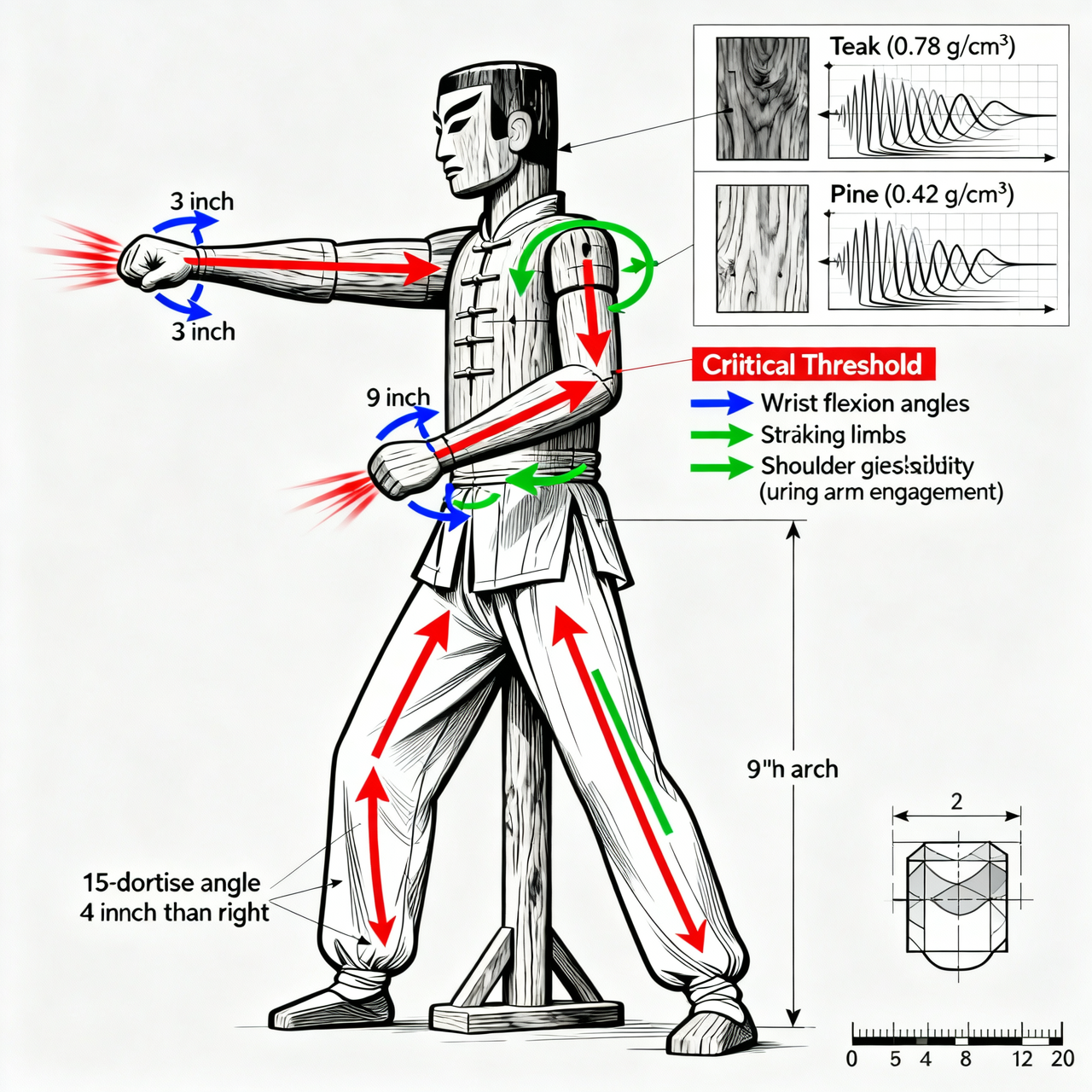
Data: The forearm must remain rigid while the wrist flexes slightly upon contact during Pak Sau execution.
Translation: If your wrist locks up, vibration travels straight up the ulna and radius. A properly executed strike allows the dummy arm to deflect slightly and return energy smoothly into your structure.
Data: Shoulder girdle stability is isolated when using both arms against opposite sides of the dummy trunk simultaneously.
Translation: Maintaining the Immovable Elbow while the dummy shifts weight forces your stance to adapt instantly. You stop relying on arm strength and start feeling the center of gravity.
Data: Removing visual dominance forces reliance on cutaneous mechanoreceptors in the skin and fascia.
Translation: Closing your eyes during light tapping trains your nervous system to calibrate force. You learn exactly how much pressure moves the wood versus how much breaks your joint alignment.
Material Physics and Equipment Constraints
The effectiveness of sensitivity drills depends entirely on the dummy’s construction. The wrong material creates false feedback and joint stress.
Data: Hardwood species like Teak, Mahogany, and Oak feature a density range of 0.65 to 0.85 g/cm³.
Translation: This density allows the slats to flex under load and rebound. You feel a springy, live energy that matches real opponent resistance.
Data: Softwood species like Pine and Fir exhibit a low shear strength of 1,000 to 1,200 PSI.
Translation: The mortise holes deform quickly under repeated strikes. The arms move too freely, masking poor technique and giving you false confidence in your sensitivity.
Data: PVC and hollow structures lack mass and cause high-frequency vibration upon impact.
Translation: This creates rebound shock that travels directly into your elbow. You will develop inflammation and learn to avoid striking rather than refine your touch.
Data: The trunk diameter measures approximately 9 inches, with a total unit weight ranging from 130 to 200 lbs.
Translation: This mass anchors the structure. It prevents the dummy from sliding or tipping during aggressive centerline drills, ensuring the feedback you feel comes from the wood grain, not a shifting base.
Critical Engineering Constraints for Fabrication and Setup
Geometry dictates function. If the mortise architecture is wrong, sensitivity drills fail immediately.
Data: The left arm channel must be positioned higher than the right arm channel.
Translation: This offset architecture matches natural shoulder elevation. Ignoring it forces your shoulders out of alignment, creating tension that blocks kinetic feedback.
Data: The leg mortise requires a precise 15-degree downward angle.
Translation: An incorrect angle alters the entire kinetic chain. Your stance geometry breaks down, and the leg slats will not transfer force correctly into the trunk.
Data: Fabrication requires 18-inch spade bits and track saws for clean mortise cutting.
Translation: Rough or oversized holes create slop in the joints. Slop kills sensitivity because the arms rattle instead of flexing. Precision tooling ensures a tight, responsive fit.
Specific Drill Protocols
Check out our top-rated Wing Chun training gear & equipment on Amazon
Apply these protocols with strict attention to form. Sensitivity develops through repetition, not power.
The Slap-Through Drill (Pak Sau Sensitivity)
Execute a Pak Sau along the top edge of the dummy’s upper arm slat. Do not strike the center.
Data: The strike must cause visible deflection without violent snap-back.
Translation: Listen to the wood grain resistance. A sensitive strike flows into the trunk. An insensitive strike jams your wrist or makes the arm snap back uncontrollably.
The Centerline Push-Pull (Bong Sau/Tan Sau Flow)
Place one hand in Tan Sau and the other in Bong Sau against opposite sides of the trunk. Apply simultaneous push and pull pressure.
Data: Maintain constant pressure while tracing the contour of the dummy arm.
Translation: This develops the Flowing Water Simulation. You learn to sense changes in the dummy’s balance point and adjust your stance instantly without breaking structure.
The Soft Touch Blindfold Drill
Strike the dummy with your eyes closed. Focus entirely on texture and temperature change upon impact.
Data: Calibrate force to create visible reaction without structural shock.
Translation: This removes visual crutches. You train your hands to feel the exact threshold between moving the wood and damaging your joints.
The One-Inch Power Test
Strike the dummy arm with maximum speed but minimum force.
Data: The arm should move slightly if the strike is correct.
Translation: If the arm does not move, you are too soft. If it flies back, your form is broken or you are using brute force. This test isolates pure kinetic transfer.
Equipment Integration and Practice Environment
Sensitivity training requires the right tools and environment. Friction points can be solved with targeted upgrades.
Problem: The dummy feels like a rock. You cannot feel your strikes.
Solution: Upgrade to a hardwood dummy like the AugustaPro Wing Chun Dummy. Cheap dummies kill sensitivity because they lack proper flex and rebound geometry.
Problem: You need isolated sensitivity work without a full dummy.
Solution: Use solid rattan training rings. These allow Chi Sao style drills that build tactile awareness and joint mobility. The Solid Rattan Training Rings (Jook Wan Heun) replicate the subtle give of human limbs under pressure.
Recommended Insights From Our Wing Chun Guide Library:
Problem: Rapid light tapping creates noise in shared spaces.
Solution: Install neoprene isolator washers at the base. This dampens acoustic vibration and protects your floors while maintaining structural stability.
Problem: Intense sensitivity drilling causes joint fatigue.
Solution: Apply aged Dit Da Jow liniment post-training. It supports tissue recovery and keeps the fascia pliable for continuous sensitivity work. The Aged Dit Da Jow Liniment is traditionally aged for 3+ years to maximize penetration and anti-inflammatory efficacy.
ComponentOptimal SpecificationConsequence of Deviation
Dummy Trunk Density0.65–0.85 g/cm³ (Teak/Mahogany/Oak)Softwood or hollow cores mask technique, cause joint shock
Left Arm Height Offset3 inches higher than right armMisaligns shoulders, blocks energy flow
Leg Mortise Angle15° downward Breaks stance geometry, invalidates force transfer
Check out our top-rated Wing Chun training gear & equipment on Amazon
Mortise Precision18-inch spade bit, track saw cutRough holes cause rattling, eliminate tactile feedback
Training Ring MaterialSolid rattan, no hollow coreHollow rings lack resistance, reduce joint mobility gains
Liniment AgeMinimum 3 years agedYoung liniment lacks bioavailability, reduces fascial recovery
Martial Arts Reference & Authority Resources:
Mastering Live Energy
Wing Chun dummy drills for improving sensitivity are not about hitting harder. They are about listening deeper. The physics of hardwood, the precision of mortise geometry, and the discipline of kinetic energy transmission all converge in your practice. Respect the 15-degree leg angle. Verify your left-high, right-low offset. Choose materials that flex and rebound. Train blind. Feel the flow. When the wood speaks back, your sensitivity has awakened.
🔍 Explore More: See all Wing Chun training guides for Wing Chun dummy drills for improving sensitivity.
Check out our top-rated Wing Chun training gear & equipment on Amazon