The Kinetic Feedback Paradox: Dead Wood vs. Live Energy
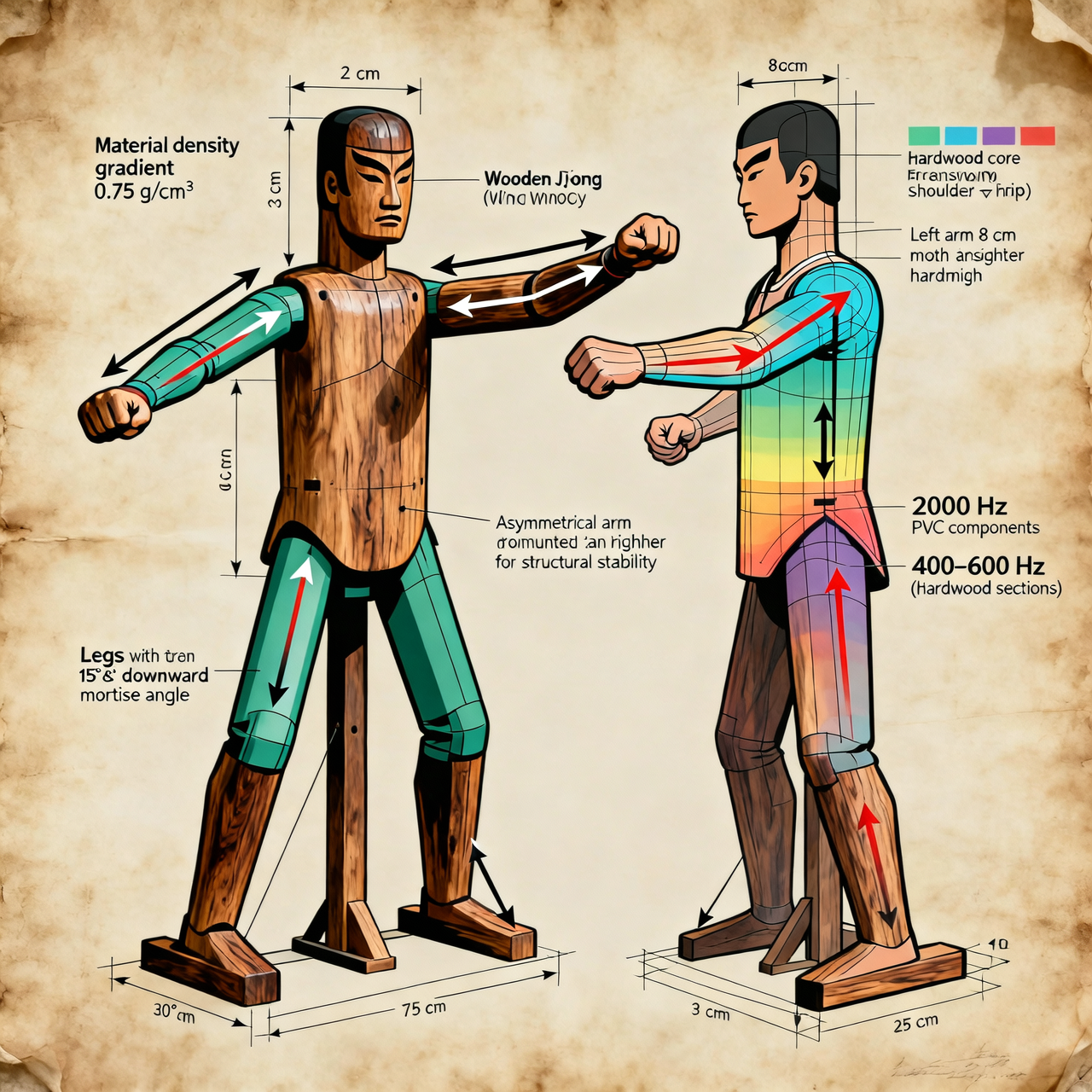
Traditional hardwood trunks like Teak or Oak possess a material density of approximately 0.75 g/cm³, with a strict threshold requirement of greater than 0.70 g/cm³ for effective training. This density creates a stationary, heavy mass that refuses to yield to sloppy technique.
When you strike correctly, kinetic energy dissipates through the flexible horizontal slats rather than rebounding up your forearm. You feel immediate resistance without joint shock. If your dummy wobbles or the arms swing freely, your own stance is unstable. Check arm tightness as a direct diagnostic for your structural alignment. Loose mortises destroy tactile feedback and teach your brain to accept collapsing structure.
Spatial Awareness and the Centerline Void
The dummy features asymmetrical arm channels with the left arm positioned higher than the right, and the lower leg mortise is cut at a precise 15-degree downward angle. This fixed geometry forces constant micro-adjustments to your head position, shoulder height, and hip alignment. The 15-degree downward leg angle dictates exactly where low-line kicks must land to maintain structural contact.
You cannot stand flat-footed or square. The asymmetry trains your body to navigate the centerline void instinctively. Step too far forward and you collide with the dummy shoulder prematurely. Step too far back and you lose trapping range. Practice blind proprioception drills. Close your eyes and locate the arm channels using only spatial memory and shoulder tension. This simulates an opponent’s reach and locks in Man Sau distance management without visual reliance.
Acoustic Awareness: Sound as Data
Check out our top-rated Wing Chun training gear & equipment on Amazon
Hollow structures like PVC resonate at high frequencies exceeding 2000Hz, which directly correlates to joint inflammation and nerve fatigue. Solid hardwood dampens impact resonance to a lower, manageable frequency range.
Your ears become a real-time diagnostic tool. A sharp, cracking thwack confirms solid bone alignment and correct striking surface contact. A dull thud or ringing echo indicates missed hard points, soft tissue impact, or improper wrist structure. Listen to every strike. If the sound lacks clarity, reset your stance and realign your skeletal structure before continuing. The acoustic signature tells your brain immediately whether the technique was mechanically sound.
Protect your skin while preserving the auditory feedback loop. Traditional Dit Da Jow liniment conditions the forearms to withstand repeated hardwood contact without bruising, ensuring you can train the sound signature daily without downtime.
The Sticky Hand Simulation: Solo Sensitivity
The intersecting square holes in the trunk create a defined pivot point. Proper sensitivity training requires applying minimal pressure against the arms to detect structural give.
You can simulate two-person Chi Sao mechanics on a static object by learning to feel micro-movements. The dummy will not push back, so you must generate the sensitivity yourself through feather-light contact and immediate structural adjustment. Push against the dummy arms with barely enough force to maintain contact. If the arms shift, your pressure is too high or your angle is compromised. This develops micro-adjustment awareness that translates directly to trapping mechanics in MMA hand-fighting and grappling scenarios.
Recommended Insights From Our Wing Chun Guide Library:
Integrate solid rattan rings around the dummy arms to increase friction and tactile feedback. This forces your hands to read subtle surface changes and improves your ability to control an opponent’s limbs before they can generate power.
Urban Constraints and Vibration Isolation
Wall-mounted dummies introduce structural vibration transfer into building frames, especially in multi-unit residential spaces. Unisolated impact energy reflects back through the floor and mounting hardware.
When your training environment vibrates, your proprioceptive feedback becomes contaminated. You start feeling the building shake instead of feeling your technique. This noise disrupts awareness and increases injury risk. Install heavy-duty neoprene isolation pads between the dummy base and the floor. This decouples the training mass from the ground, stopping floor bounce and restoring clean kinetic feedback. You train the technique, not the architecture.
The Awareness Manifesto
The dummy does not make you better. Your attention to its feedback makes you better. Strip away the desire to hit hard. Focus on the density threshold, the acoustic signature, the pivot geometry, and the blind spatial navigation. When you stop treating the Mook Yan Jong as a target and start treating it as a sensory extension of your centerline, awareness stops being a concept. It becomes a physical reflex. Train the feedback. Trust the data. Let the structure speak.
Check out our top-rated Wing Chun training gear & equipment on Amazon
Recommended Training Hardware
- AugustaPro Iron Body Wooden Dummy
- Portable Steel Wall-Mount Wing Chun Dummy
Martial Arts Reference & Authority Resources:
- Traditional Solid Rattan Chi Sao Rings
🔍 Explore More: See all Wing Chun training guides for How to use the dummy for better awareness.
Check out our top-rated Wing Chun training gear & equipment on Amazon