
Wall-Mounted vs. Freestanding Wing Chun Dummy: A Comprehensive Comparison ⚔️
The Wing Chun Wooden Dummy represents a cornerstone training tool for martial artists. 🪵
Mook Yan Jong development focuses on structure, positioning, and continuous attack flow.
Practitioners face critical decisions when selecting home training equipment types.
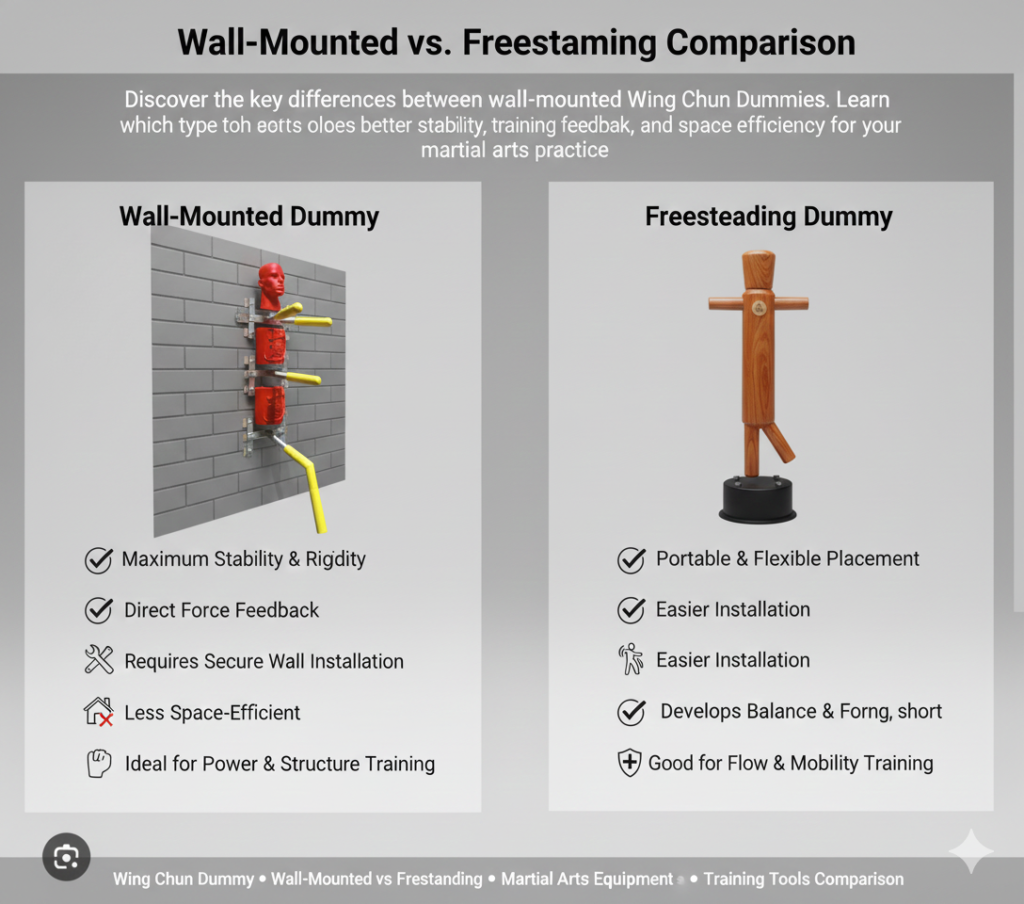
Wall-mounted and freestanding models offer distinct training experiences and considerations.
Stability, space requirements, and cost factors vary significantly between both options.
This comprehensive comparison helps practitioners determine optimal training solutions.
The Core Difference: Training Feedback and Stability 🔄
Fundamental distinctions between dummy types involve force response mechanisms.
Training feedback quality directly impacts technique development and progression.
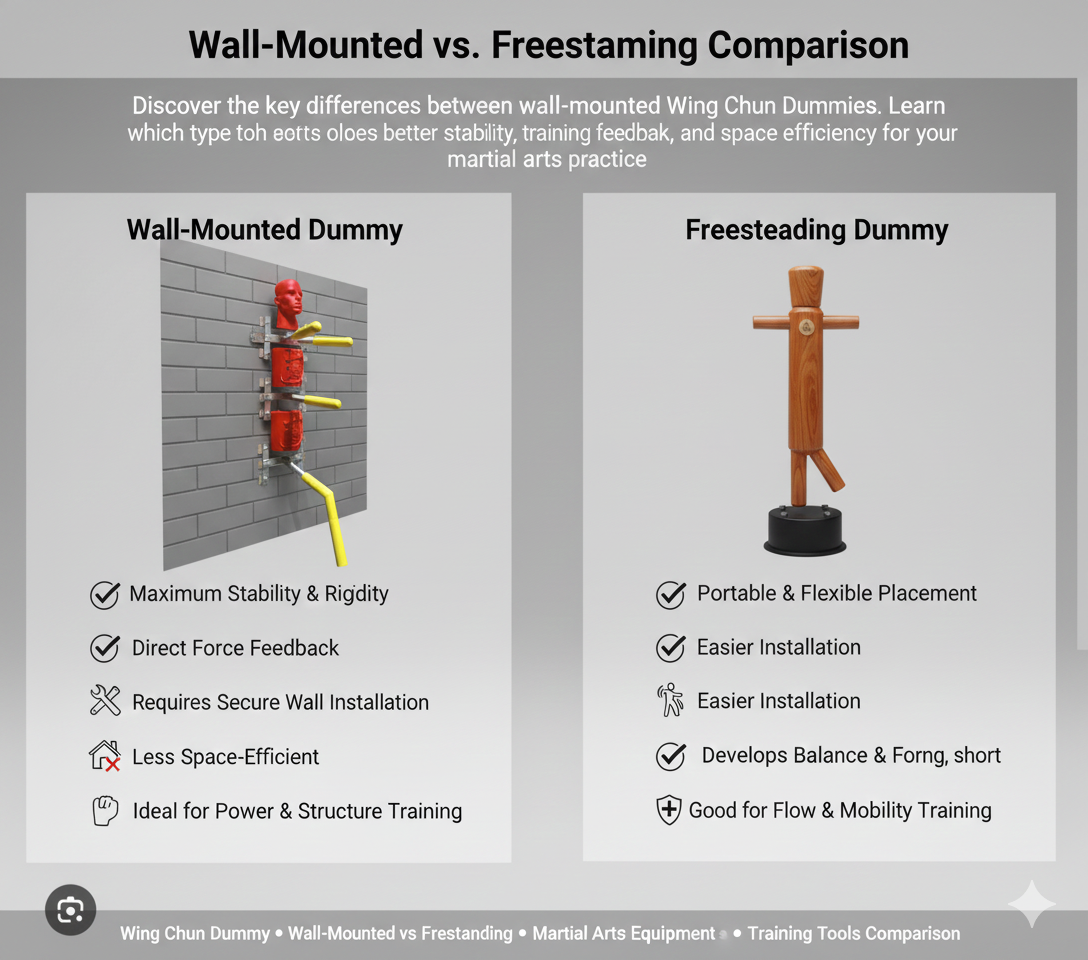
Wall-Mounted Dummy: The Traditional Standard 🏛️
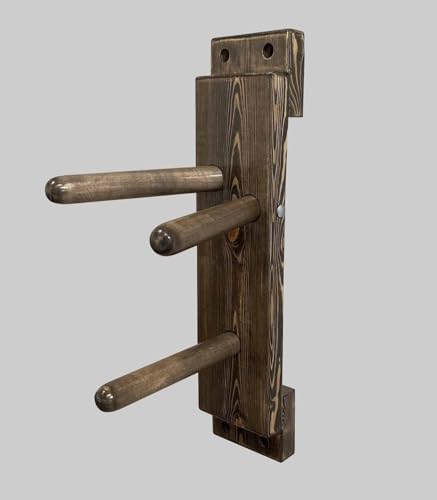
Traditional wall-mounted dummies secure to walls through horizontal wooden slats.
These suspension systems enable controlled movement rather than rigid fixation.
| Feature | Description | Impact |
|---|---|---|
| Stability | Bolted to structural wall studs | Maximum stability for powerful strikes |
| Feedback | Slight forward/backward movement | Simulates human opponent reactions |
| Suspension | Designed slat flexibility | Absorbs and returns training energy |
Wall-mounted suspension systems provide authentic yielding feedback for advanced training.
The traditional design forces practitioners to maintain proper structure continuously.
Energy absorption and return mechanisms simulate realistic combat interactions.
Freestanding Dummy: The Modern Compromise 🏗️
Freestanding dummies utilize floor-based support systems for flexibility.
These designs accommodate various living situations and training environments.
| Feature | Description | Impact |
|---|---|---|
| Stability | Heavy base or frame design | Variable performance under impact |
| Feedback | Spring-loaded or weighted base | Different movement characteristics |
| Ballast | 100+ lbs sand/water required | Prevents tipping during training |
Freestanding models accommodate renters and shared training spaces effectively.
Modern spring-loaded bases attempt to replicate traditional movement patterns.
Weighted bases provide solid resistance but lack authentic yielding characteristics.
Detailed Comparison of Key Factors 📊
Practical decision-making requires comprehensive factor analysis and evaluation.
Multiple considerations influence optimal dummy selection for individual circumstances.
| Factor | Wall-Mounted Dummy | Freestanding Dummy |
|---|---|---|
| Stability | Superior – zero sliding or tipping | Variable – requires heavy ballast |
| Training Feedback | Authentic yielding movement | Compromise – solid or dynamic |
| Space Requirement | Minimal floor space | Significant footprint |
| Portability | None – permanent installation | High – movable design |
| Installation | Difficult – structural work | Easy – simple assembly |
| Cost | Generally lower | Generally higher |
Space constraints and installation capabilities significantly influence optimal selection.
Pros and Cons Analysis ⚖️
Comprehensive advantage and disadvantage evaluation informs smart purchasing decisions.
Understanding trade-offs ensures realistic expectations and training outcomes.
Wall-Mounted Dummy: The Purist’s Choice 🎯
Traditional wall-mounted systems offer authentic training experiences with specific limitations.
These models suit dedicated practitioners with permanent training spaces available.
| Pros | Cons |
|---|---|
| Authentic training simulation | Installation barrier for renters |
| Maximum stability for power training | Limited training angles available |
| Space efficiency in small areas | Potential wall damage risk |
| Traditional movement patterns | Structural wall requirements |
Wall-mounted dummies provide the closest simulation to human opponent reactions.
Freestanding Dummy: The Practical Choice 🏠
Freestanding models deliver flexibility with specific performance compromises.
These solutions address modern living situations and space limitations effectively.
| Pros | Cons |
|---|---|
| Flexibility and portability | Stability concerns during impact |
| No structural changes required | Large floor space footprint |
| Varied feedback options available | Less authentic training feel |
| Ideal for shared spaces | Ballast management required |
Freestanding models eliminate installation barriers for temporary training spaces.
Installation Requirements and Considerations 🛠️
Installation complexity varies dramatically between both dummy types.
Proper installation ensures safety, performance, and long-term durability.
Wall-Mounted Installation Challenges 🧱
Traditional dummy installation requires specific structural considerations and techniques.
Proper mounting ensures safety during powerful training sessions and exercises.
- Structural Wall Requirements: Solid stud walls capable of absorbing impact forces. 🏗️
- Professional Installation Recommended: Experienced help ensures proper mounting. 👷
- Stud Location Precision: Accurate measurement prevents installation failures. 📏
- Weight Distribution: Proper force distribution across multiple studs. ⚖️
Improper wall-mounted installation risks injury and property damage.
Freestanding Setup Simplicity 🎪
Freestanding dummy assembly focuses on base preparation and ballast management.
Simple setup processes enable quick training commencement without structural work.
| Setup Step | Description | Time Required |
|---|---|---|
| Base Assembly | Frame construction and connection | 30-60 minutes |
| Ballast Preparation | Sand/water weight acquisition | 15-30 minutes |
| Dummy Mounting | Trunk attachment to base | 15-30 minutes |
| Stability Testing | Initial impact assessment | 10-15 minutes |
Most freestanding dummies require minimal tools and technical expertise for assembly.
Quick setup enables immediate training without permanent space commitment.
Training Effectiveness and Skill Development 🥋
Different dummy types influence technique development and training outcomes.
Understanding these effects ensures proper skill progression and development.
Wall-Mounted Training Advantages 🎯
Traditional dummies offer specific training benefits for advanced practitioners.
These advantages become particularly noticeable during long-term skill development.
- Energy Flow Development: Proper force absorption and return training. 🔄
- Structural Integrity: Continuous pressure maintenance requirements. 💪
- Angle Precision: Exact positioning for technique refinement. 📐
- Power Generation: Full-force striking capability development. ⚡
Traditional dummies develop the live energy essential for advanced Wing Chun.
Freestanding Training Adaptations 🔄
Freestanding models require specific training adjustments and technique modifications.
Understanding these adaptations maximizes training effectiveness with portable equipment.
| Training Aspect | Adaptation Required | Benefit |
|---|---|---|
| Striking Power | Controlled impact management | Prevents equipment tipping |
| Footwork | Circular movement patterns | Compensates for fixed position |
| Energy Flow | Visualization techniques | Simulates yielding responses |
| Structure Training | Self-monitoring emphasis | Develops internal awareness |
Freestanding training develops valuable skills despite movement limitations.
Proper adaptations ensure effective technique development with portable equipment.
Cost Analysis and Budget Considerations 💰
Financial investment varies significantly between dummy types and quality levels.
Understanding cost structures helps practitioners make informed purchasing decisions.
| Cost Component | Wall-Mounted | Freestanding |
|---|---|---|
| Dummy Unit | $800 – $1,500 | $1,000 – $2,000 |
| Mounting System | $100 – $300 | $400 – $800 |
| Installation | $200 – $500 | $0 – $100 |
| Total Investment | $1,100 – $2,300 | $1,400 – $2,900 |
Freestanding models typically cost 20-30% more due to complex base systems.
Conclusion: Optimal Selection Guidelines 🏆
Choosing between wall-mounted and freestanding dummies depends on individual circumstances.
Training goals, space availability, and budget constraints guide optimal selection.
Wall-mounted dummies suit dedicated practitioners with permanent training spaces.
These traditional systems provide authentic feedback and maximum stability for power development.
Freestanding models benefit beginners, renters, and practitioners with shared spaces.
Modern desig
Modern designs offer effective training despite slight traditional feedback compromises.
Consider future mobility and space changes when making long-term equipment investments.
Both dummy types effectively develop Wing Chun skills when used consistently and properly.
The optimal choice aligns with your current situation while supporting future training goals.