
For the dedicated Wing Chun practitioner, the Mook Yan Jong (Wooden Dummy) is more than just a training tool; it is a mirror reflecting the depth of their understanding. 🤓
While beginners use the dummy to establish basic structure and learn the form’s choreography, the advanced practitioner engages in a profound, almost meditative, dialogue with the wood. 🧘
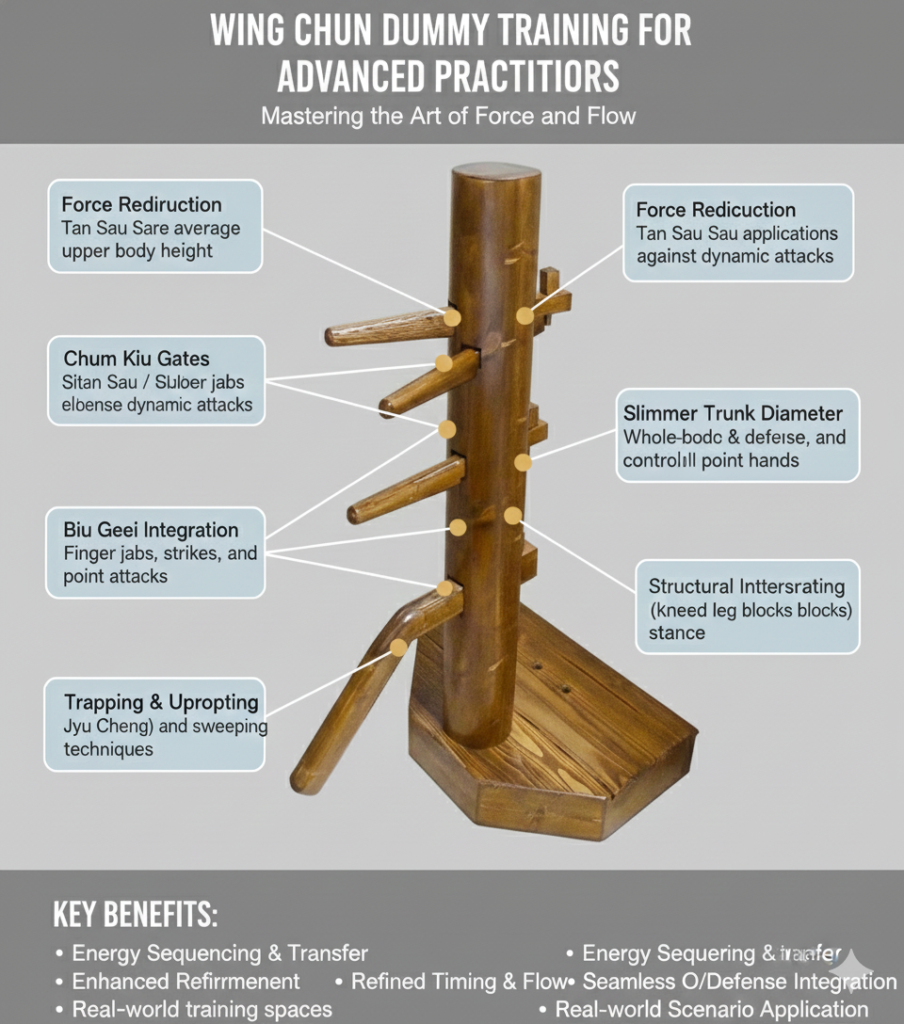
Advanced training transcends mere technique, focusing instead on the subtle, internal mechanics of force redirection, energy sequencing, and the seamless integration of the three empty-hand forms: Siu Nim Tau, Chum Kiu, and Biu Gee. ☯️
This is the stage where the practitioner moves from performing the form to truly living the principles it embodies. 🚀
This guide will explore the advanced concepts and drills necessary to unlock the true potential of the Mook Yan Jong, transforming your practice from mechanical repetition into a dynamic, responsive art. 💡
The Foundation: Beyond Choreography
The first step in advanced training is the realization that the Mook Yan Jong form is not a sequence of fixed movements, but a codified system of principles. 📜
A beginner’s focus is on memorizing the 116 movements; an advanced practitioner’s focus is on the intent and energy behind each movement. 🎯
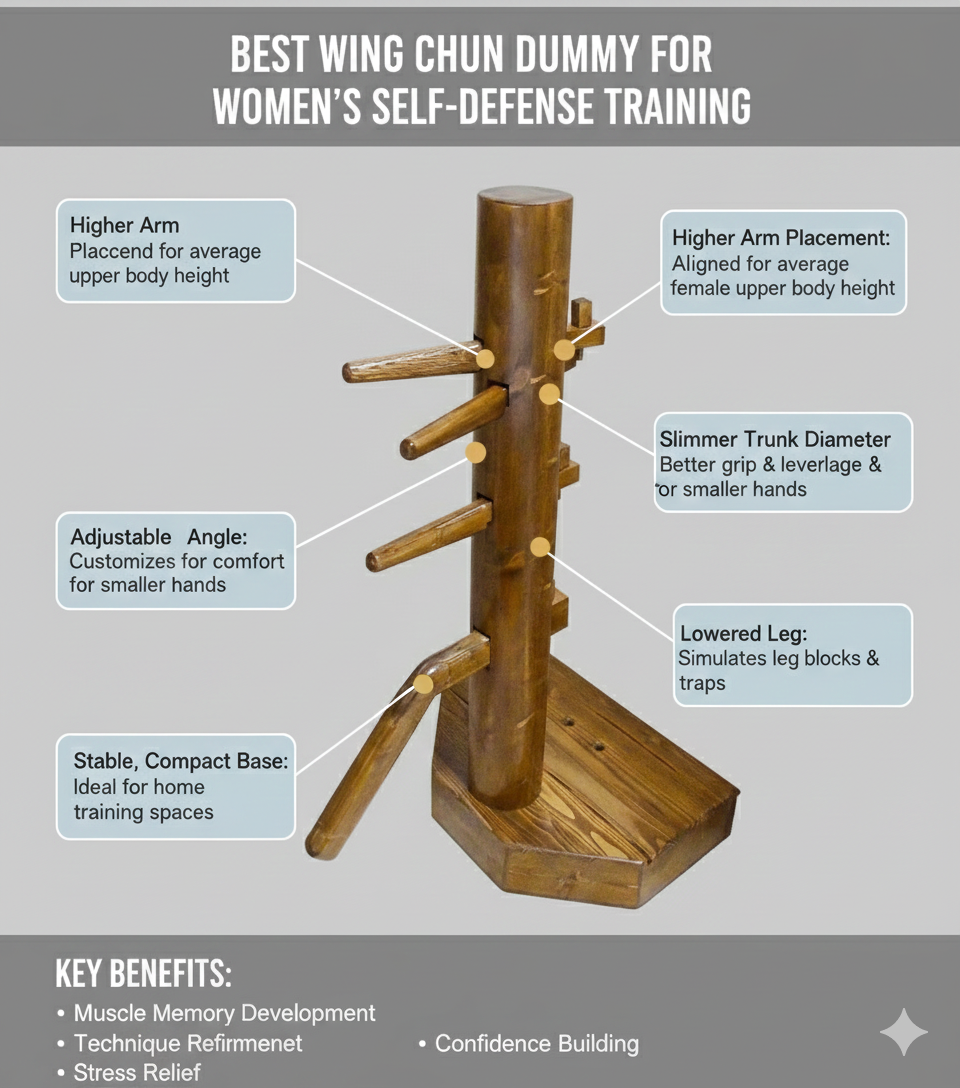
Every block, strike, and step must be executed with the structural integrity of Siu Nim Tau (Little Idea), the bridging and angling of Chum Kiu (Seeking the Bridge), and the emergency power release of Biu Gee (Thrusting Fingers). 🔗
The dummy’s unyielding nature is the perfect crucible for testing this integration. 🧪
If your Siu Nim Tau structure is weak, the dummy will jar your joints. If your Chum Kiu footwork is poor, you will be unable to maintain the correct angle of attack. 📐
The advanced practitioner uses the dummy to expose these subtle flaws, refining the internal connections until the entire body moves as a single, unified force. 🌊
This is the stage where the three empty-hand forms are understood as a continuous spectrum of skill, all converging on the dummy. [1]
Mastering Tactile Sensitivity and Density
The most critical element of advanced dummy training is the development of tactile sensitivity, often referred to as “listening skill.” 👂
This is the ability to read the opponent’s intention and force through the slightest physical contact. 🖐️
The dummy’s arms, with their slight give and spring, are used to simulate the pressure of an opponent’s limbs. 🤏
Advanced drills focus on detecting subtle changes in pressure, speed, and the vector of force, which is termed “tactile density.” 🧠
The goal is to train the nervous system to recognize patterns, filter noise, and map tactile input onto precise, reflexive motor responses. 🔄
The practitioner must learn to “touch the dummy with purpose, or don’t touch it at all,” ensuring every contact is a moment of information gathering and structural adjustment. 🎯
This level of sensitivity allows the advanced practitioner to neutralize an attack before it fully manifests. 🛡️
Advanced Drills: Force Redirection and Energy Sequencing
The advanced practitioner moves beyond the set form to isolated, high-intensity drills that focus on specific combat principles. ⚔️
These drills are designed to teach the body to stop fighting force with force and instead use the opponent’s energy against them. 🌊
The Force Interception Drill
This drill focuses on the principle of force interception, a core concept of Wing Chun. 🛑
The practitioner strikes the dummy’s arm with a Pak Sau or Tan Sau, and instead of pushing, they immediately feel the rebound force and redirect it into a simultaneous strike. 💥
The key is to use the dummy’s rebound to fuel the next attack, minimizing the use of one’s own muscular effort. 🔋
This is a practical application of the Siu Nim Tau principle of “borrowing force” and the Chum Kiu principle of “chasing the bridge.” 🌉
The drill is performed at high speed, demanding that the practitioner’s structure remain relaxed yet firm, allowing the force to flow through the bones. 🦴
The advanced goal is to achieve a state of continuous flow, where the dummy’s resistance is instantly converted into the next offensive action. 🔄
This video demonstrates advanced drills for releasing and intercepting power on the wooden dummy, moving beyond simple striking. 🎥
The Biu Gee Emergency Release
The third form, Biu Gee (Thrusting Fingers), is often considered the emergency form, dealing with situations where the practitioner’s structure has been compromised. 🚨
Advanced dummy training incorporates Biu Gee principles to practice recovering from a structurally weak position. 🤕
Drills involve intentionally placing the hands in a poor position on the dummy’s arms and then using the whipping, spiraling energy of Biu Gee to instantly recover the centerline and deliver a devastating counter-strike. 🌪️
This is not about finger-poking; it is about the full-body, spiraling energy release that the form teaches. 🌀
The dummy’s arms are used to simulate the pressure that has pushed the practitioner off-balance, and the Biu Gee movement is the structural reset. 🎯
The advanced practitioner uses the dummy to practice the Gaan Sau (Splitting Hand) and Biu Sau (Thrusting Hand) movements to slice through the dummy’s arms and regain control. ⚔️
This video provides examples of Biu Gee applications, which are critical for the advanced dummy practitioner to understand and integrate. 💡
The Ambidextrous Flow Drill
Advanced training moves away from the set sequence of the form and into a free-flowing, ambidextrous practice. 🔄
The practitioner engages the dummy’s arms with random combinations of Pak Sau, Jut Sau, Biu Sau, and Gum Sau (Pinning Hand), flowing seamlessly from one technique to the next without a predetermined pattern. 🌊
This drill is designed to develop combat adaptability and reflexive switching between techniques. 🧠
The goal is to achieve a state where the hands and feet move independently of conscious thought, responding only to the tactile feedback from the dummy. 🖐️
This is the true test of mastery: the ability to execute complex, structurally perfect movements under the pressure of continuous, random contact. 💯
The advanced practitioner’s dummy work is characterized by a quiet, effortless power, where the wood seems to move for them, not against them. 🛑
Advanced Focus: Beginner vs. Master
The difference between a beginner and an advanced practitioner on the Mook Yan Jong is not in the movements they perform, but in the principles they apply. 📜
The table below highlights the shift in focus that defines the advanced stage of training. 📈
| Training Aspect | Beginner Focus | Advanced Focus |
|---|---|---|
| Goal | Memorize the 116 movements of the form. | Internalize the principles of force, flow, and structure. |
| Contact | Striking the dummy’s arms and trunk. | Reading the dummy’s force and redirecting it. |
| Power Source | Muscular strength and arm tension. | Ground force, hip rotation, and bone alignment. |
| Footwork | Stepping to complete the sequence. | Angling and bridging to maintain centerline dominance. |
| Forms Integration | Separate practice of Siu Nim Tau, Chum Kiu, and Biu Gee. | Seamless application of all three forms’ principles in every movement. |
The Philosophy of Non-Fighting Force
At the highest level, advanced dummy training is a lesson in non-fighting force. 🕊️
The goal is to neutralize the dummy’s resistance without opposing it directly. 🙅
This is achieved by using the correct angle and structure to allow the dummy’s force to simply flow past the practitioner’s body, or to be instantly absorbed and returned. 🌊
This principle is beautifully summarized by the idea of “sticking and redirecting,” where the practitioner remains in constant contact with the opponent’s force, but never engages in a strength-versus-strength contest. 🤝
The dummy’s arms are not seen as obstacles to be pushed away, but as channels of energy to be controlled and exploited. 💡
This level of mastery requires a deep understanding of the Yin and Yang of Wing Chun—the balance between yielding and attacking. ☯️
The advanced practitioner uses the dummy to cultivate a state of relaxed alertness, where the body is soft enough to absorb and hard enough to strike. 🥋
This is the ultimate expression of Wing Chun’s efficiency. High-level Wing Chun training is often explained as the art of stopping the fight against force with force. [3]
The dummy is the tool that allows you to practice this paradox until it becomes a natural, reflexive response. 💯
Conclusion: The Journey to Mastery
Advanced Wing Chun dummy training is a journey of refinement, moving from the external mechanics of the form to the internal mechanics of energy and intent. 📈
It is a commitment to the relentless pursuit of structural perfection and reflexive adaptability. 🎯
By focusing on tactile sensitivity, force redirection, and the integration of the three forms, the Mook Yan Jong ceases to be a static piece of wood and becomes a dynamic, responsive training partner. 🤝
Embrace the subtle feedback of the dummy, and let it guide you to the highest levels of Wing Chun mastery. 🏆
The quiet power of the advanced practitioner is a testament to the profound lessons learned from the unyielding wood. 🙏
Keep practicing, keep listening, and keep flowing. 🌊
References
[1] Wing Chun Forms – What They Are & Why Practice? – Dragon Institute
[3] High Level Wing Chun Explained – How to Stop Fighting Force Against Force! – YouTube
[4] Wooden Dummy in Wing Chun: Techniques, Benefits, and History – Elemental Combat Arts
[5] Wooden Dummy and third form (Biu Jee) explanation by Sifu – YouTube