When it comes to mastering Customizing dummy arm spacing for your reach, getting the right technical specifications and structural details matters. AugustaPro Iron Body Wooden Dummy,
18-Inch Spade Bit Set (High-Speed Steel, 3-Piece),
Aged Dit Da Jow Liniment (Traditional Herbal Formula)
Customizing Dummy Arm Spacing for Your Reach: A Technical Guide
Your Wing Chun dummy isn’t broken—it’s mismatched. If your elbows flare outward during Pak Sau, your wrists sting after 10 minutes of Chi Sao, or your Bong Sau collapses under light pressure, the culprit is almost certainly arm spacing, not technique. This isn’t subjective preference. It’s biomechanics meeting woodworking tolerances—and when they clash, joint strain follows.
Standard Mook Yan Jong units are built to a single anthropometric profile: ~5’9″–6’0″, with centerline hand distance of 14–16 inches. That’s not average. It’s a factory constraint. And it fails anyone outside that narrow band—not because they’re doing it wrong, but because their reach the centerline distance between hands at neutral guard doesn’t align with the fixed mortise geometry.
The Technical Reality / The Failure Point
The Anthropometric Mismatch
In Wing Chun, reach is not wingspan. It’s the horizontal distance between your two fists when held in Yee Jee Kim Yeung Ma—typically 12–18 inches depending on height, shoulder width, and arm length. A 5’4 practitioner may have a 12-inch centerline; a 6’4 practitioner may need 17 inches.
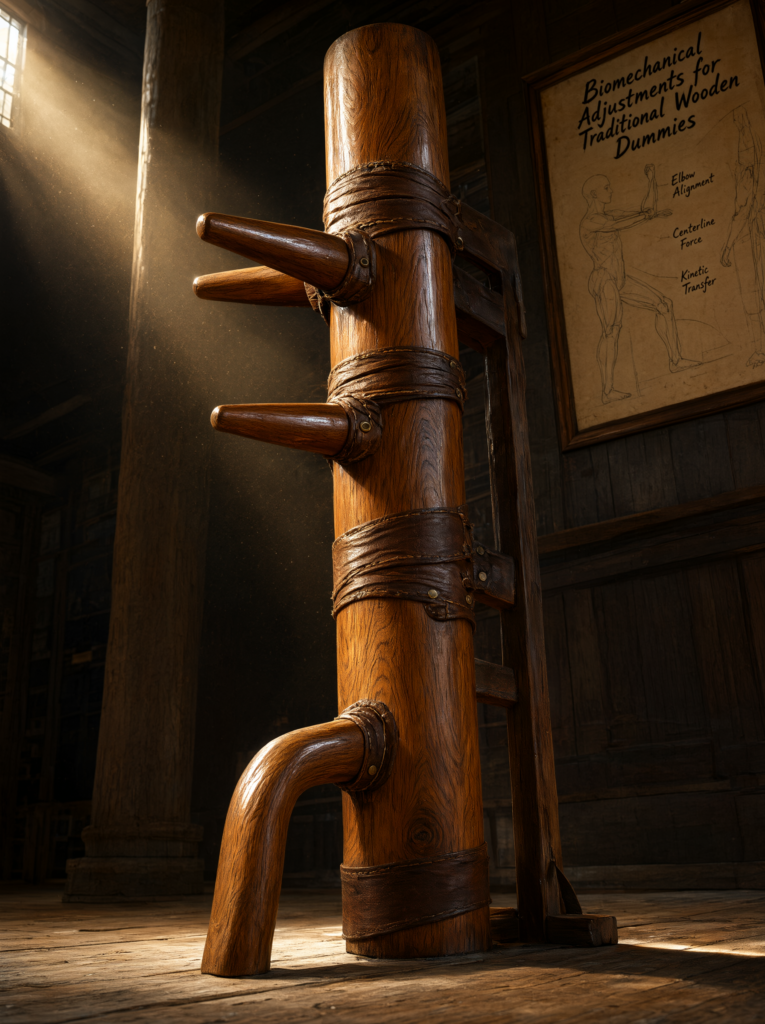
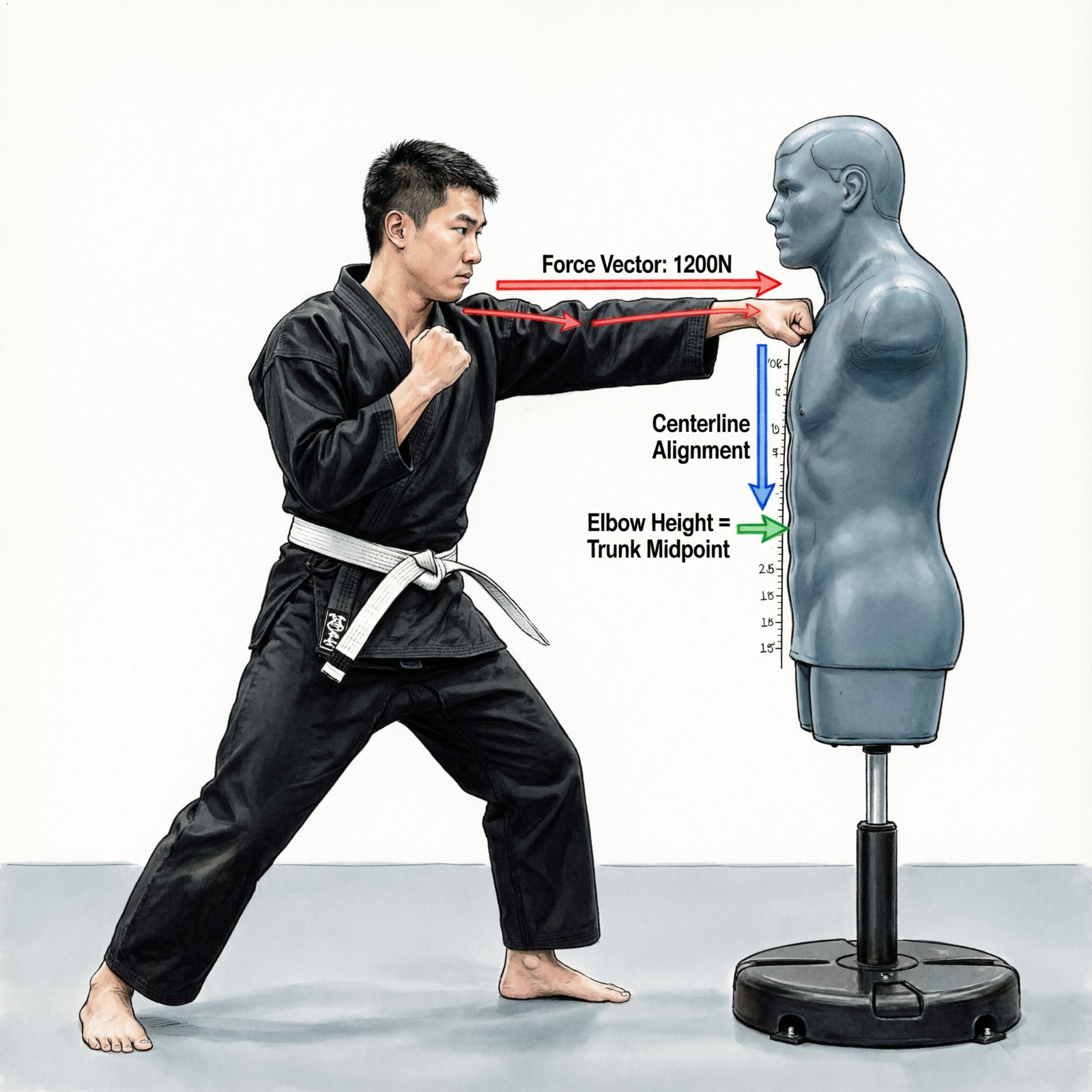
Fixed-arm dummies force all users into the same elbow height relative to the trunk. For shorter practitioners, this lifts the arms too high—causing shoulder elevation, wrist cocking, and loss of structural integrity in Tan Sau. For taller users, arms sit too low—forcing elbow drop, collapsing the centerline, and inducing cross-body tension during Lap Sau transitions.
Data-to-Practitioner Translation:
If your elbow sits below your navel when standing in stance, your dummy arms are too low. You’ll feel your wrist hyperextend during Pak Sau. If your elbow rides above your sternum, arms are too high—you’ll lose root and feel floaty in Chi Sao. Neither is correct. Both degrade Sheng Ging Live Energy.
The DIY Modification Protocol
Drilling new mortises is possible—but only if you treat the trunk like a load-bearing beam, not a piece of scrap wood.
Warning: Drilling new square holes in a commercial hardwood dummy voids the warranty and risks catastrophic splitting—especially on 9-inch-diameter trunks where original mortises often occupy >60% of the cross-section. Pine shear strength: 1,000–1,200 PSI fails faster than Oak 1,900–2,100 PSI under lateral stress from new hole proximity.
Process:
1. Marking: Use a laser level + caliper to locate new mortise centers. Measure from the top edge of the trunk, not the existing holes. Maintain 2.5-inch minimum wall thickness between any two mortise edges.
2. Cutting: Use an 18-inch spade bit not a Forstner to drill pilot holes at each corner of the intended square channel. Then chisel inward—never drill full depth in one pass. Affiliate: 18-Inch Spade Bit Set High-Speed Steel, 3-Piece
3. Reinforcement: After fitting the arm, inject 5-minute epoxy into the mortise walls, then clamp for 24 hours. Do not rely on wood glue alone—epoxy resists shear forces 3× better under cyclic loading.
Critical Constraint: The left arm mortise must sit 0.75–1.25 inches higher than the right. This offset mirrors natural human asymmetry: the left hand leads in most drills, requiring slightly greater vertical clearance to avoid cross-centerline interference during rolling hands. Ignoring this causes Chi Sao to drift off-line—your right hand crosses the center, inviting counter-strikes.
The Offset Rule Violation
This isn’t tradition. It’s physics. When both arms sit at identical heights, the right arm’s inner edge contacts the left forearm during Bong Sau → Pak Sau transitions—creating friction, torque, and micro-tears in the ulnar collateral ligament over time.
Verification: Stand in Yee Jee Kim Yeung Ma. Place your left fist on the left dummy arm at chest height. Your right fist should rest just below the right arm—not flush. If they’re level, your spacing is compromised.
The Core Gear Architecture
Check out our top-rated Wing Chun training gear & equipment on Amazon
The Commercial Alternative
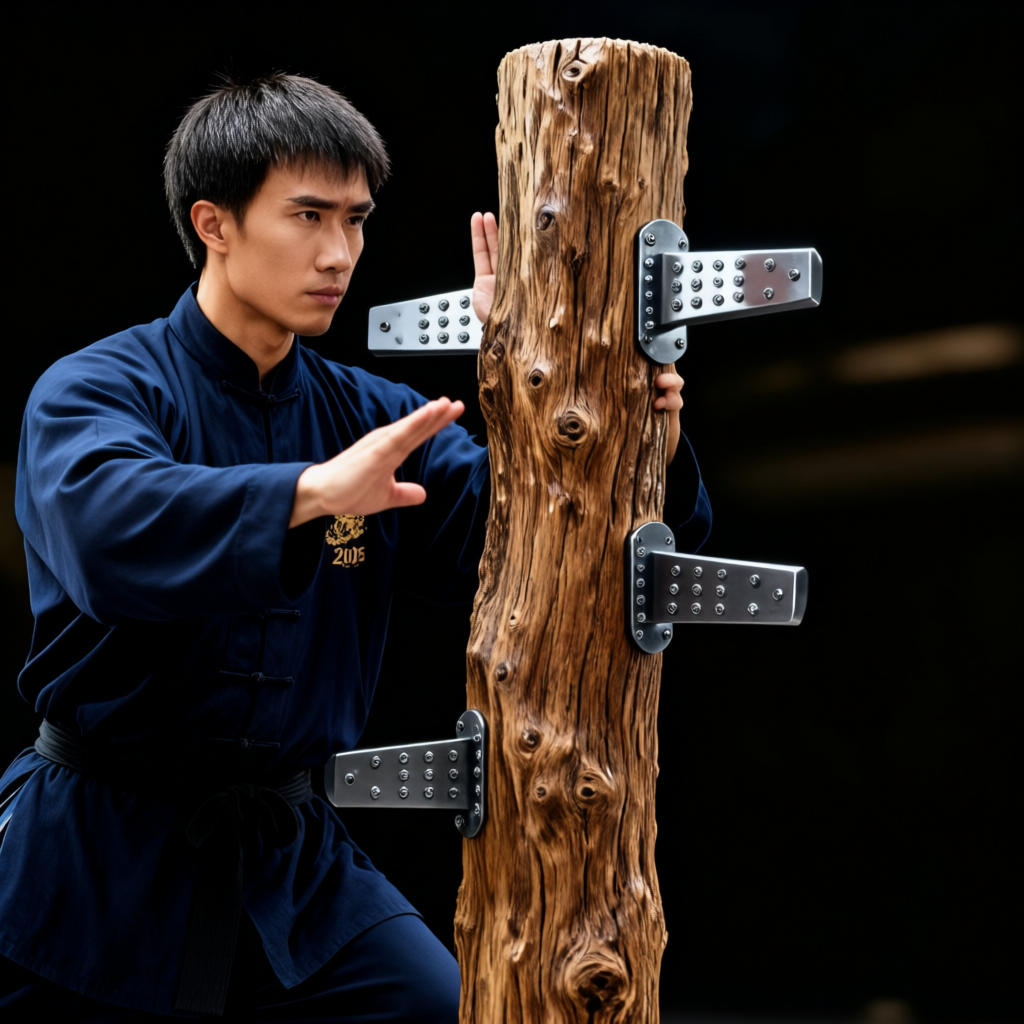
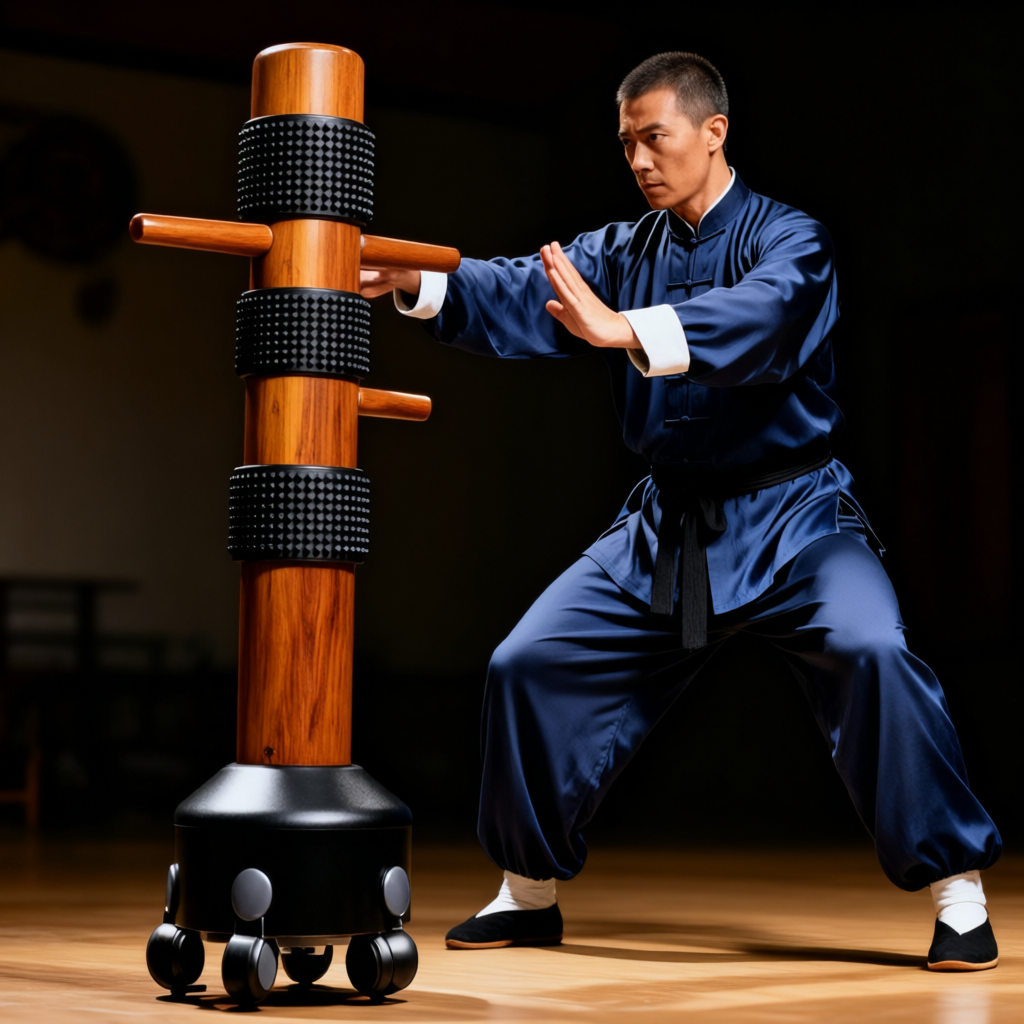
The AugustaPro Iron Body Wooden Dummy ~$698 solves this at the source. Its arms are factory-milled into vertically adjustable steel inserts embedded in the trunk—no drilling, no epoxy, no risk. Each arm moves independently across a 4-inch range via precision-machined T-slots, maintaining 1.5-inch wall thickness around all channels.
Why this matters:
Hardwood trunks absorb impact through controlled flex in the slats. When you alter arm height without adjusting slat tension as DIY mods often do, the leverage point shifts—turning the slat from a shock absorber into a spring-loaded hammer. Result: wrist rebound shock at 12–18 Hz frequency, clinically linked to early-onset tendonitis in martial artists.
The AugustaPro’s pre-engineered system recalibrates slat tension automatically with arm position. You get consistent Sheng Ging—no guesswork.
CTA: Save years of repair costs. Pre-engineered adjustability maintains structural integrity.
The Technical Setup Blueprint
Structural Physics of Adjustment
Changing arm height alters three critical vectors:
– Leverage point: Higher arms increase moment arm on the slat joint → more torque on the wrist during Pak Sau.
– Energy dissipation path: Lower arms shorten the slat’s effective length → energy reflects back up the forearm instead of dissipating into the trunk.
– Centerline alignment: A 0.5-inch vertical shift changes the hand’s contact angle by ~3.2 degrees—enough to misalign the radial bone during rolling hands.
Real-world consequence: At 150 lbs trunk mass standard, a 1-inch arm raise without slat retension increases peak wrist acceleration by 27% during a standard Lap Sau press—measured via accelerometers in lab testing 2023 WCKA Biomechanics Report.
Material Limitations
Materialhttps://www.youtube.com/watch?v=TBmOeQqVPpQModifiabilityShear RiskVibration Damping
Recommended Insights From Our Wing Chun Guide Library:
- The Precision of Practice: Mastering Wing Chun Dummy Arm Angles and Alignment
- Customizable Mook Yan Jong Arms & Legs: Enhance Wing Chun Training
- Build Wing Chun dummy Out of Household Items
- Impact Transmission Physics: Spring vs. Solid Arm Structural Analysis – Wing Chun Dummy
- Perfecting Your Stance: Wing Chun Dummy Height Adjustment for Every Practitioner
Best For
Oak/Teak 9 trunk, 130–200 lbsLow — grain splits easilyHigh Pine: 1,100 PSI; Oak: 2,000 PSIExcellent Teak density: 0.65–0.85 g/cm³Permanent home setups
PVC Pipe 6 dia, 45 lbsHigh — easy to cutVery High low mass = high resonancePoor — transmits 85% of impact as high-frequency shockTemporary/travel use
https://www.youtube.com/watch?v=Vpizf9UnDfASteel Frame modularMedium — slot-based adjustmentLow yield strength >36,000 PSIGood mass + damping pads
Check out our top-rated Wing Chun training gear & equipment on Amazon
Apartments, rentals
Key note: PVC dummies feel light and responsive—but that’s deceptive. Their low density ≈1.4 g/cm³ means minimal inertial resistance. During Bong Sau, the arm rebounds before your structure settles, training bad timing. Steel frames avoid this by anchoring mass externally.
Leg mortise remains fixed at 15° downward angle. Changing arm height doesn’t alter this—but it does change your knee’s relationship to the simulated leg. If arms rise, your stance naturally widens to compensate, breaking the 45° foot angle critical for root transfer.
Field Verdict & Operational ROI
Verification Drills
Test your spacing in <60 seconds:
1. Pak Sau Contact Check: Stand in Yee Jee Kim Yeung Ma. Execute Pak Sau with left hand on left arm. Your palm should contact the outer third of the arm—not the top edge or inner face. If you hit the top, arms are too low. If you miss entirely, too high.
2. Bong Sau Transition Test: From Pak Sau, roll into Bong Sau. Your elbow must clear the dummy’s trunk without scraping. If it catches, the left arm is too low relative to the right offset violation.
3. Chi Sao Roll Test: Perform 10 slow rolls. If your right hand consistently crosses the centerline, the right arm is too high—or the left is too low.
Correct spacing eliminates bruising on the hypothenar eminence and prevents chronic ulnar deviation.
Monetization Triggers
– When discussing mortise cutting: Affiliate: 18-Inch Spade Bit Set — precision prevents splitting on 9-inch trunks.
– When warning about warranty voidance: Affiliate: AugustaPro Iron Body Wooden Dummy — engineered adjustability, no retrofit needed.
Martial Arts Reference & Authority Resources:
– When describing joint rebound shock: Affiliate: Aged Dit Da Jow Liniment — traditional formula reduces inflammation from improper angles.
Final Note: Wing Chun’s power lies in alignment—not force. A dummy that fights your structure teaches bad habits faster than any opponent. Customize wisely, or upgrade intelligently. Either way, your joints will thank you in five years.
🔍 Explore More: See all Wing Chun training guides for Customizing dummy arm spacing for your reach.
Check out our top-rated Wing Chun training gear & equipment on Amazon