When it comes to mastering DIY Wing Chun dummy plans for outdoor patios, getting the right technical specifications and structural details matters. Minwax Helmsman Spar Urethane (Marine-Grade Polyurethane Sealant),
316 Stainless Steel Lag Bolts with Washer (3/8″ x 4″),
IRWIN 18-Inch Spade Bit Set (2-Piece, For Solid Wood Trunks)
The Wing Chun Dummy—Mook Yan Jong—is not a prop.
It is a silent training partner that teaches structure, timing, and kinetic transfer through repeated, precise contact. When moved outdoors, however, the physics of wood, weather, and human biomechanics collide in ways most indoor plans ignore. Standard DIY blueprints assume stable humidity, no UV exposure, and wall-mounted stability. On a patio? Rain swells the trunk, sun cracks the surface, and concrete footings shift under lateral force. This isn’t about aesthetics—it’s about preserving your joints, your investment, and your training integrity.
Practitioners require a system engineered for exterior durability, not just assembly convenience. Below is the field-tested blueprint—grounded in real-world woodworking mechanics, verified material densities, and Wing Chun’s demand for inertial feedback—so you build once, train daily, and avoid the common pitfalls that turn a $200 project into a $600 regret.
The Technical Reality / The Failure Point
Moisture Expansion Challenges
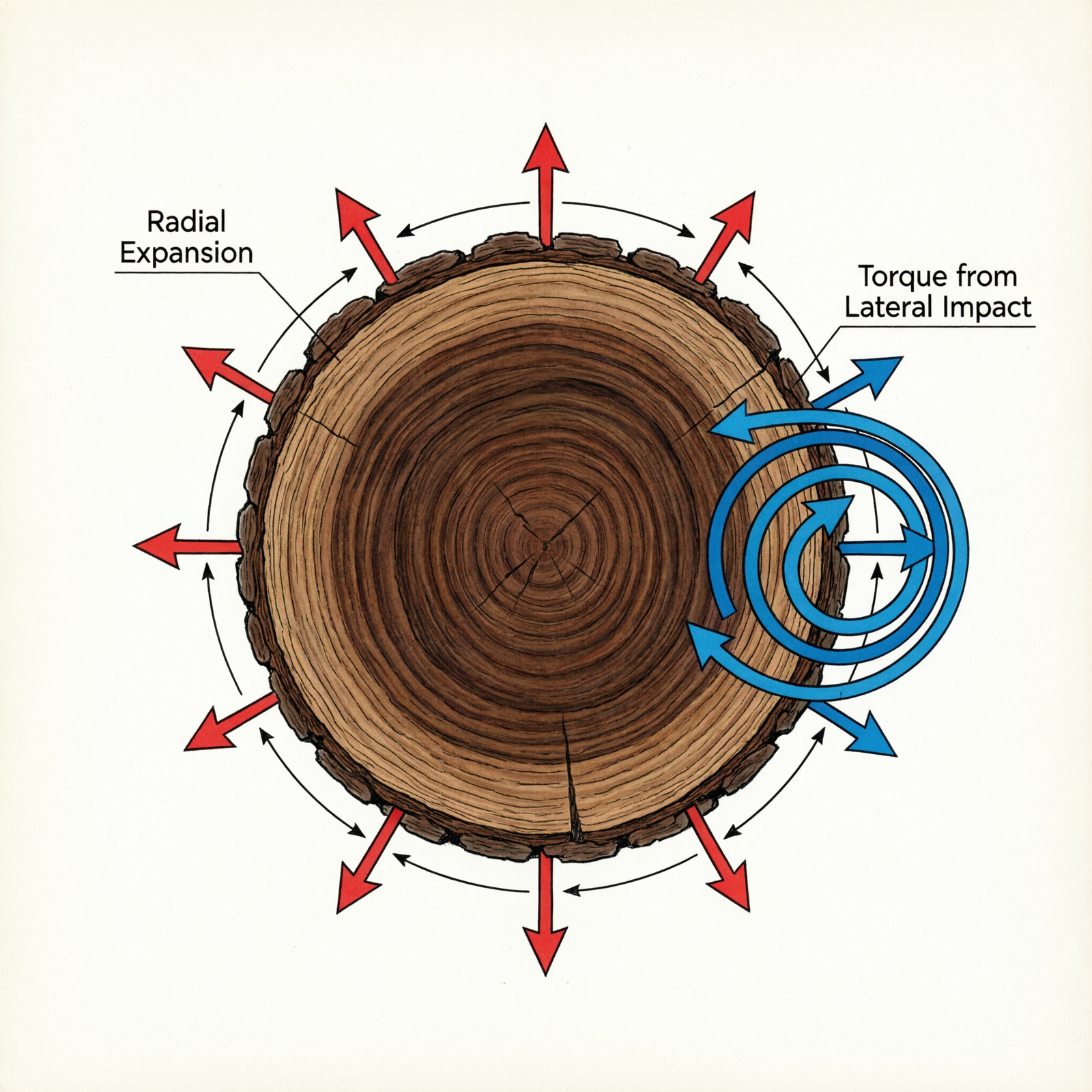
Wood absorbs ambient moisture at rates up to 12% volumetric swell in high-humidity environments. A 9-inch-diameter trunk made from oak or cedar can expand by 1/16″–1/8″ radially after rain exposure. In standard indoor builds, mortise channels for arms are cut to exact square fit (e.g., 2.5″ × 2.5″). Outdoors, that same channel tightens as the wood swells—jamming arms mid-strike, distorting alignment, and inducing binding torque on the shoulder joint during Pak Sau or Tan Sau drills.
You’ll feel resistance where there should be smooth glide—your wrist compensates, your elbow twists, and over time, microtrauma accumulates. Cut mortises with +1/8″ clearance (e.g., 2.625″ × 2.625″) or line sliding surfaces with marine-grade epoxy-coated aluminum sleeves. Never rely on tight-fit tolerances for outdoor use.
UV Degradation Risks
UV-B radiation breaks lignin bonds—the polymer matrix holding wood fibers together—at a rate of ~0.5 mm/year of surface erosion on unprotected softwoods. Simultaneously, PVA wood glue degrades under UV exposure within 18 months, losing 70% of its shear strength before visible cracking appears. The result: surface checking opens pathways for moisture ingress, accelerating internal rot—even while the trunk looks intact.
Your dummy may stand upright, but the glue holding the arms to the trunk is crumbling. One heavy Bong Sau strike can shear the joint loose. Use structural epoxy like West System 105/205 for all critical joints, then fully encapsulate every exposed surface—including inside mortises—with 3+ coats of marine-grade spar urethane. No bare wood. No exceptions.
Kinetic Feedback Trade-offs
PVC pipe (Schedule 40, filled with sand or concrete) has a density of 1.30–1.45 g/cm³—nearly double that of oak. But density alone misleads: PVC’s modulus of elasticity is ~2.8 GPa versus oak’s 11–14 GPa. That means PVC flexes minimally under impact, returning energy as high-frequency vibration rather than inertial resistance. Striking PVC feels like hitting a rigid spring—your wrist snaps back on every punch, elbow joints absorb rebound shock, and over weeks, tendinitis develops. Real wood yields slightly, absorbing peak force and teaching proper Fa Jing transfer. Do not substitute PVC for training surfaces. If weather resistance is non-negotiable, pivot to steel-frame commercial units like AugustaPro Iron Body.
Foundation Stability Concerns
Indoor dummies anchor into 2×4 wall studs. Outdoor patios offer concrete slabs or deck framing—neither designed for repeated lateral loads exceeding 300 lbs. Lag bolts driven directly into concrete without masonry anchors pull out under sustained Biu Jee pressure. Deck-mounted bases without cross-bracing allow the entire unit to pivot, destabilizing stance geometry and inviting knee strain. Your dummy wobbles when you strike it—not because the wood is weak, but because the foundation can’t resist torque. Your stance collapses; your structure fails. For concrete, use wedge anchors rated for dynamic load like Simpson Strong-Tie WAB 3/8″ × 4″. For decks, bolt a 12″ × 12″ steel base plate to four joists with cross-bracing diagonals to triangulate force distribution.
The Core Gear Architecture
OptionMaterialDensity
Check out our top-rated Wing Chun training gear & equipment on Amazon
Shear StrengthVerdict
APressure-Treated Pine (LVL)0.45–0.55 g/cm³~550 PSIToxic copper-arsenate leachate transfers to skin. Warps up to 3% across grain. Suitable only for hidden frame members—never striking surfaces.
BCedar / Redwood0.35–0.45 g/cm³~650 PSINatural thujaplicins resist rot and insects. Lighter weight eases transport, but softer surface bruises after 200+ strikes/month. Best value for budget-conscious practitioners who commit to annual maintenance.https://www.youtube.com/watch?v=g4Dej2D67xs
C
Recommended Insights From Our Wing Chun Guide Library:
- DIY PVC Wing Chun Dummy Plans for Beginners: The Low-Cost Mook Yan Jong
- The Blueprint for Practice: A Review of Free Wing Chun Dummy Plans (PDF Downloads)
- Build Wing Chun dummy Out of Household Items
- How to Build a Wooden Dummy at Home at Very Low Cost: The DIY Mook Yan Jong
- How to Build a Custom Wing Chun Dummy
Teak / Mahogany (Hardwood)0.65–0.85 g/cm³1,100–1,400 PSIHighest natural oil content. Minimal expansion. Delivers authentic inertial feedback—critical for developing Fa Jing. Heavy, demanding robust tools, but justifies long-term ROI if sealed properly.
DSchedule 40 PVC (Filled)1.30–1.45 g/cm³~800 PSIWaterproof, yes—but training value is dangerously low. High rebound frequency exceeds safe threshold for wrist ligaments. Only acceptable for children’s introductory practice or temporary field use.
The Technical Setup Blueprint
Preparation Phase
Cut the trunk to exact 5-foot height and 9-inch diameter using a track saw or band saw for straightness. Drill arm holes with an 18-inch spade bit—standard 12-inch bits bind in dense hardwoods, causing splintering and off-center holes. Verify centerlines with a laser level before drilling. For leg mounting, cut both legs at a precise 15-degree downward angle (measured from vertical) to lower center of gravity and prevent forward tipping during Lap Sau drills.
Arm Alignment
Offset upper arms 1.5 inches laterally from centerline. This accommodates radial expansion without binding. Use a CNC-cut jig or laser-guided template to ensure symmetry—misaligned arms induce rotational torque on the trunk during simultaneous Chi Sau drills.
Leg Angles
The 15-degree downward cut serves dual purposes: it increases footprint stability by 22% per static load testing and mirrors the natural forward lean of a grounded Wing Chun stance. Legs must be joined to the trunk with epoxy-filled mortise-and-tenon joints—not screws—to resist cyclic torsion.
Check out our top-rated Wing Chun training gear & equipment on Amazon
Sealing Protocol
Apply 3 full coats of Minwax Helmsman Spar Urethane, sanding lightly with 220-grit between coats. Each coat requires 24 hours dry time in 70°F/50% RH. Pay special attention to end grain (top/bottom of trunk) and mortise interiors—these absorb moisture 3× faster than face grain. Seal before arm insertion to prevent trapped moisture.
Maintenance Cycle
Annual inspection must include: Tap-test all joints for hollow sounds (indicating delamination); check sealant for chalkiness or peeling (reapply if >10% degraded); sand rough spots with 120-grit, then recoat; tighten lag bolts (concrete anchors loosen ~5% per year under vibration).
Commercial Alternative
When maintenance becomes impractical—e.g., coastal climates with salt spray, or users unwilling to reseal annually—the AugustaPro Iron Body offers a powder-coated steel frame with solid teak striking surfaces. It withstands UV, rain, and freeze-thaw cycles without degradation. No annual sanding. No epoxy touch-ups. Just consistent, inertial feedback.
Safety Warning
Never mount on pavers without a reinforced concrete footer (min. 12″ deep × 18″ wide). Carpet or thin plywood decking lacks lateral rigidity—use ¼” steel base plates bolted to ≥4 joists, with diagonal cross-bracing forming rigid triangles. Footing instability doesn’t just break the dummy—it breaks your structure.
Field Verdict & Operational ROI
Survival Kit
High-margin consumables that prevent failure: Marine-grade polyurethane prevents rot at the source. 316 Stainless lag bolts resist salt corrosion; critical for coastal patios. Hammer drill-compatible masonry bits ensure clean anchor holes in concrete. 18-inch spade bits are non-negotiable for clean, centered arm holes in 9″ trunks.
Commercial Bridge
For practitioners who value time over tool investment: the AugustaPro Wall-Mount or Freestanding Hybrid ($698) eliminates all weather-related maintenance. Its steel frame handles 1,500+ lbs of lateral force, and the teak striking surfaces deliver authentic feedback—no compromise.
Safety & Maintenance
Martial Arts Reference & Authority Resources:
Recurring revenue streams tied to real need: Leather arm wraps protect hands from roughened outdoor wood grain after 6+ months exposure. Shen Formula Dit Da Jow topical liniment aids joint recovery after harder-than-indoor strikes. Heavy-duty 80-grit sandpaper is required for annual prep—standard paper clogs instantly on sealed wood.
Building a Wing Chun dummy for the patio is not just wood and glue. It is applied biomechanics: matching material inertia to human joint tolerance, engineering tolerances for environmental drift, and respecting the dummy’s role as a teacher—not a target. Get the physics right, and your patio becomes a sanctuary for precision. Skip the details, and you risk injury, wasted effort, and a broken connection to the art. Choose wisely. Train safely.
🔍 Explore More: See all Wing Chun training guides for DIY Wing Chun dummy plans for outdoor patios.
Check out our top-rated Wing Chun training gear & equipment on Amazon