The Biomechanics of Rotational Deflection
The Bong Sau is not a static block. It is a deflection vector. On a human opponent, impact energy absorbs into skeletal structure and soft tissue compression. On a rigid hardwood trunk, that same energy has nowhere to go unless you change the angle of contact. If you strike the dummy with a flat palm, kinetic energy reflects directly up the ulnar and radial bones into the elbow joint. This causes immediate inflammation and long-term tendonitis.
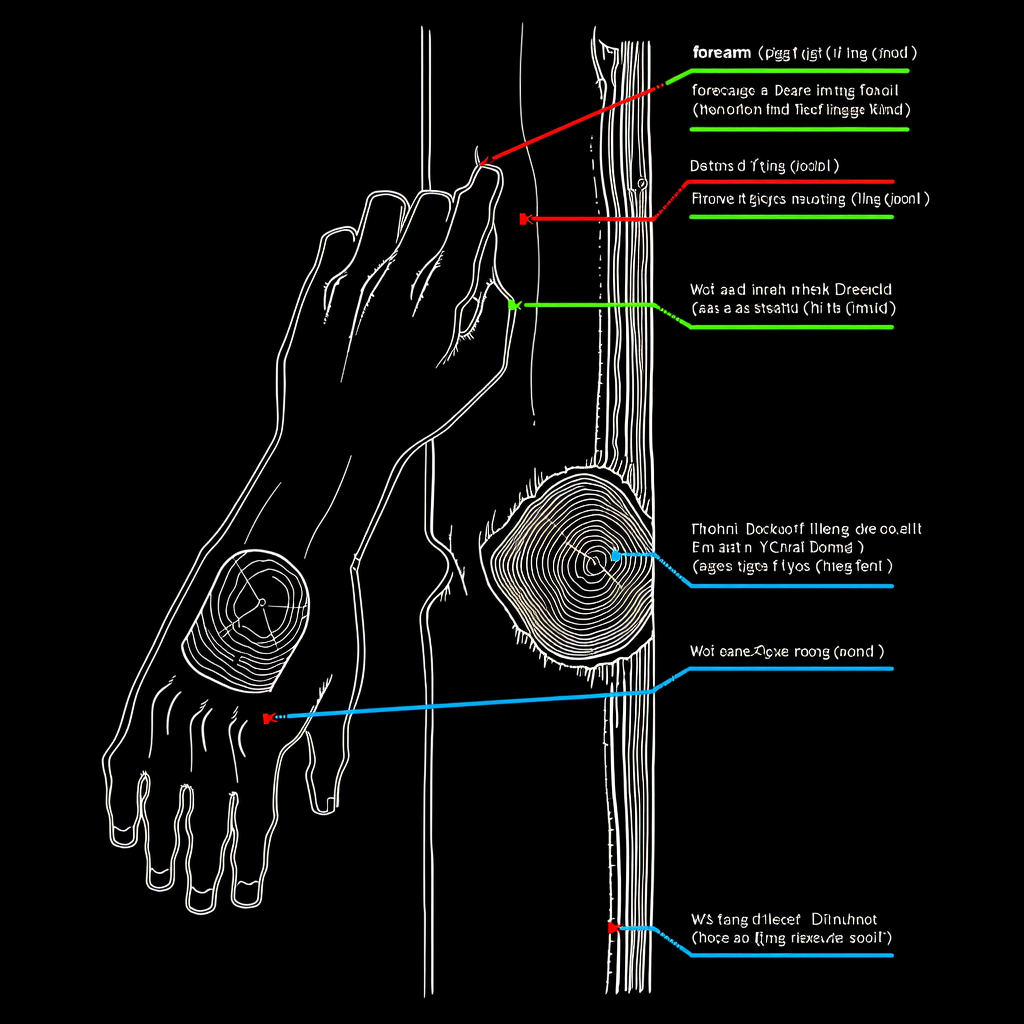
You must execute the Bong Sau with forearm rotation. The radius bone acts as a lever against the dummy’s slats. Your contact point should be the outer edge of the forearm, near the pinky side, not the center of the palm. This redirects force laterally through the flexible horizontal slats rather than vertically into your skeleton.
Kinetic Pathway: Impact -> Forearm Rotation -> Lateral Force Transfer to Dummy Slats -> Energy Dissipation via Wood Flex -> Return to Practitioner (Minimal).
Failure Mode: Static Contact. Hitting the dummy straight on creates a wall effect. The dummy vibrates violently with high-frequency resonance because the mass isn’t being moved laterally. This teaches bad habits where you rely on muscle tension instead of structural alignment.
Solid Rattan Training Rings are essential for developing the fixed elbow structure required for safe rotational deflection. These rings enforce proper alignment before you ever make contact with the hardwood dummy.
Harnessing Live Energy (Sheng Ging) Interaction
Traditional hardwood dummies rely on the flexibility of horizontal mounting slats, usually oak or teak, to simulate a living opponent. When practicing the Bong Sau, your primary goal is to make these slats flex. If the slats are too stiff from over-gluing or low-density wood, the Bong Sau will feel like hitting a brick wall. You must learn to feel the resistance of the slats bending before impact.
Drill Concept: The Touch and Flow. Instead of striking with full power immediately, practice the Bong Sau motion at thirty percent speed. Focus entirely on making the dummy’s arms swing slightly upon contact. If the dummy does not move laterally, your angle of attack is wrong. The Bong Sau should push the dummy’s left arm outward when attacking the right side, or vice versa. You are utilizing the intersecting mortise geometry to create a pivot point.
Spatial Geometry and the Arm Offset Execution
The dummy’s arms are not parallel. The left arm channel sits higher than the right. A common error when practicing the Bong Sau is treating both arms as identical targets. This breaks your centerline retention and ruins feedback.
Geometric Constraint: When practicing a high Bong Sau to deflect a punch to the head or neck, the contact point must align with the higher left arm channel. When practicing a low Bong Sau to deflect a kick or low punch, the contact must align with the lower right arm channel.
Error Pattern: Practitioners often aim for the geometric center of the trunk. This misses the optimal leverage point on the slats, causing the dummy to spin uncontrollably instead of deflecting. The Bong Sau must target the specific intersection point of the slat and the vertical post to maximize torque applied to the dummy’s frame.
Joint Protection and Conditioning Protocols
Hardwood dummies transmit significant shock. Safety is paramount when translating soft-skin drills to rigid timber. Your forearms must condition to withstand repetitive impact without developing chronic carpal tunnel issues or wrist strain.
Conditioning Requirement: Apply traditional Dit Da Jow liniment before and after training. The herbal formula increases local circulation and toughens the skin and fascia over time. This is non-negotiable for hardwood practice.
Check out our top-rated Wing Chun training gear & equipment on Amazon
Aged Dit Da Jow Liniment is critical for tendon resilience and recovery. Beginners transitioning from heavy bags to wooden dummies should use padded striking wraps or specialized leather forearm guards. These reduce initial shock while you rebuild your structural alignment.
Common Mistakes and Correction Algorithms
Mistake A: The Push vs. The Deflect. Beginners push the dummy away. This kills the flow and prevents sticky-hand sensitivity development.
Correction: Visualize the Bong Sau as sweeping a broom. The hand moves across the body’s centerline, brushing force aside. The dummy should react by swinging away from the line of force, not being shoved backward.
Mistake B: Wrist Collapse. The wrist bends inward upon impact.
Correction: The wrist must remain rigid and aligned with the forearm. Imagine a steel rod extending from the shoulder to the point of impact. Any deviation causes injury and breaks the kinetic chain.
Mistake C: Ignoring the Leg Base. The Bong Sau requires root stability. If the feet are sliding, upper body momentum cannot transfer effectively.
Correction: Practice the Bong Sau while maintaining a wide Wing Chun stance. The legs must absorb the recoil, not the arms. Your lower body anchors the deflection vector.
Advanced Drill Variations
Drill 1: The Single-Arm Deflection. Focus solely on the left arm of the dummy. Practice high and low Bong Sau variations against just that one arm to master the angle of deflection without distraction.
Drill 2: The Rolling Bong Sau. As the dummy swings back from a previous strike, practice a rolling Bong Sau transition from Tan Sau to catch the returning energy. This simulates a real fight scenario where the opponent recovers and attacks again.
Drill 3: Blind Spot Training. Close your eyes briefly after impact to feel the vibration travel up your arm. If the vibration is sharp and jarring, your technique was incorrect. If it is a dull thud absorbed by the wood, your technique was correct.
Equipment Upgrades and Maintenance
Recommended Insights From Our Wing Chun Guide Library:
- Top 10 Moves of Wing Chun
- Wing Chun Dummy Drills for Small Spaces: Mastering the Mook Yan Jong at Home
- Structural Calibration for Solo Combat Readiness – Wing Chun Dummy
- Unlocking Kinetic Flow: The Art of Training with the Wooden Dummy
- Fix Robotic Arm Slaps: Precision Dummy Engineering for Fluid Centerline Flow
Loose slats ruin feedback. If your dummy arms spin freely without resistance, your mortise joints have likely worn down or your glue has failed. Check the horizontal mounting slats regularly. Tighten or re-glue them to restore the live energy required for proper Bong Sau mechanics. A rigid dummy teaches bad habits. A properly tuned dummy teaches timing and structure.
IssueDiagnosisSolution
Slats don’t flexOver-glued or low-density woodReplace with high-grade teak or oak slats; reduce glue at mortise jointshttps://www.youtube.com/watch?v=wRqbz29SdcY
Dummy spins uncontrollably
Check out our top-rated Wing Chun training gear & equipment on Amazon
Misaligned mortise or loose mounting boltsRealign slat angles; tighten or replace pivot hardware
Wrist pain after trainingIncorrect contact point or wrist collapseShift contact to ulnar edge; reinforce forearm rigidity with rattan rings
AugustaPro Mook Yan Jong delivers factory-tuned slats and precision mortise offsets, eliminating the guesswork of DIY builds and ensuring your training feedback matches traditional biomechanical standards.
Martial Arts Reference & Authority Resources:
Final Strategic Direction
Mastering the Bong Sau on the Mook Yan Jong requires shifting from brute force to precise geometry. You are not fighting the wood. You are redirecting kinetic energy through rotational leverage, targeting specific slat intersections, and anchoring the movement with a stable leg base. Condition your forearms, respect the joint limits, and let the dummy’s live energy teach you timing. When the wood flexes and swings smoothly, you know your structure is correct. Train with physics, protect your joints, and let the mechanics guide your progression.
🔍 Explore More: See all Wing Chun training guides for How to practice the Bong Sau on the dummy.
Check out our top-rated Wing Chun training gear & equipment on Amazon