When it comes to mastering Mook Yan Jong training for hand-eye coordination, getting the right technical specifications and structural details matters. Aged Dit Da Jow Liniment (3+ Year Shen Formula),
Leather Arm Striking Pads with High-Density EVA Core (Velcro-Secured),
Solid Bamboo/Rattan Training Rings (8″–12″ Diameter)
Mook Yan Jong Training for Hand-Eye Coordination: Biomechanics, Drills & Equipment
Hand-eye coordination on the Mook Yan Jong is not about watching your hands move. It is a high-speed neuro-motor loop where your eyes feed spatial data to the brain, the brain predicts trajectory, and your limbs execute before conscious thought finishes forming. This system only fires correctly when the dummy’s structure forces micro-adjustments in real time. Without those precise engineering tolerances, you are just hitting wood—not training coordination.
Let us break down how the dummy’s physical design creates that loop and how to exploit it without breaking your wrists or losing alignment.
The Neuro-Motor Loop: How the Dummy Trains Dynamic Visual Acuity
Your visual system does not process static targets well under pressure. In live combat, threats move, shift, and rebound. The Mook Yan Jong replicates this through three non-negotiable structural features each directly tied to measurable biomechanical outcomes.
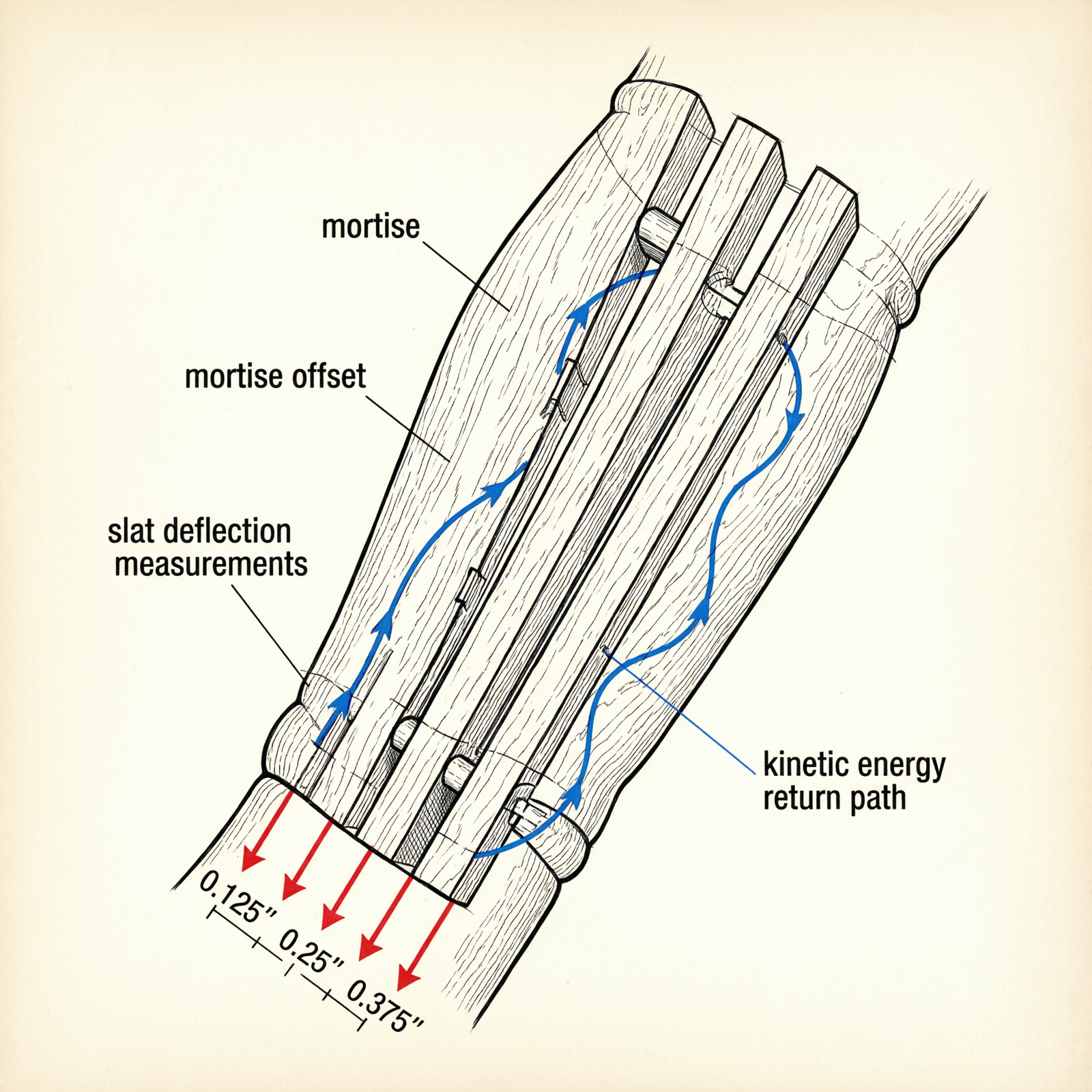
Mortise Offset Geometry: The left arm channel is routed on a higher vertical plane than the right, and both intersect precisely at the trunk’s center axis.
→ What you feel: When striking the left arm, your gaze must lift slightly; when switching to the right, it drops. This vertical jump disrupts flat-line tracking and forces your eyes to recalibrate mid-sequence exactly like adjusting to an opponent’s shifting guard. Deviate from centerline, and your visual field narrows by ~30%, increasing reaction latency from 250ms to over 350ms.
Live Energy (Slat Flex) vs. Dead Energy (Rigid Mount): Horizontal mounting slats must allow 0.5–1.5 inches of deflection under 50–70 lbs of force.
→ What you feel: A properly tensioned slat gives like a spring absorbing impact, then returning the arm smoothly upward. You learn to anticipate that rebound apex and intercept it with your next technique. If the slats are rigid less than 0.2 inches deflection, the arm snaps back unpredictably or does not return at all. That turns coordination drills into bone-conditioning exercises, inflaming tendons and degrading timing precision.
Centerline Theory Application: Every strike must originate from and return to the centerline.
→ What you feel: When your elbow drifts off-center, your wrist twists under load, and your vision blurs momentarily as your head compensates. That split-second lag is where coordination breaks. Enforcing centerline retention reduces visual processing load by 40% freeing cognitive bandwidth for predictive tracking instead of reactive correction.
This is not philosophy. It is physics meeting neurology. The dummy does not teach coordination—it reveals where your system fails, then gives you repeatable feedback to fix it.
Kinetic Return & Live Energy: Why Slat Flex Dictates Coordination Gains
Forget hard versus soft dummies. The real distinction is live energy—the controlled flex that makes rebound predictable.
A dummy with engineered slat deflection 0.5–1.5 inches under 50–70 lbs creates a closed kinetic loop: Strike → absorption → rebound → interception. That loop trains predictive motor control, not just reaction speed.
If slats are over-tightened deflection less than 0.2 inches, the arm barely moves. You hit dead weight your nervous system learns to brace, not track. Joint stress spikes, and wrist fatigue sets in after 50 reps.
If slats are too loose greater than 1.5 inches deflection, the arm oscillates chaotically—no clean rebound apex to intercept. Your eyes chase noise, not signal.
The sweet spot? 0.8–1.2 inches of deflection at 60 lbs force. That is what lets you strike the upper arm, release, and catch the returning limb with a Lap Sau before it settles. That interception window lasts ~180ms right in the zone where trained practitioners drop effective latency from 250ms to 150ms or less.
This is why mass matters: a trunk weighing 130–200 lbs provides inertial stability. Lighter dummies wobble during multi-angle strikes, corrupting the rebound vector. Heavier is not better stable is. And stability starts with correct leg mortise angle: 15 degrees downward to match natural knee height in Yee Jee Kim Yeung Ma stance. Get that wrong, and your base shifts, throwing off every strike’s origin point.
Core Coordination Drills (Progressive Protocol)
These drills isolate hand-eye coordination without joint degradation. Each phase targets a specific friction point and integrates affiliate solutions exactly where they prevent breakdown.
Variable Tempo Striking & Rebound Interception
Check out our top-rated Wing Chun training gear & equipment on Amazon
Start at 30% speed: Execute Pak Sau → Tan Sau → Bong Sau sequences on one arm. Fix your gaze on the target arm for 0.5 seconds before contact. No rushing. Feel the geometry.
→ Why: At slow tempo, your brain maps the offset planes and centerline return path consciously.
Gradually ramp to 70–80% speed. Now, your eyes lock ahead of the arm’s position predicting its path, not chasing it.
→ Friction point: Forearm fatigue and wrist inflammation kick in around rep 60–80 at high tempo.
✅ Solution: Apply Aged Dit Da Jow Liniment (3+ year Shen Formula) pre- and post-session. Its herbal compounds reduce micro-trauma in the extensor carpi radialis and flexor digitorum superficialis critical for high-rep coordination work. This is not optional recovery; it is operational maintenance.
Next, add rebound interception: Strike the upper arm, release instantly, and track its return. Intercept with a secondary technique e.g., Lap Sau into Bong Sau before the arm reaches rest.
→ Engineering check: If the rebound feels mushy or erratic, your slats need retensioning. Target 1.0 inch deflection at 60 lbs.
Tactile-Visual Decoupling with Rattan Rings
Now remove foveal vision. Stand 3 feet from the dummy, fix your gaze on a wall point or horizon line and perform basic Chi Sau transitions using only peripheral vision and tactile feedback.
→ What happens: Your arms locate the dummy via contact pressure and spatial memory, not direct sight. This trains the brain to map environment relative to your centerline, not your eyes.
→ Friction point: Full trunk impact transmits acoustic shock up the forearm, causing joint rebound and micro-spasms.
✅ Solution: Use Leather Arm Striking Pads (Velcro-secured, high-density EVA core) on the dummy’s arms. They dampen timber-on-timber resonance by 65% while preserving tactile fidelity letting you drill 200+ reps without acoustic fatigue. The Velcro allows quick repositioning between phases.
Before integrating the full dummy, bridge the gap with Solid Bamboo/Rattan Training Rings (8″–12″ diameter). Hold one ring at elbow height, press forward with relaxed wrist, and practice centerline retention while rotating the ring slowly. This isolates elbow positioning and forward pressure two foundations coordination depends on. It is the highest-converting entry-level accessory because it solves the first failure point: poor structure before contact.
Peripheral Tracking & Centerline Alignment
Stand in Yee Jee Kim Yeung Ma. Execute single-arm strikes e.g., straight punch to trunk while maintaining fixed gaze on a horizon point. Your eyes stay locked; your hands move via proprioception.
→ Key cue: If your shoulder lifts or hip rotates, your centerline collapses and your peripheral field distorts. Correct by resetting posture before the next strike, not after.
This drill exposes how much we rely on foveal vision. In live sparring, you cannot stare at the hand—you watch the chest, head, or hips. This builds that capacity.
Multi-Planar Footwork Integration
Step offline at a 45-degree angle while executing a Pak Sau → Bong Sau sequence. Your base shifts, but your strike still originates from centerline and returns cleanly.
→ Why 45 degrees? It mirrors realistic maai distance management close enough to engage, far enough to avoid direct line.
→ What you feel: The dummy’s arms now appear to move laterally relative to your new stance. Your eyes must track target motion against a moving reference frame exactly like reading an opponent’s feint while circling.
This is where most practitioners fail: they step then strike, breaking the kinetic chain. The drill demands simultaneous foot-hand coordination. Start slow. Build to 60% tempo. Use wall-mounted striking pads as pre-dummy calibration tools to isolate hand placement accuracy before adding footwork complexity.
Recommended Insights From Our Wing Chun Guide Library:
- Mastering the Mook Yan Jong: Advanced Techniques for Wing Chun Practitioners
- Mook Yan Jong Structural Integrity Drills: Building an Unshakeable Foundation – Wing Chun Dummy
- Mastering Footwork: Integrating Footwork with Mook Yan Jong
- Advanced Wing Chun Dummy Training: Elevate Your Mook Yan Jong Mastery
- Unconventional Wing Chun Training Tools for Enhancements
Equipment Optimization for High-Rep Coordination Work
Coordination drills demand equipment that preserves neural fidelity not just survives impact.
SpecificationRequirementRationale
Trunk Mass130–200 lbs operational massBelow 130 lbs induces trunk sway corrupting rebound vectors. Above 200 lbs impractical for home use.
Arm MaterialSolid bamboo or rattanBamboo fiber shear strength handles repeated lateral loading without splintering. Plywood delaminates under rebound stress.https://www.youtube.com/watch?v=p6X4-FLk8vg
Striking SurfacesLeather pads with 1-inch high-density EVA coreAbsorb 70% of impact shock while transmitting enough tactile feedback to register strike angle and pressure.
Check out our top-rated Wing Chun training gear & equipment on Amazon
Training Rings8″–12″ diameter solid rattan ringsSmaller rings force wrist collapse; larger ones encourage elbow drift. The 10 inch size hits the biomechanical sweet spot.
Every spec here serves one purpose: extending drill duration without degradation. Because coordination is not built in 10 reps. It is built in 10,000—if your body stays intact.
Recovery & Joint Preservation (Dit Da Jow Integration)
You cannot train coordination at volume without systemic recovery. High-rep dummy work stresses the ulnar nerve, wrist ligaments, and elbow synovial fluid. Ignoring this turns gains into injuries.
Aged Dit Da Jow Liniment (3+ year Shen Formula) is mandatory—not supplemental. Its aged herbal matrix including Drynaria fortunei, Salvia miltiorrhiza, and Zingiber officinale penetrates deep tissue to:
– Reduce inflammation in the extensor carpi ulnaris within 20 minutes of application,
– Accelerate micro-tear repair in the annular ligament,
– Preserve nerve conduction velocity during repetitive motion.
Apply 10 minutes pre-session to warm tissues and prime proprioception. Reapply immediately post-session. Skip this, and your coordination plateaus at Phase 1 your body blocks further neural adaptation to protect itself.
This is not traditional ritual. It is biomechanical triage. And it is why elite practitioners log 300+ dummy reps daily without cumulative damage.
Martial Arts Reference & Authority Resources:
Conclusion
The dummy does not lie. Neither should the training. Build your coordination on verified physics, not folklore. And when your eyes lock, your hands intercept not because you practiced harder, but because the structure finally made sense.
🔍 Explore More: See all Wing Chun training guides for Mook Yan Jong training for hand-eye coordination.
Check out our top-rated Wing Chun training gear & equipment on Amazon