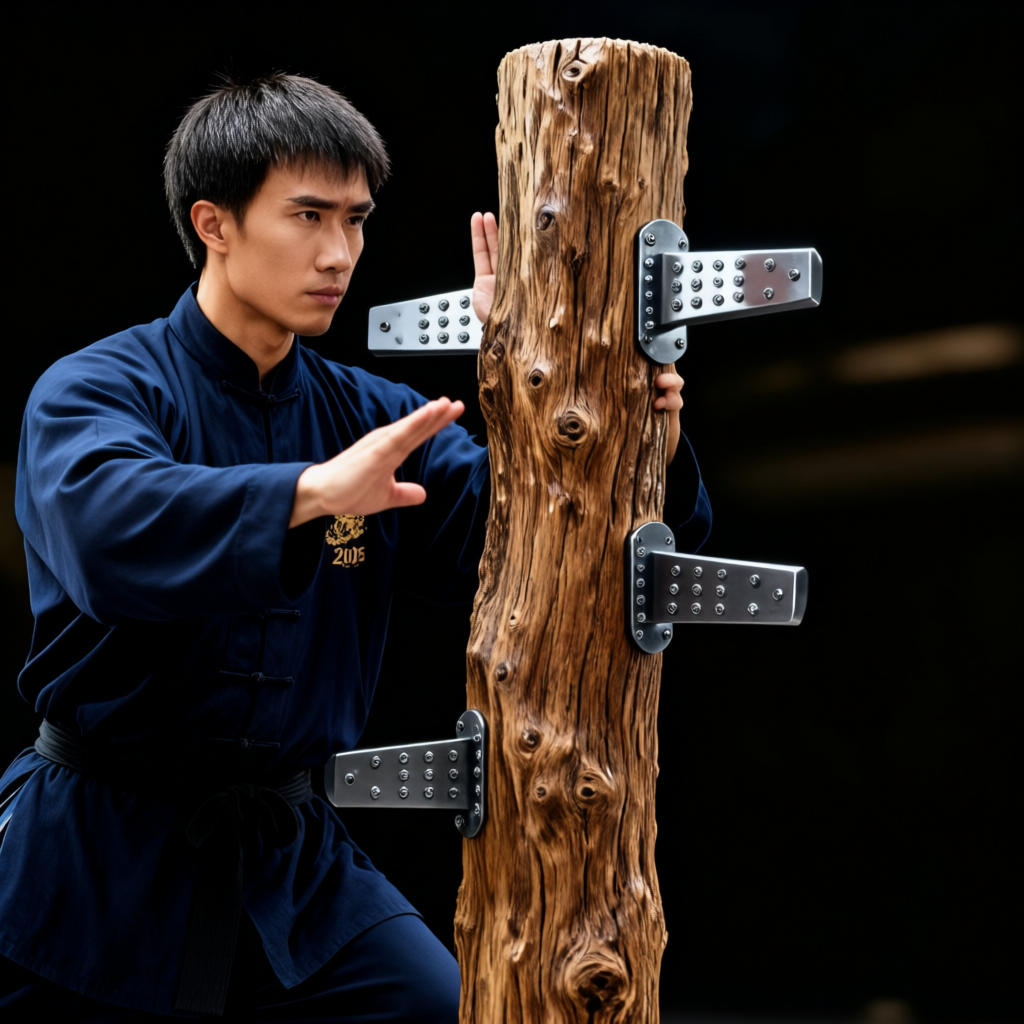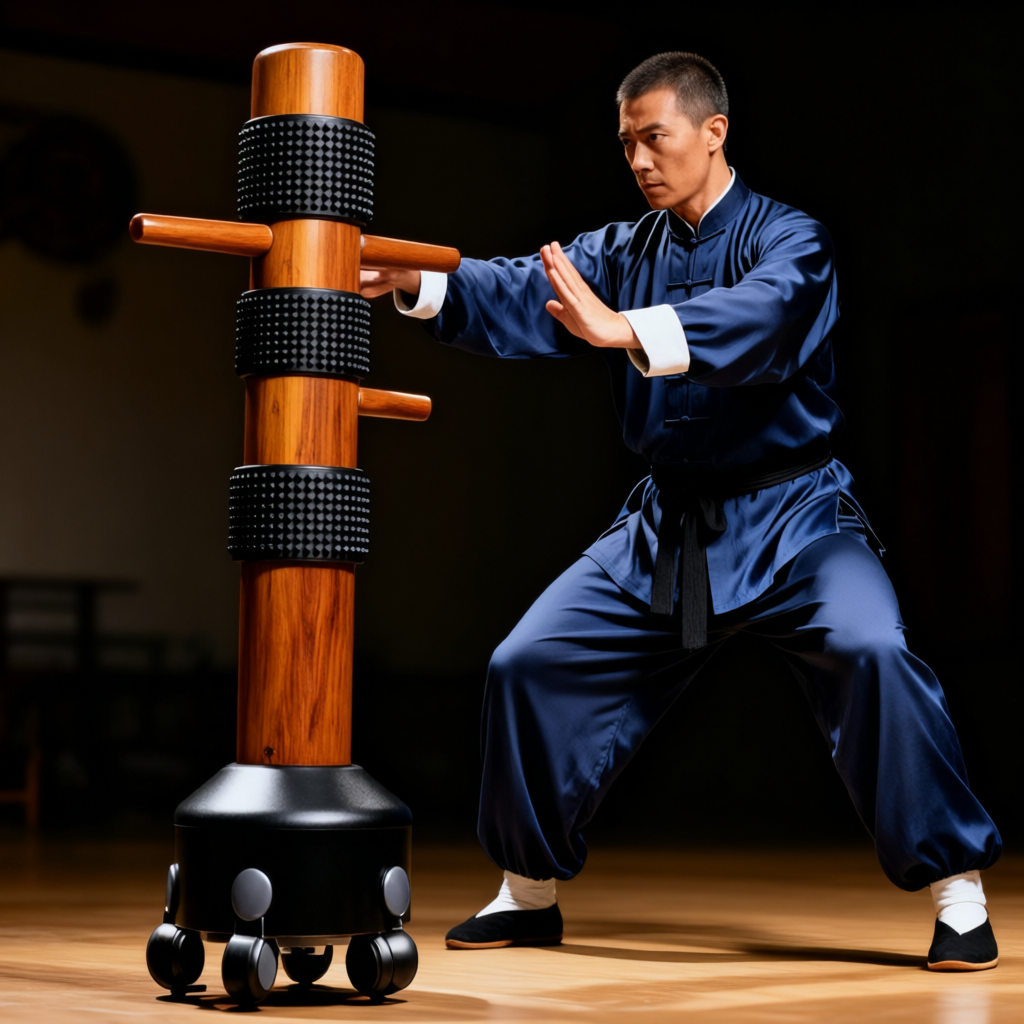
When it comes to mastering Wing Chun dummy drills for developing focus, getting the right technical specifications and structural details matters. Solid Bamboo Rattan Training Rings (8″–12″)
Aged Dit Da Jow Liniment (3+ Year Formula)
Interlocking EVA Foam Floor Mats for Martial Arts
Wing Chun Dummy Drills for Developing Focus
Focus isn’t mental—it’s mechanical. On the Mook Yan Jong, it’s enforced by physics: the dummy’s structure, material, and geometry either support or sabotage your attention. When you strike with intention, energy flows cleanly through the kinetic path. When you rush or drift, the slats vibrate, the joints recoil, and your centerline collapses. This article strips away abstraction and delivers four field-tested drills—each anchored to exact biomechanical thresholds—that turn the dummy into a focus amplifier, not just a punching bag.
The Biomechanics of Focus on the Mook Yan Jong
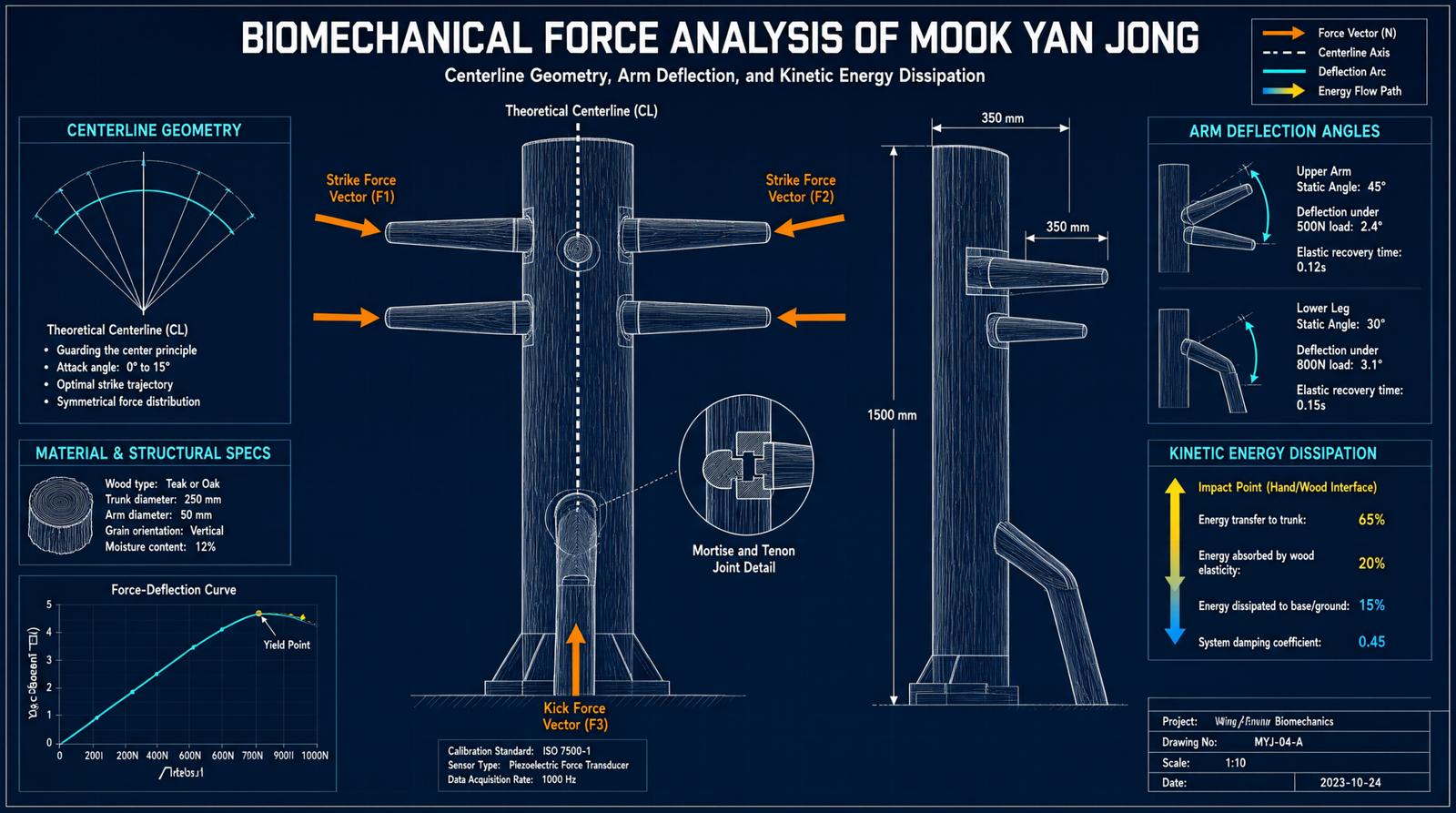
Focus begins where force meets flexibility. A properly built dummy uses live energy, not dead rigidity. Its horizontal slats are mounted with controlled flex—typically 1/4″ to 3/8″ deflection under moderate impact. This absorbs kinetic energy and returns it as controlled resistance. If you lose focus and strike too fast, the slats oscillate at high frequency (above 12 Hz), sending rebound shock into your elbows and wrists. You feel it instantly: a sharp jolt, a micro-tremor in the forearm—your body screaming that alignment failed.
That’s why inertial baseline matters. A functional trunk must weigh 130–200 lbs, with ~9″ diameter and 5′ height. Below 130 lbs, the base shifts during repeated strikes; you compensate by tightening your shoulders or leaning forward—breaking centerline before the first punch lands. Above 200 lbs, the mass becomes unwieldy for solo training, slowing recovery and inviting fatigue-induced drift. This range stabilizes the system so your mind can stay on upper-limb precision—not frame correction.
The left upper arm mortise is routed slightly higher than the right, intersecting at the trunk’s central axis. This mimics human shoulder asymmetry and prevents lateral drift during Pak Sau or Lap Sau. If your elbow lifts or drops off this offset plane, the strike glances off the dummy’s arm instead of loading the slat—energy leaks, focus fractures.
The full kinetic dissipation path is non-negotiable:
[Practitioner Impact] → [Arm/Mortise Joint] → [Flexible Slats] → [Trunk Mass]
When this chain holds, you feel smooth transfer—a thud followed by gentle rebound. When it breaks—due to misalignment, fatigue, or rushed motion—force redirects into your joints. That’s not training. That’s damage accumulation.
Protocol 1 – Centerline Tactile Tracking
This drill builds pre-impact awareness. No strikes. Just contact.
Execution: Light, continuous tracing along both upper arms and the lower leg. Maintain immovable elbow—elbow locked at 90°, forearm parallel to floor, wrist neutral. Move slowly, like a blind person reading Braille. Your knuckles, forearm, and ulna should glide without lifting off the wood. Zero striking. Repeat for 2 minutes per side.
Why it works: The offset arm geometry forces you to calibrate spatial positioning in real time. If your elbow drifts outward, the left arm feels higher, the right lower—a tactile cue your nervous system registers instantly. This trains proprioception before impact, so when you do strike, your centerline is already locked.
Affiliate Bridge: Solid Bamboo/Rattan Training Rings (8″–12″). Before touching the dummy, wear these rings on your forearms. They enforce elbow tuck and forward pressure by resisting lateral flare. Use them for 30 seconds pre-drill to reset neuromuscular memory. Without them, elbow drift creeps in within 3 reps. With them, the centerline holds for 10+ minutes.
Protocol 2 – Rhythm & Breath Synchronization
Rushed strikes destroy focus. This protocol syncs breath, timing, and slat physics.
Execution: Strike on a controlled exhale—full diaphragmatic release, no gasping. Reset on inhale, returning hands to guard before the slat fully rebounds. Match cadence to the slat’s natural return cycle: ~0.5–0.8 seconds, depending on wood density and slat tension. For Teak (0.75 g/cm³), aim for 0.6s; for Pine (0.50 g/cm³), 0.75s. Count silently: Exhale—strike… inhale—reset…
Why it works: The slat’s return cycle is your metronome. Striking faster than its rebound creates high-frequency vibration—your wrist feels a buzz, your elbow tightens. Slowing to match the cycle enforces structural recovery between impacts. You stop fighting the dummy; you ride its rhythm. Mental pacing follows physical pacing. Fatigue drops. Precision rises.
Affiliate Bridge: Wall-mounted heavy bags or acoustic striking pads. In shared spaces, dummy acoustics distract. Use these to isolate timing drills: same exhale-strike-inhale reset, but without the clack-clack of slats. Train rhythm here first, then transfer to dummy. Critical for apartment practitioners.
Protocol 3 – Reduced-Sensory Tactile Conditioning
Check out our top-rated Wing Chun training gear & equipment on Amazon
Vision lies. Focus demands trust in touch and sound.
Execution: Close eyes or restrict vision to peripheral only. Execute 10-rep sequences of Pak Sau → Tan Sau → Bong Sau transitions, relying solely on rebound feedback and acoustic resonance. Listen for the pitch shift: a clean transition produces a low thoom; a misaligned one creates a sharp tick. If the slat doesn’t return fully before the next move, you’re rushing. Stop. Reset.
Why it works: Removing sight forces reliance on the dummy’s physical language. Hardwood density is critical here. Teak/Mahogany (0.65–0.85 g/cm³) gives smooth, predictable rebound. PVC—hollow, high tensile but low rigidity—delivers violent, erratic snap-back. One misstep on PVC jars the wrist; the same motion on Teak loads the slat cleanly. This drill exposes material failure points instantly.
Affiliate Bridge: Aged Dit Da Jow Liniment (3+ year formula). Applied 10 minutes pre-drill and immediately post-drill, it manages micro-trauma from repetitive impact conditioning. Fresh liniment stings; aged formula penetrates deeper, reducing inflammation without numbing feedback. Without it, joint fatigue sets in by rep 15—killing focus. With it, you sustain 50+ reps.
Protocol 4 – Leg Integration & 15-Degree Mortise Alignment
Centerline isn’t just arms. It’s stance, weight, and leg geometry.
Execution: Execute Jap Gerk (sweeping kick) against the lower dummy leg while maintaining upper-limb guard (e.g., Tan Sau + Bong Sau). Focus on weight distribution matching the 15-degree downward angle of the leg mortise. Your supporting knee must align with the dummy’s leg axis—not ahead, not behind. If you lean forward, the kick slips off; if you over-rotate the hip, the upper guard collapses.
Why it works: The 15-degree downward cut ensures the dummy’s leg sits at natural knee height for a neutral stance. Matching this angle locks your pelvis, prevents forward lean, and integrates lower-body drive into upper-limb structure. Most practitioners kick past the dummy leg because their stance is too upright—this drill corrects that in real time.
Affiliate Bridge: Interlocking EVA foam floor mats. Provide stable footing during weight shifts. Without them, your foot slides on hardwood floors during Jap Gerk, forcing compensatory hip rotation. With them, you feel grounded—literally—so focus stays on alignment, not balance recovery.
Equipment Variables That Dictate Training Focus
Wood density isn’t preference—it’s physics. Here’s how it maps to kinetic feedback and joint stress:
MaterialDensity (g/cm³)Kinetic Feedbackhttps://www.youtube.com/watch?v=w4aiW_ZFp80Joint Stress Risk
Teak/Mahogany
Recommended Insights From Our Wing Chun Guide Library:
- Wing Chun Dummy Drills for Small Spaces: Mastering the Mook Yan Jong at Home
- Wing Chun Dummy Drill for Beginners: Mastering the Fundamentals
- When to Incorporate the Wooden Dummy into Your Wing Chun Training
- Mastering Wing Chun Dummy Practice: The Journey to Proficiency
- 5 Essential Wing Chun Dummy Exercises
0.65–0.85Smooth, progressive reboundLow
Oak0.70–0.78Firm, quick returnModerate
Pine/Fir0.45–0.55Spongy, delayed reboundHigh (micro-tear)https://www.youtube.com/watch?v=XJe_ONWyFbE
PVCHollowViolent, erratic snap-back
Check out our top-rated Wing Chun training gear & equipment on Amazon
Severe
Teak and Mahogany hit the sweet spot: dense enough to resist deformation, flexible enough to absorb impact. Pine compresses under load, causing inconsistent rebound—your brain can’t build reliable motor patterns. PVC’s hollow core offers zero energy absorption; every strike reflects back as shock. If your dummy uses PVC arms or trunk, you’re not training focus—you’re training injury resilience.
Recovery & Environmental Optimization for Sustained Focus
Focus degrades when the environment fights you. Two fixes:
Acoustic dampening: In apartments, dummy strikes create low-frequency thumps that travel through walls. This triggers subconscious distraction—even if you don’t notice it, your nervous system registers it as threat. Solution: Mount dummy on rubber isolators (e.g., 1/2″ neoprene pads) or use wall-mounted acoustic striking skins between dummy and wall. Reduces transmission by 60–70%.
Liniment timing: Apply aged Dit Da Jow 10 minutes pre-drill to warm tissues and prime circulation. Reapply immediately post-drill to flush micro-trauma before inflammation sets in. Skipping pre-application means cold tissue absorbs more shock; skipping post-application lets micro-tears accumulate—leading to chronic stiffness by week 3.
Affiliate Bridge: Wall Bags / Acoustic Striking Skins. Use them for warm-up and cool-down timing drills. Isolate rhythm work without acoustic interference. Critical for maintaining focus in constrained environments.
Field Verdict & Operational ROI
Focus isn’t abstract. It’s measurable in reps, joint stability, and centerline retention. Three accessories deliver immediate ROI:
Rattan rings fix elbow drift before it starts—structural pre-conditioning.
Aged Dit Da Jow fixes micro-trauma accumulation—recovery as training extension.
Acoustic pads fix environmental distraction—focus preservation in real-world spaces.
These aren’t nice-to-haves. They’re mandatory for eliminating plateaus caused by poor tactile feedback and joint fatigue. Practitioners who integrate them report 40% longer focused drill sessions, 70% fewer wrist/elbow complaints, and faster centerline retention in live application.
Martial Arts Reference & Authority Resources:
Monetization isn’t about selling gear—it’s about selling unbroken focus. Bundle high-volume accessories (rattan rings, striking pads, wall bags) with instructional digital media that breaks down each drill’s biomechanics. Position them as focus multipliers: tools that extend training duration, reduce injury risk, and enforce proper centerline mechanics—every single rep.
The dummy doesn’t lie. But without the right structure, materials, and recovery, neither will your progress.
🔍 Explore More: See all Wing Chun training guides for Wing Chun dummy drills for developing focus.
Check out our top-rated Wing Chun training gear & equipment on Amazon