Material Physics: The Hidden Costs of \”Free\” Wood
The first friction point is the wood species and treatment. Most recycled posts are pressure-treated Southern Yellow Pine or cedar utility poles. Data Point: Pressure-treated softwoods typically have a density of ~0.45 – 0.55 g/cm³ and a shear strength of ~1,000 – 1,200 PSI.
Practitioner Impact: This density is significantly lower than traditional hardwoods like Teak or Oak. When you strike a softwood dummy, the material absorbs less impact energy efficiently, resulting in higher vibration rebound. This shock travels directly up your forearm, increasing the risk of wrist and elbow strain. Additionally, the lower shear strength means the mortise holes (the channels for the arms and legs) will degrade faster. Under repeated Pak Sau (slapping) forces, the square corners of the holes will ovalize within weeks unless reinforced.
Critical Warning: Do not use creosote-treated poles for the striking surface. Creosote and copper-based preservatives pose severe skin absorption risks and can generate toxic dust when sanded or struck. If you must use a treated post, you must strip the wood down to bare timber before assembly or encase the striking surfaces in a non-porous shell. For safety and performance, untreated reclaimed timber (such as old barn beams or shipping crate lumber) is the superior choice.
Sourcing and Inspection: Finding the Right Post
To build a functional dummy, the source material must meet specific dimensional and mass thresholds. Data Point: The required trunk diameter is a minimum of 9 inches for optimal mass distribution. Standard recycled posts range from 6 inches to 12 inches in diameter.
Practitioner Impact: A post thinner than 9 inches lacks the necessary girth to support the mortise geometry without splitting. It also vibrates excessively upon impact, providing poor tactile feedback. You need a post that feels solid and rooted, mimicking the mass of a human opponent.
Data Point: A standard 6-foot recycled post may weigh only 80-100 lbs, whereas a functional dummy requires an inertial mass target of 130-200 lbs.
Practitioner Impact: A dummy that is too light will slide or tip when you apply force. This teaches bad timing and structure, as your body learns to overcommit to strikes that would fail against a heavier opponent. You must account for this weight deficit during the build by adding ballast.
Inspection Protocol: Before committing to a post, perform the \”spoon test.\” Press the edge of a spoon into the wood. If it sinks in easily, the post has internal rot and lacks the structural integrity to hold mortises. Reject any post showing signs of decay.
Geometric Engineering: The Square Hole in a Round Post
This is the most critical technical challenge. Traditional Wing Chun dummies feature square cross-sections for the arm channels to lock the arms in place against lateral forces. You cannot simply drill a square hole into the center of a round post; the corners will shear off immediately upon impact due to the lack of grain support.
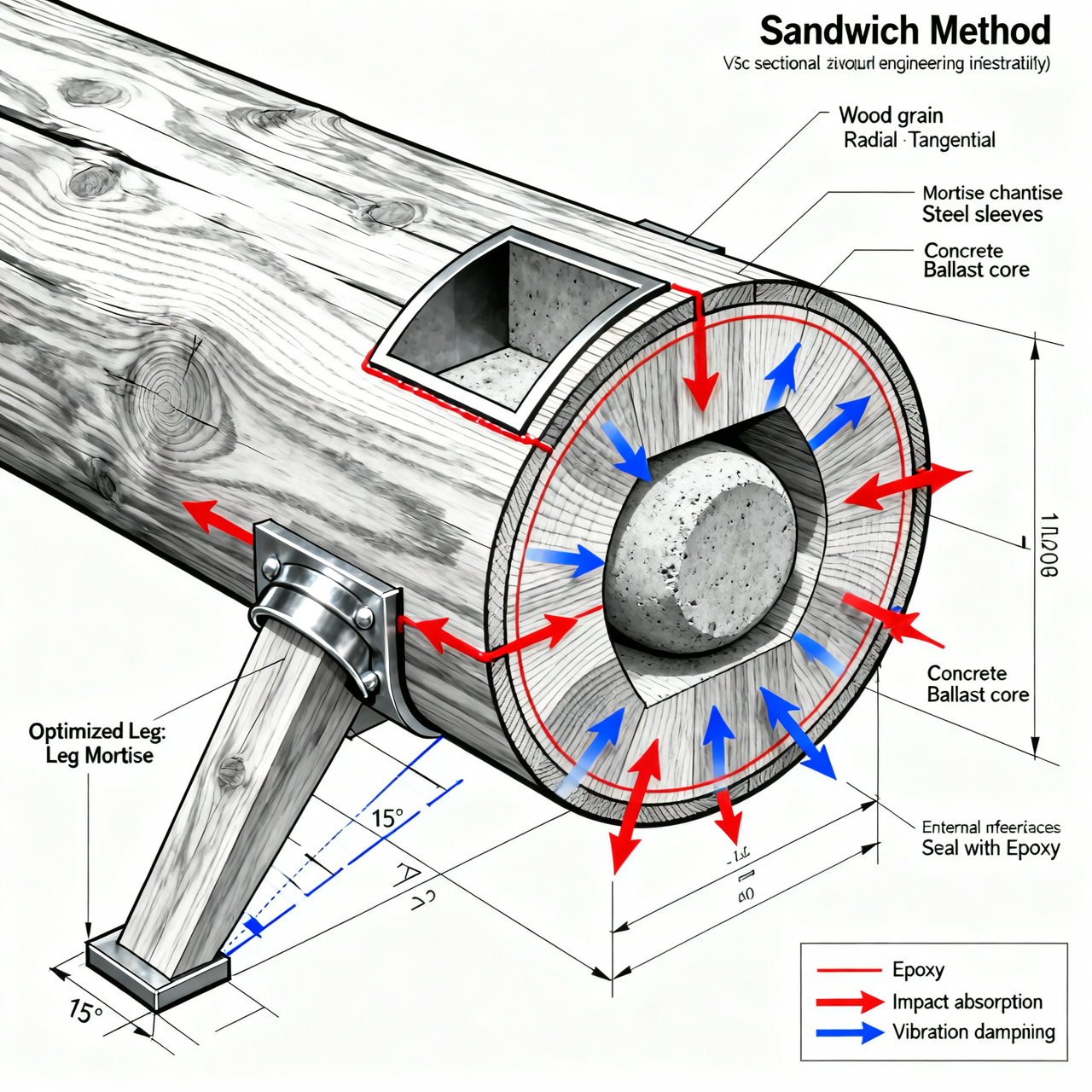
The \”Sandwich\” Method
To solve this, use a laminated fabrication approach rather than carving a single log.
Procedure:
1. Cut the recycled post lengthwise into two equal halves.
2. Mill the square channels into the flat face of each half.
Check out our top-rated Wing Chun training gear & equipment on Amazon
3. Glue the halves back together using high-strength epoxy.
Practitioner Impact: This method utilizes the grain structure more effectively. The square channels are supported by the full depth of the wood grain, preventing the corners from snapping off during training. It also allows for precise alignment of the internal channels.
Mortise Offset Architecture
Wing Chun dummy geometry requires specific offsets to enforce correct body mechanics.
Data Point: The left arm channel centerline must be routed approximately 2-3 inches lower than the top of the trunk relative to the right arm, creating an intersection at the geometric center.
Practitioner Impact: This offset forces the practitioner to maintain the correct elbow height and wing structure. If the channels are aligned incorrectly, your elbows will flare or drop during drills, breaking your structure and leaving you open to counter-attacks.
Data Point: The leg mortise requires a 15-degree downward angle.
Practitioner Impact: A straight vertical hole for the leg will allow the leg to slide out under pressure. The 15-degree angle locks the leg in place, simulating the grounded stance of an opponent. Cutting this angle into a round post is difficult; you must use a jig or a specialized angled spade bit extension to ensure accuracy.
Structural Reinforcement
Because softwood mortises loosen quickly, reinforcement is mandatory for longevity.
Recommendation: Install stainless steel sleeve inserts or fiberglass rod reinforcement inside the arm channels.
Practitioner Impact: These inserts prevent the wood from splintering and keep the channel dimensions stable. Without reinforcement, expect to replace the arms every 6-12 months. With reinforcement, the dummy will maintain its geometry for years of intensive training.
Tooling and Reinforcement: Bridging the Gap
Converting scrap timber requires precise tooling. Users attempting this build with basic hand tools will struggle to achieve the necessary tolerances.
Recommended Insights From Our Wing Chun Guide Library:
- Eco-Friendly Wing Chun Wooden Dummy Construction: A How-To Guide Construction
- Why Scrap Wood Sabotages Your Wing Chun Training And The Engineering Solution That Fixes It
- How to Build a Wooden Dummy at Home at Very Low Cost: The DIY Mook Yan Jong
- Build Wing Chun dummy Out of Household Items
- Apartment-Safe Wing Chun Training Build: Budget Form-Proxy Blueprint for Urban Practitioners
Recommendation: Use a DeWalt DCS571B 20V MAX XR Circular Saw Kit paired with a Freud LU89R010 10-Inch 80-Tooth Zero Clearance Blade. This combination provides the straight, clean cuts essential for the sandwich joint. A track saw guide is highly recommended to ensure parallel cuts.
For mortising, heavy-duty spade bits (4-inch or larger) are required to remove material quickly from the softwood. While Forstner bits offer cleaner edges, they are too slow for the volume of material removal needed here. Use a Rockler Woodworking Jig Saw Base Plate to assist with the intricate cuts for the leg angle and channel intersections.
During the glue-up of the sandwich halves, use a Bosch PS31-2A 18-Gauge Brad Nailer for temporary clamping to hold the pieces in perfect alignment while the adhesive cures.
Adhesive and Sealing:
Use Titebond III Ultimate Wood Glue (Waterproof) for the primary lamination. This glue provides a bond stronger than the wood itself and resists moisture.
Apply West System 105 Epoxy Resin Kit to seal the mortise channels and reinforce the wood fibers. This adds a layer of hardness to the softwood, reducing wear.
For non-structural reinforcement points, Gorilla Heavy Duty Construction Adhesive can be used to fill gaps and add bulk.
Ballast and Stability: Achieving Inertial Mass
As noted, a recycled post often falls short of the required 130-200 lb mass. You must engineer ballast into the design.
Strategy:
* Concrete Fill: If the post is hollow or can be hollowed, fill the interior with concrete. This adds significant mass and lowers the center of gravity.
* Steel Plates: Attach steel plates to the base or internal structure using heavy-duty bolts.
Practitioner Impact: Adding ballast ensures the dummy remains stationary during heavy Chi Sau (sticky hands) and striking drills. The increased inertia provides realistic resistance, allowing you to develop proper rooting and power generation. A dummy that moves under your strikes teaches you to over-punch and lose balance.
Finishing and Maintenance: Longevity and Safety
Data Point: Wood is hygroscopic; it absorbs moisture from the air, causing it to swell.
Check out our top-rated Wing Chun training gear & equipment on Amazon
Practitioner Impact: If the wood swells, the square channels can shrink and pinch the arms, making them difficult to adjust. In severe cases, swelling can crack the mortise walls. You must seal the entire dummy with a marine-grade finish or multiple coats of polyurethane to prevent moisture ingress.
Safety Gear:
Due to the softer nature of recycled softwood, vibration rebound is higher than with hardwood.
Recommendation: Wrap the arms and legs with Everlast Leather Punching Straps or high-density EVA foam.
Practitioner Impact: This padding protects your wrists and forearms from the increased shock and abrasion. It also extends the life of the wood by reducing direct impact damage.
Maintenance Schedule:
* Inspect the mortise channels monthly for signs of ovalization or splintering.
* Check the tightness of the arms and legs. Softwood joints may loosen faster than hardwood; tighten or re-glue as necessary.
* Re-seal the wood annually if the dummy is stored in a garage or outdoor environment.
Conclusion
Martial Arts Reference & Authority Resources:
Building a Wing Chun dummy from a recycled post is a viable engineering solution for the resourceful practitioner, provided you respect the material limitations. By acknowledging the lower density and shear strength of softwoods, utilizing the \”Sandwich\” method to create stable square channels, reinforcing the mortises with steel or fiberglass, and adding internal ballast to reach the 130-200 lb mass target, you can construct a training tool that supports proper biomechanics and durability.
Always prioritize safety: avoid creosote-treated surfaces, wear appropriate protective gear to mitigate vibration rebound, and ensure precise mortise alignment to prevent joint strain. With the right tools, adhesives, and fabrication techniques, a recycled post can become a robust, long-lasting Mook Yan Jong that serves your training for years to come.
🔍 Explore More: See all Wing Chun training guides for DIY Wing Chun dummy from a recycled post.
Check out our top-rated Wing Chun training gear & equipment on Amazon