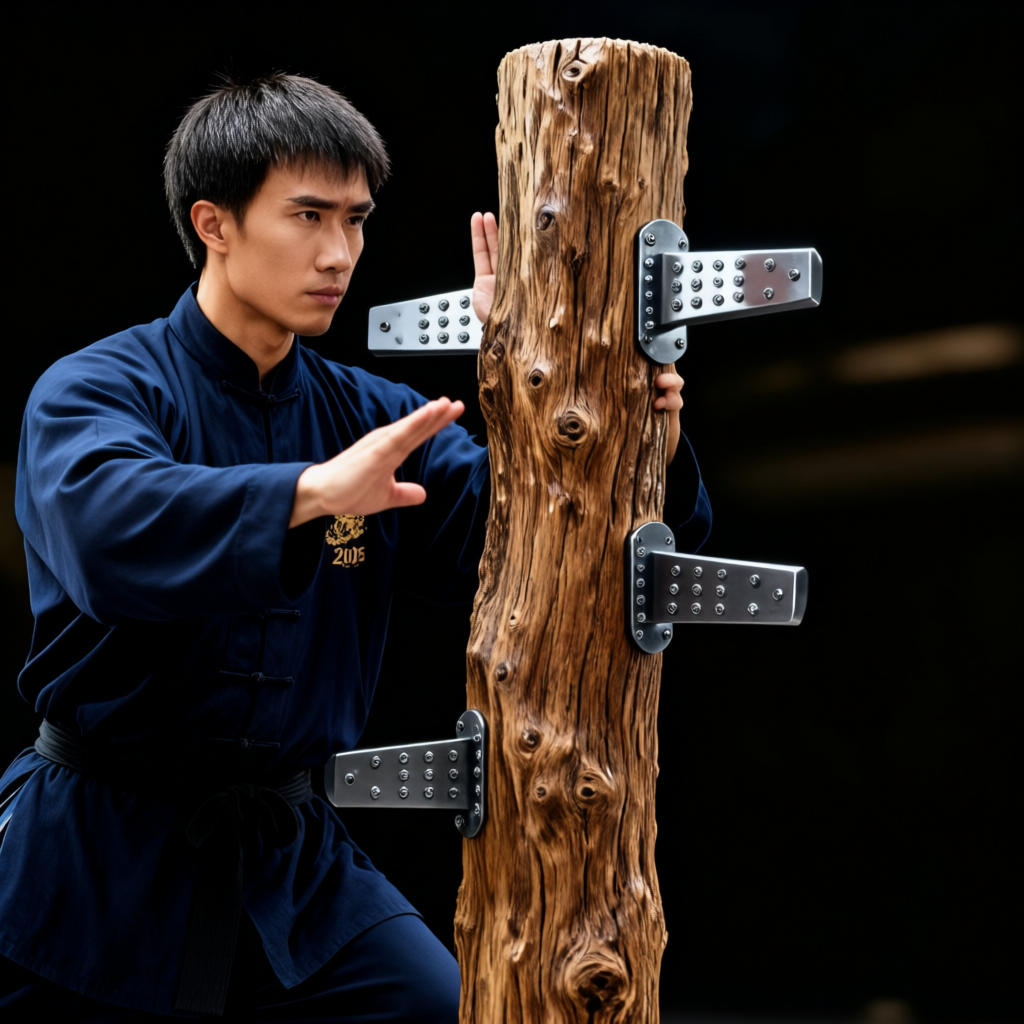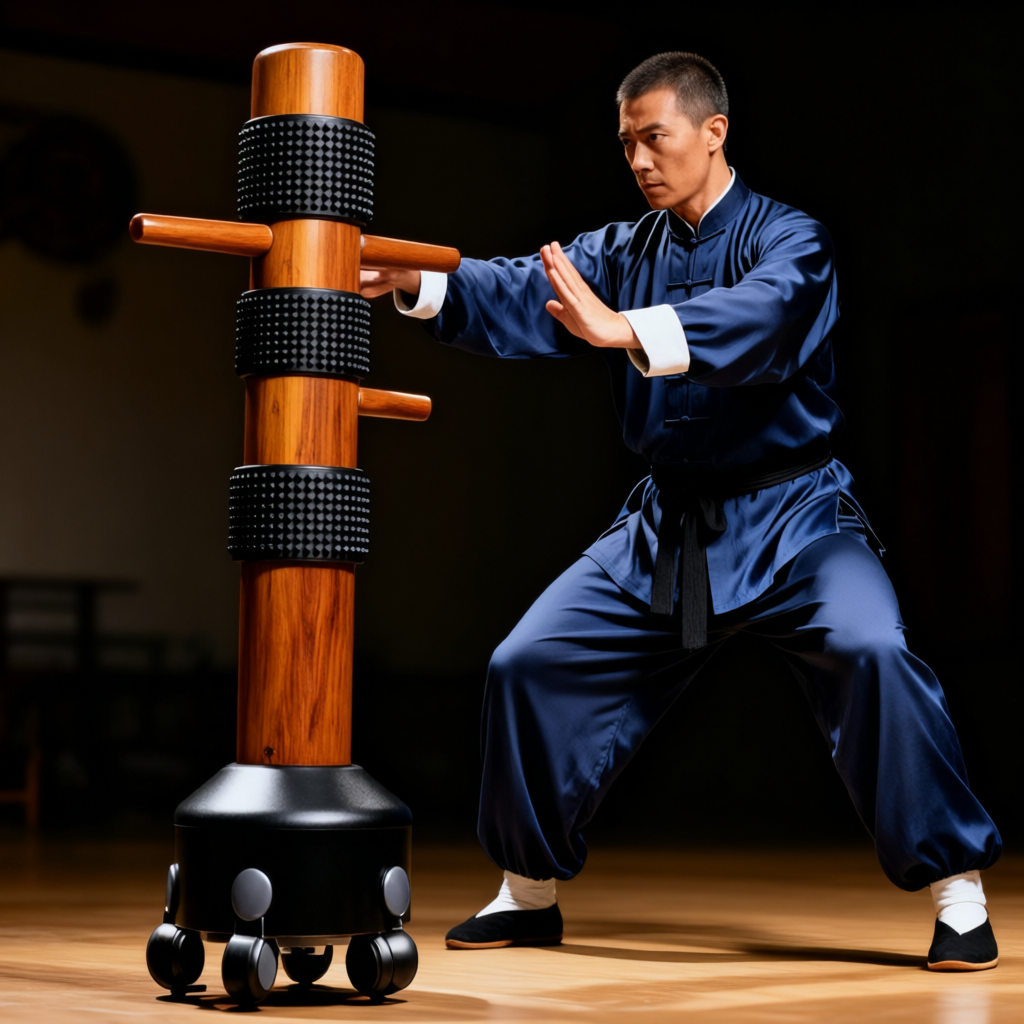
The Physics of Inefficiency: Why \”Punching Wood\” Fails
Most practitioners treat the dummy as a rigid target. This approach ignores the physics of impact and leads to diminishing returns. To drill efficiently, you must understand the material properties and geometry of your tool.
A standard Mook Yan Jong features a trunk approximately 9 inches in diameter, weighing between 130 and 200 lbs. This mass is critical. When you strike a dummy made from hardwoods like Teak or Mahogany, which have a density of 0.65–0.85 g/cm³, the wood provides optimal \”Live Energy.\”
When you strike, the energy transfers into the wood rather than bouncing back into your elbow. If you are using a softwood DIY build (Pine or Fir), the lack of mass causes the trunk to shake violently upon impact. This vibration forces you to subconsciously slow your strikes to protect your joints, killing your training efficiency and preventing you from developing explosive power.
Mortise Offset and Geometric Constraints
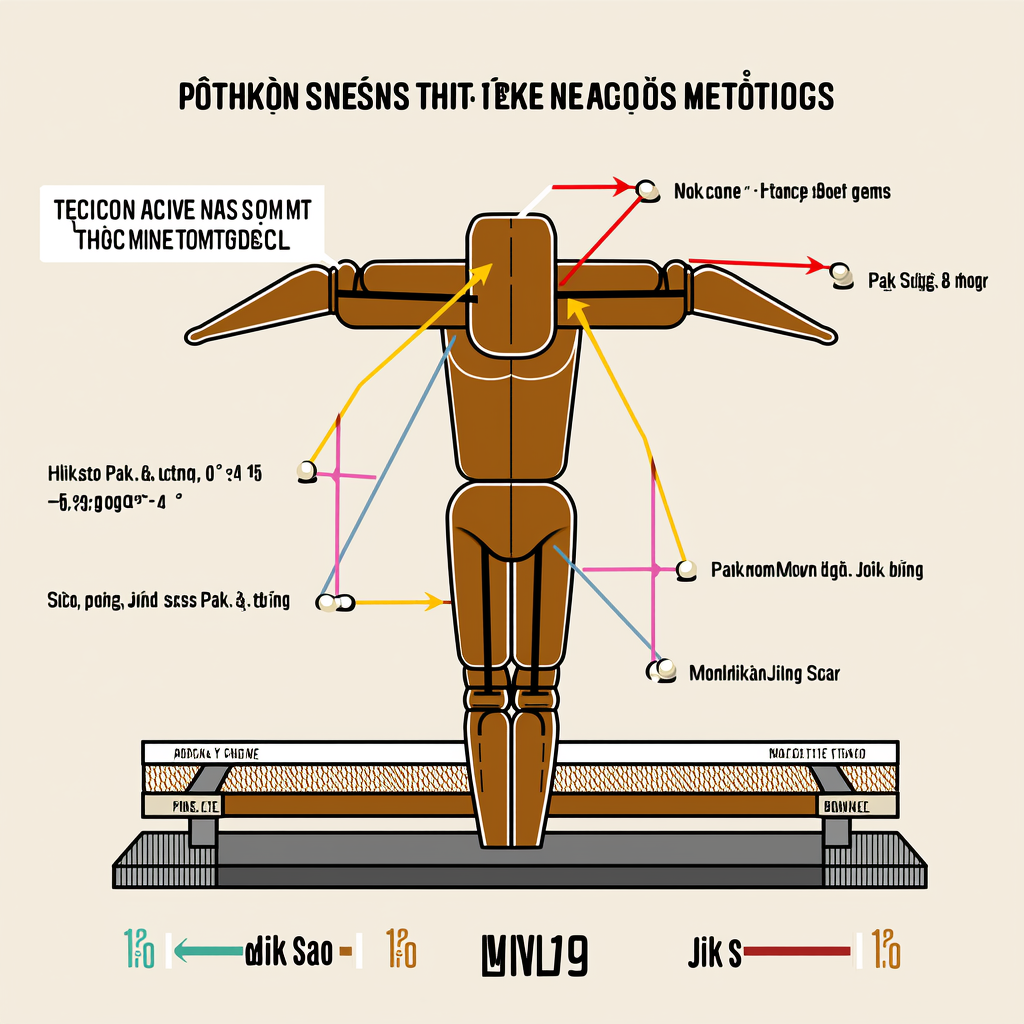
The engineering of the dummy dictates your biomechanics. The left arm channel is mortised higher than the right. This offset creates a specific intersection point where the arms cross.
If you drill straight vertical punches, you ignore this geometry and reinforce bad habits that fail against a real opponent. Efficient drills must target the intersection point where the channels cross. This forces your body to navigate the centerline under realistic geometric constraints, training your arms to work in tandem rather than isolation.
Leg Angle and Hip Rotation
The lower leg mortise is angled at 15 degrees downward. This is not an aesthetic choice; it simulates the knee joint of an opponent.
Many users drill straight kicks, which miss the functional purpose of the leg. Efficiency lies in hitting the \”knee joint\” simulation point. This requires a specific hip rotation that mimics a real sweep. You must rotate your hip to align your shin with the 15-degree angle, training the torque generation needed for effective low-line attacks.
Drill Set 1: Vector Variation (Breaking Monotony)
Check out our top-rated Wing Chun training gear & equipment on Amazon
Repetitive pathology occurs when you perform the same linear movements without variation. This stagnates muscle memory. To improve efficiency, you must disrupt vectors to engage different muscle groups, including the triceps, deltoids, and obliques.
The Spiral Pak Sau
Instead of linear centerline punches, this drill forces diagonal entry and rotational torque.
Execution: Strike the dummy’s upper arm with a Pak Sau, but do not slap directly. Wrap your arm around the dummy’s arm in a spiral motion, engaging the rotator cuff. Immediately transition into a Jik Sao (straight punch) targeting the intersection point.
This drill measures how quickly you can transition from defense to offense without resetting your stance. By wrapping around the arm, you engage the rotator cuff and improve shoulder mobility. The efficiency metric is the speed of the Pak Sau to Jik Sao transition. This builds rotational torque generation, which is superior to linear extension for close-quarters power.
High-efficiency drilling involves fast, hard strikes. If your dummy is constructed from softwood, the mortises will enlarge within weeks of intense use, degrading the fit of the arms. Ensure your equipment uses high-PSI shear strength hardwoods to withstand the torque of spiral drills without cracking.
Drill Set 2: Rhythm and Timing (Sticky Hands on Wood)
Efficiency is also measured by reaction time and tactile sensitivity. The dummy can simulate Chi Sao (sticky hands) if you use auditory and tactile feedback rather than visual tracking.
The Blind Tap
This drill develops spatial inertia awareness and reduces reliance on sight.
Recommended Insights From Our Wing Chun Guide Library:
- Wing Chun Dummy Drill for Beginners: Mastering the Fundamentals
- When to Incorporate the Wooden Dummy into Your Wing Chun Training
- Mastering Wing Chun Dummy Practice: The Journey to Proficiency
- Wing Chun Dummy Exercises Before Practice
- Mastering the Bridge: How the Wing Chun Dummy Elevates Your Entry Techniques
Execution: Close your eyes or look away from the dummy. Rely solely on the sound of impact and tactile feel to locate the dummy’s arms. Strike the correct arm slot immediately after hearing the slat snap or feeling the air displacement.
The goal is to hit the correct arm slot within 0.5 seconds of the auditory cue. This drill reduces reaction time by forcing your nervous system to process feedback instantly. It bridges to MMA hand-fighting and BJJ grip fighting by training you to control the opponent’s limbs through touch and sound, not just vision.
Drill Set 3: Structural Integrity (Protecting the Joint)
High-volume drilling causes micro-trauma to the skin and joints. Efficiency includes sustainability. If your practice causes injury, your training loop is broken.
The Slap-and-Flow
This drill maximizes energy absorption while minimizing shock transmission.
Execution: Execute a high-speed Pak Sau, but do not stop. Immediately flow the momentum into a Tan Sau, then flow into a Bong Sau, maintaining continuous motion. The goal is unbroken momentum. Stopping equals inefficiency.
Continuous momentum trains your body to absorb and redirect energy rather than colliding with the dummy. Stopping your strikes creates shockwaves that travel back into your joints. If your current dummy arms are causing skin bruising, use high-density EVA foam wraps or leather pads. Bruising slows down practice duration and limits your ability to drill with intensity.
When drilling mortises for arm channels, practitioners often use 18-inch spade bits. Ensure the wood density is sufficient to hold the tolerance. If the wood is too soft, the bit can wander, enlarging the mortise and creating a loose fit that ruins the \”live energy\” feedback essential for these flow drills.
The Gear Gap: Optimizing Your Training Ecosystem
Check out our top-rated Wing Chun training gear & equipment on Amazon
To achieve true efficiency, you may need to supplement your dummy work with gear that addresses specific limitations.
Solid Rattan Training Rings (Jook Wan Heun)
The dummy is static. To improve efficiency in centerline retention and elbow structure without the bulk of a full dummy, solid rattan rings are essential. They allow you to practice the spiral mechanics and centerline pressure anywhere. This solves the efficiency problem of waiting for a partner or setting up a full dummy, enabling high-frequency micro-sessions.
Aged Dit Da Jow Liniment
Efficient training implies high volume. High volume implies micro-trauma to the forearms and joints. Users searching for efficiency are likely pushing hard. Aged Dit Da Jow liniment promotes faster recovery between high-intensity sessions, reducing inflammation caused by the \”Dead Wood\” rebound effect. This ensures you can train consistently without downtime.
AugustaPro Vibration-Dampening Wall Mount
Efficiency isn’t just speed; it’s sustainable practice. Drills that generate excessive vibration annoy neighbors, forcing you to stop early. Using vibration-dampening mounts or sound-isolating striking skins extends your training hours legally and quietly, allowing for longer, uninterrupted flow sessions.
Martial Arts Reference & Authority Resources:
From Punching Wood to Training the Body
Improving efficiency on the Wing Chun dummy requires a shift in mindset. You are not punching wood; you are training your kinetic chain to interact with resistance. By respecting the material physics of hardwood density, honoring the geometric constraints of the mortise offsets, and utilizing vector variation drills, you transform the dummy from a static object into a dynamic training partner. Focus on kinetic transfer, protect your joints with proper flow and recovery gear, and your drills will yield measurable gains in speed, power, and structural integrity.
🔍 Explore More: See all Wing Chun training guides for Wing Chun dummy drills for improving efficiency.
Check out our top-rated Wing Chun training gear & equipment on Amazon